What is Data as a Service (DaaS)? Benefits, Use Cases, and How It Works

Cheta Pandya
Data quality costs organizations $12.9 million a year on average. Most of that cost is due to delayed decisions and duplicated pipeline work. Organizations build, manage, and maintain complex on-premises data infrastructure, which can be handled using a data as a service (DaaS) model.
If your engineering time is spent mostly on pipeline maintenance, or you're a product leader trying to bolt market data onto your platform without owning ingestion and compliance, that gap is the whole problem.
Data as a service is a cloud-based delivery model that gives you on-demand access to processed, ready-to-use data through APIs, subscriptions, or managed platforms, so you consume data without owning the plumbing behind it.
This piece breaks down what data as a service actually means, how the architecture works, and where it delivers measurable value.
What is Data as a Service (DaaS)?
Data as a Service (DaaS) is a cloud-based model that gives users on-demand access to clean, ready-to-use data through APIs, subscriptions, or managed platforms. This allows businesses and applications to access the data they need without having to build, manage, or own the underlying data pipelines and infrastructure.
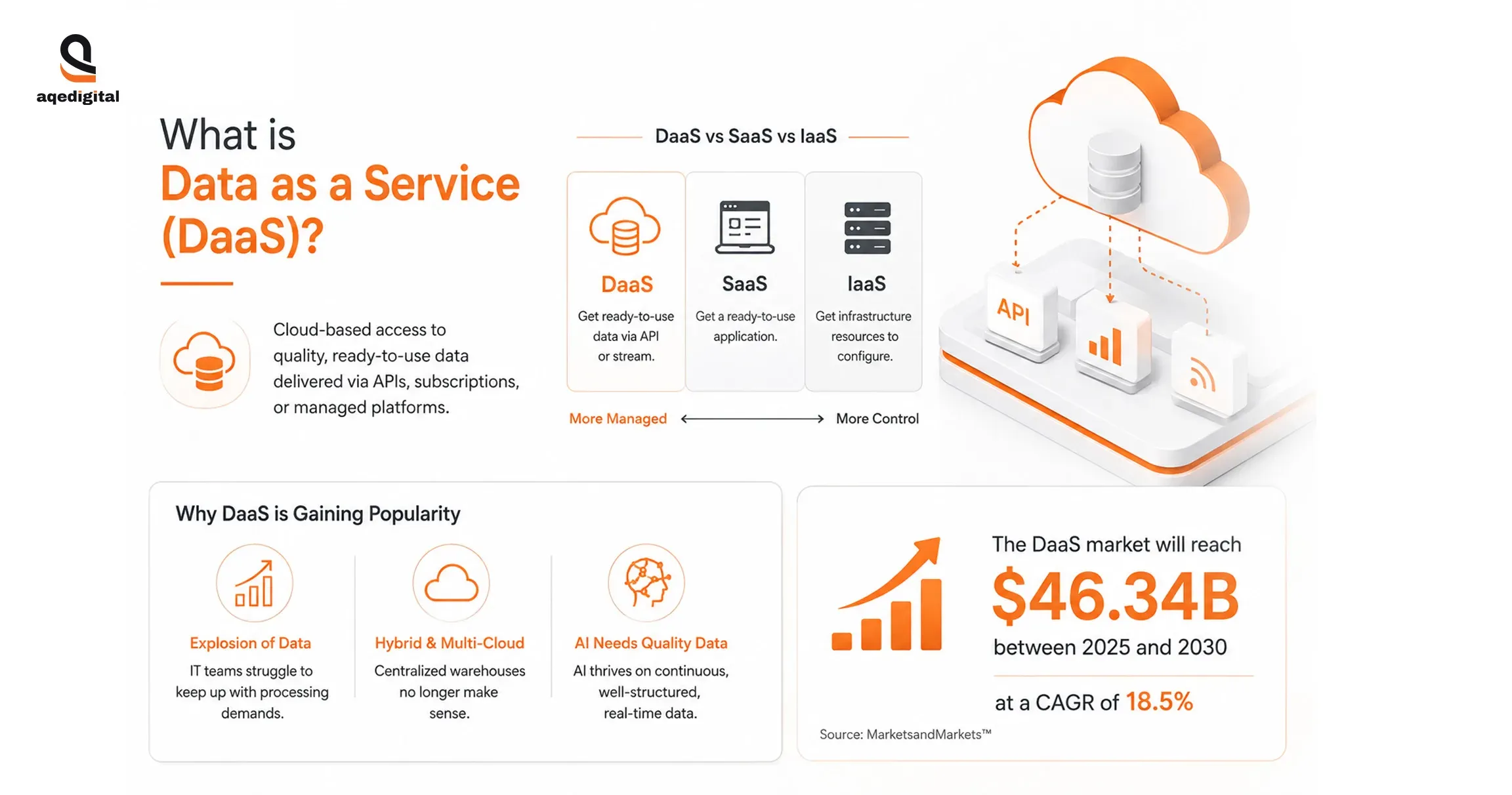
DaaS vs SaaS: Cloud "As-a-service" Family
SaaS gives you a ready-to-use app. IaaS provides you with compute and storage resources that you have to configure yourself. DaaS occupies a place between these two: you do not manage any servers, and you do not create a user interface for the processed data. All you receive is the ready-to-use data delivered to your stack via an API or a stream.
Why is DaaS Gaining Popularity Today?
Three main reasons push people to use DaaS. First of all, there is a rapid increase in big data, while IT departments cannot cope with the processing. Second, a hybrid and multi-cloud environment makes centralized data warehouses unreasonable. Third, AI requires continuous streams of well-organized data to function properly. It makes unstructured data highly valuable.
DaaS market will grow to $46.34 billion between 2025 and 2030 at a CAGR of 18.5%. This forecast does not appear to be exaggerated because it reflects the demands of IT departments tired of creating an ingestion pipeline in three different departments.
How Does Data as a Service Work?
DaaS operates as a cloud-based delivery model that abstracts data consumption and management from the platforms where data is stored. It considers the data as a centralized, governed, and liquid asset. Data as a Service functions like an oil refinery but for data. It collects raw, unstructured data from different systems and transforms it into business-ready data products.
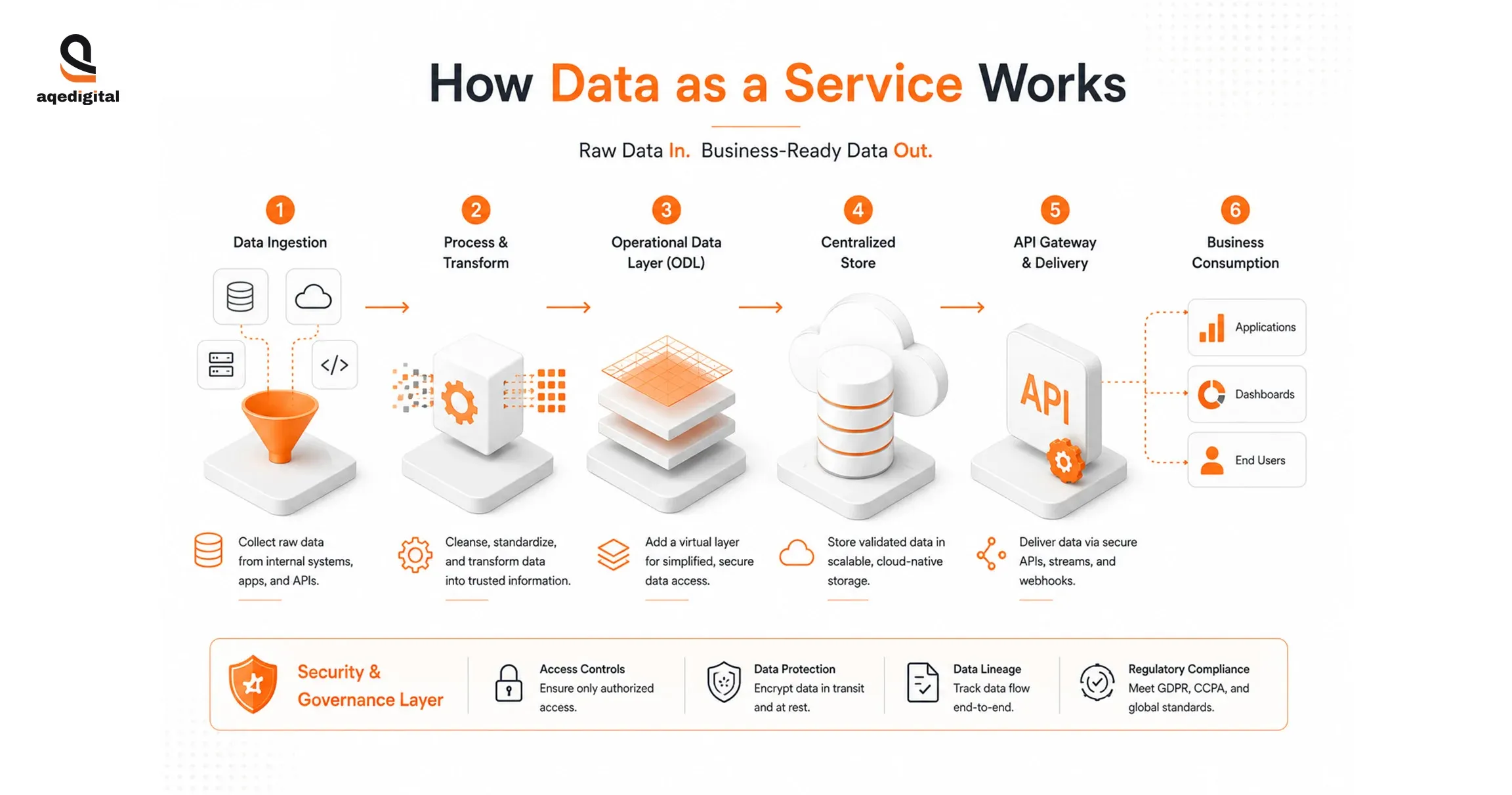
- Data Ingestion- DaaS system gathers raw data from a wide variety of sources. This includes internal operational databases, legacy mainframes, data lakes, and third-party apps or APIs.
- Processing, Cleansing, and Transformation- Once data is ingested, it undergoes rigorous extraction and transformation. DaaS Platform cleanses data, resolves formatting issues, reduces duplicates, and ensures standardized information reaches the intended function.
- Operational Data Layer (ODL) and Virtualization- An operational data layer is added right on top of the legacy database to ensure access to information without understanding the underlying complex architecture.
- Centralized Store- After the processing and validation phase, all the data is placed into a scalable, and cloud-native storage system. These storage systems offer capabilities of supporting high-volume access to data at minimal latency.
- API Gateway and Delivery- All the curated data is ultimately sent to business applications, analytics dashboards, and end-users through secure, RESTful APIs, webhooks, or continuous data streams. Leveraging AI, organizations can deploy automated API management processes to handle orchestration, caching, and documentation.
- Security and Governance Layer- DaaS comes with a security and governance framework that enforces access controls, encrypts data in transit, and at rest. This maintains strict data lineage and guarantees compliance with global privacy regulations like GDPR or CCPA.
If your team is evaluating where this kind of delivery model fits within a broader modernization push, AQe Digital's AI and data engineering services handle exactly this kind of build-versus-buy scoping.
What are the Benefits of Data as a Service?
The case for data as a service isn't abstract. Each layer above removes a specific cost center.
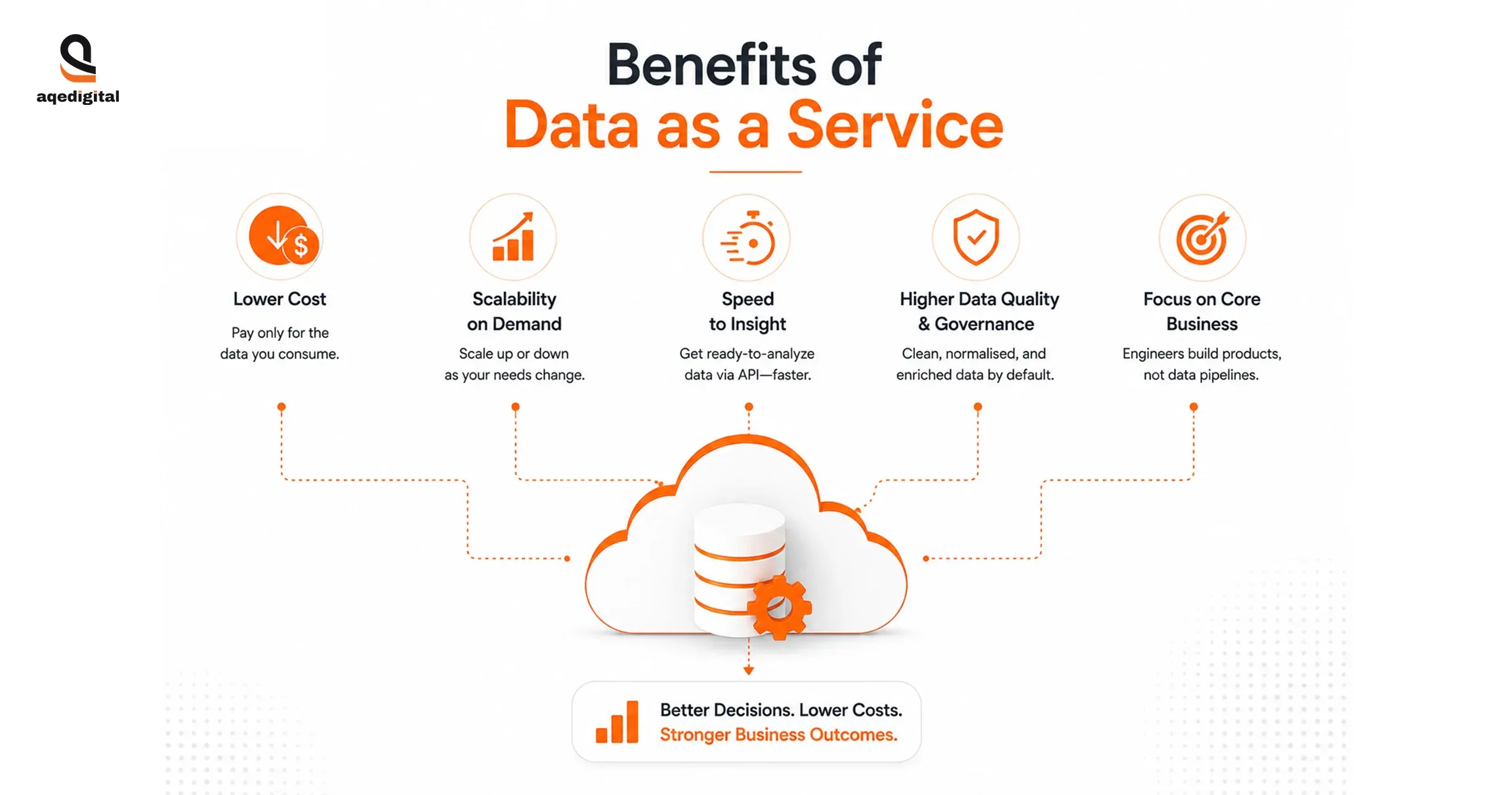
- Lower cost (OpEx vs CapEx)- Cloud infrastructure eliminates the hardware capital expense of standing up your own data platform, and you pay only for the data you actually consume.
- Scalability on demand- Storage and processing scale up or down with actual demand instead of forcing you to over-provision for a peak load that hits twice a year.
- Speed to insight- Ready-to-analyze data delivered via API removes the infrastructure setup time that usually sits between “we need this data” and “we can act on this data.” Teams without a dedicated data engineer skip the queue entirely.
- Higher data quality and governance- Cleansing, normalization, and enrichment are baked into the delivery layer, which directly counters the annual cost of bad data.
- Focus on core business- Every hour your engineers aren't maintaining an ingestion pipeline is an hour they're spending on work that actually differentiates your product.
What are Data as a Service Use Cases for Enterprises?
DaaS shows up differently by industry, but the pattern is consistent: buy the data feed instead of building the pipeline.
Finance and Banking
DaaS provides real-time access to key data like company financials, economic indicators, and alternative data feeds. Financial and investment firms, banks,s and even individual traders can leverage real-time data for functions like
- Anti-fraud detection
- Credit scoring
- Algorithmic trading signals
Plus, banks can use DaaS analytics tools to scale their data science projects. It can help them build AI-driven recommendation engines. Such platforms allow banks to offer more personalized financial products for customers.
Retail and eCommerce
Retailers can leverage DaaS to access historical purchase data of customers and forecast future demand. It helps them understand key customer buying trends. For example, it helps fashion retail brands get insights into fast fashion trends that quickly change. This allows retailers and eCommerce brands to adapt according to changing trends and offer products that attract repeat business.
Healthcare and Pharma
Hospitals and life sciences companies use DaaS to analyze patient information, gather and store RE, and manage clinical trial information. The transition towards decentralized clinical trials is made easier thanks to real-time data feeds from multiple sites. This also supports organizations in remaining compliant with standardized health-data interoperability requirements.
Marketing and Sales
DaaS is utilized by the go-to-market teams for audience segmentation, ad targeting, and territory planning. By combining business contact and intent and firmographic data in real time, marketing teams can boost their hyper-targeting and personalization efforts. The same contact intelligence is leveraged by sales teams to identify leads to pursue, enrich lead records automatically, and hone outreach.
Insurance Companies
In Financial Services, Insurers leverage DaaS to retrieve financial and consumer data sets that are compliant to perform risk assessment, exposure monitoring, and fraud detection. They also integrate real-world and operational data with their platforms to speed up and improve the claim processing.
Transportation and Logistics
Logistics teams interface with DaaS solutions to find real-time transit feeds, geospatial location intelligence, fuel indexes, and the weather forecast. On-demand data delivery enables more visibility, monitors IoT devices, dynamically routes shipments, and assists in optimizing inventory holding levels on live supply-chain dashboards.
Data as a Service (DaaS) vs. Data as a Product (DaaP)
Organizations often start with DaaS to quickly solve accessibility and infrastructure problems, then layer internal DaaP (data mesh) principles on top so the ingested data stays discoverable and reusable across business domains.
| Data as a Service (DaaS) vs. Data as a Product (DaaP) | ||
| Parameter | Data as a Service (DaaS) | Data as a Product (DaaP) |
| Overview | Subscription-based access to managed, continuously updated external or third-party datasets. | High-value, internal or external dataset treated as a polished, reusable, and discoverable product. |
| Acquisition Model | Rent on demand via cloud APIs, streaming feeds, or pay-as-you-go subscriptions. | Built internally (via Data Mesh architecture) or licensed as a standalone managed asset. |
| Ownership | Vendor retains full ownership, governance, and control of the underlying source data. | Domain team or enterprise retains ownership with dedicated product management and SLA accountability. |
| Maintenance Burden | Vendor manages all data cleansing, pipeline orchestration, security, and infrastructure. | Domain engineering team manages schema evolution, data quality, CI/CD pipelines, and observability. |
| Cost Structure | Operating expense (OpEx) with predictable, recurring consumption or tier-based fees. | Capital investment (CapEx) or dedicated engineering budget to build, maintain, and scale assets. |
| Update Frequency | Real-time, near-real-time streaming, or continuous API synchronization. | Event-driven, batch, or micro-batch updates depending on domain SLAs and consumer requirements. |
| Best Fit | Teams needing immediate access to enriched external data without managing pipelines. | Decentralized data mesh organizations aiming to democratize internal proprietary data across teams. |
| Typical Use Cases | Market intelligence, credit scoring, enrichment feeds, weather data, B2B firmographics. | Customer 360 platforms, unified enterprise analytics, AI/ML feature stores, operational dashboards. |
A Practical Roadmap: How to Get Started with DaaS?
Here's how to strategically implement DaaS based on modern enterprise architectures.
1. Identify the data gap and the decision it blocks
Pinpoint the specific bottlenecks caused by legacy databases. Instead of a risky rip-and-replace of old systems, organizations can deploy an Operational Data Layer (ODL). An ODL acts as a high-performance buffer that aggregates data from legacy mainframes and unifies it with external DaaS feeds, letting you solve stalled decisions without disrupting existing infrastructure.
2. Map build-versus-buy cost
Evaluate your data utility efficiency ratio, the balance of active data consumption against infrastructure and maintenance overhead. DaaS shifts data expenses from high capital expenditures (CapEx) to predictable operational expenses (OpEx). Since the vendor handles the backend, your internal pipeline maintenance costs trend toward zero.
3. Shortlist providers by domain
The DaaS market is highly fragmented into specialists, so the right vendor depends entirely on your industry.
- Finance and markets: Providers like Bloomberg offer premium financial and ESG data.
- B2B sales and GTM: Providers like ZoomInfo, Apollo.io, or Cognism specialize in contact intelligence, firmographics, and buyer intent signals.
- Spatial and location data: Vendors like SafeGraph provide detailed global points of interest (POI) and building footprints.
4. Test delivery fit with your tech stack.
Make sure the provider's method for delivering data is a match for your team's capabilities. The current generation of DaaS providers uses an API-first model that provides data via RESTful APIs or streaming data.
Ensure that you are able to integrate the real-time streams into your downstream systems, such as trading engines, CRMs, and analytics dashboards, or that you have a layer of orchestration for the integration.
5. Verify quality, governance, and compliance before scaling.
A quick integration is no good if it doesn't comply with the law or pass an audit. Since DaaS aggregates sensitive external data, you want to make sure the provider can accommodate your internal governance requirements and comply with global privacy regulations such as GDPR and CCPA, as well as robust access controls and encryption.
If you're at step one and need a structured data strategy engagement rather than a vendor list, AQe Digital's enterprise development team scopes this as a phased assessment, not a one-size template.

Conclusion
Data as a service solves the access problem: it gets governed, processed data into your stack without you owning the pipeline behind it. Data Analytics as a Service (DAaaS) is the next layer up, delivering on-demand analytics tools and insights on top of that data, without requiring you to staff a full analytics team or run the infrastructure yourself.
Enterprises that treat data as a service as step one, not the finish line, are the ones actually converting data spend into decision speed.