What is a Data Aggregator? How it Works, Types, Use Cases, and Why Your Business Needs One.

Jigar Mistry
Fragmented data is not an information problem. It is an execution problem. Enterprises generate more data than ever, yet most data goes unused for analytics. The raw material exists. What fails is the infrastructure to make it coherent.
That infrastructure has a name: the data aggregator. Whether you are a data engineering lead evaluating pipeline architecture, a VP of Analytics building a KPI stack, or a fintech product manager assembling open banking feeds, the data aggregator is the layer that converts fragmented signals into a single, decision-ready view.
This guide covers both dimensions of the term: the software concept used in enterprise BI and analytics pipelines, and financial data aggregation. It explains how aggregation actually works, the types that exist, where it sits in the modern data stack, and how to evaluate the right tooling for your environment.
What is a Data Aggregator?
A data aggregator is a system, either software or a specialized service, that collects raw data from multiple disparate sources, normalizes and compiles it into a centralized repository, and presents it in a summarized, analysis-ready format. The term covers two related but distinct use cases.
- First: enterprise data aggregation software, used within BI and analytics pipelines to consolidate data from ERP systems, SaaS applications, databases, IoT sensors, and APIs into a unified layer.
- Second: data aggregator businesses that gather, compile, and resell third-party data from public records, purchase histories, and behavioral signals.
The distinction from data ingestion matters. Ingestion pulls raw data into a system. Aggregation is the transformation step that follows: applying logic, standardization, and roll-ups to turn raw records into structured, queryable outputs.
In the modern data stack, the data aggregator operates between the ingestion layer and the analytics or warehouse layer. It is the stage where raw volume becomes business intelligence.
AQe Digital's AI and Data Solutions are built around this exact layer. Clients across manufacturing, financial services, and healthcare engage AQe Digital specifically to architect and operationalize the aggregation pipeline that their downstream analytics depend on.
How Does a Data Aggregator Work?
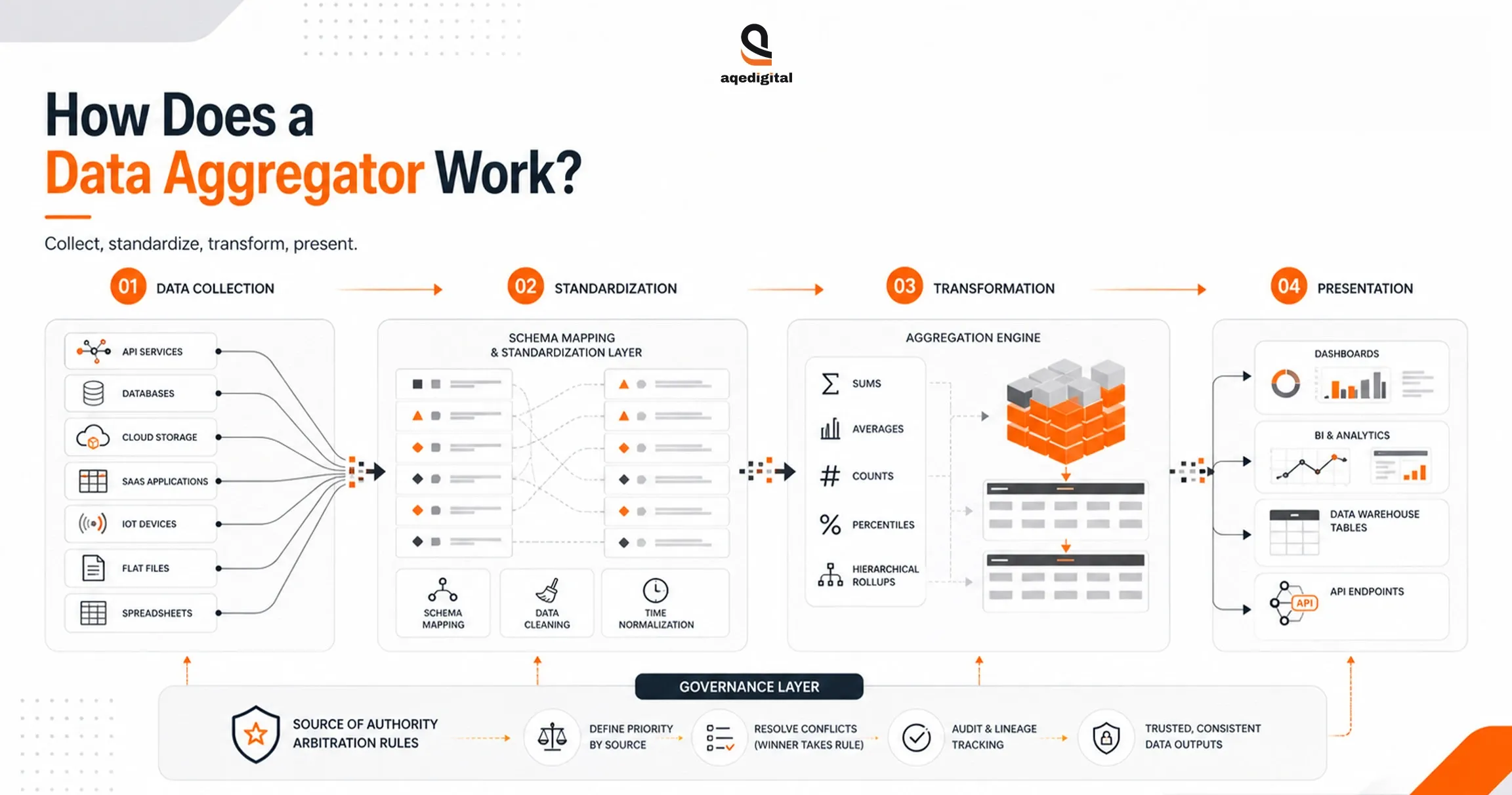
The aggregation process follows four sequential steps. Each step has a specific failure mode. Understanding the sequence is the starting point for evaluating any data aggregator.
Step 1: Data Collection
The data aggregator pulls from every relevant source: REST APIs, relational databases, cloud storage, SaaS platforms, IoT device streams, flat files, and spreadsheets. Source breadth determines coverage. Connector reliability determines consistency.
A data aggregator that cannot reach all your production sources creates blind spots in every downstream report.
Step 2: Standardization
Raw data arrives in different formats, timestamps, field naming conventions, and encodings. Standardization converts all inputs into a consistent schema.
This is where field mapping occurs: "customer_id" from Salesforce maps to "cust_no" in the ERP. Without this step, every query becomes a reconciliation exercise.
Step 3: Transformation
Transformation applies aggregation logic to the standardized data. This includes sums, averages, counts, percentile calculations, and hierarchical roll-ups.
A retail operation might aggregate daily SKU-level transactions into weekly category-level revenue. A manufacturer aggregates hourly sensor readings into shift-level OEE scores.
Step 4: Presentation
The processed output surfaces through dashboards, BI tools, data warehouse tables, or API endpoints. This is what the analyst, executive, or downstream ML model actually consumes.
One concept that separates reliable from unreliable pipelines is the Source of Authority. When two sources conflict on a value, the data aggregator's schema arbitration rules decide which source wins.
Without explicit definitions of Source of Authority, contradictory records produce corrupted aggregates. Most pipeline failures are not technical. They are governance failures at this decision point.
What Are The Types of Data Aggregation?
Not every aggregation type fits every business problem. The six primary types differ in what dimension they group by and what analytical question they answer.
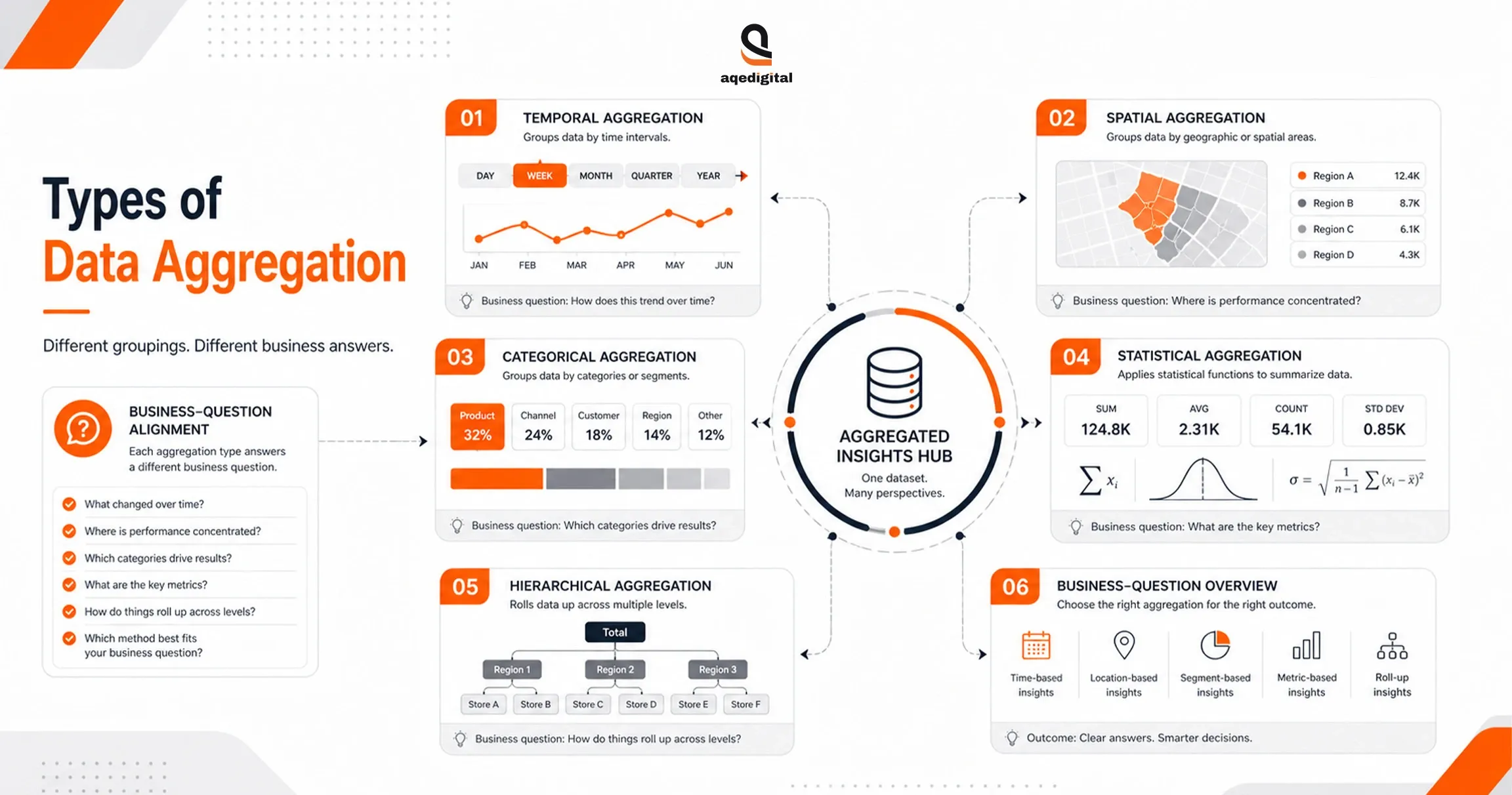
- Temporal aggregation: groups data by time period. Daily revenue, monthly patient volumes, and weekly fill rates. The most common type in BI reporting.
- Spatial aggregation: groups by geography. Sales by region, coverage gaps by city, logistics cost by delivery zone.
- Categorical aggregation: groups by attribute. Product line, customer segment, account tier. Used for segmentation and comparative analysis.
- Statistical aggregation: computes metrics across a dataset, such as sums, averages, min/max, counts, and standard deviations. The engine behind KPI dashboards.
- Hierarchical aggregation: rolls up from the transaction level to the team, team to the department, and department to the enterprise. Required for multi-level reporting structures.
What is Financial Data Aggregation?
Financial data aggregation is a specialized sub-category where account-level data, balances, transactions, investments, and credit lines are collected from banks, credit unions, and investment platforms and consolidated into a single view.
Open banking regulation, including the CFPB's Rule 1033 in the United States, is accelerating the shift from credential-based screen scraping to direct API access.
API-based financial aggregation produces cleaner data, lower latency, and better compliance posture than scraping. Platforms like Plaid, Yodlee, and Envestnet operate at this layer.
AQe Digital's revenue intelligence solutions draw on similar aggregation architectures to provide financial services clients with a unified view of account activity, cross-sell potential, and customer lifetime value.
Data Aggregator Use Cases Across Industries
The data aggregator is not sector-specific. Its application changes by industry, but the underlying value remains the same: replacing fragmented, siloed records with a unified, trustworthy dataset.
Financial Services
Citibank and similar institutions aggregate transaction data across channels and geographies to identify suspicious activity patterns. Plaid operates a financial data aggregator that connects to over 12,000 financial institutions.
Envestnet's aggregation platform produced a documented $37M increase in wealth conversion and a $35M reduction in onboarding cost, per Forrester's Total Economic Impact analysis.
Healthcare
Cleveland Clinic uses aggregated patient histories, combining EHR records, lab results, imaging data, and prescription logs, to guide treatment and prescription decisions. Without a data aggregator, the same patient's data sits in four systems and gets reconciled manually each visit. That reconciliation is where clinical errors originate.
Retail and eCommerce
Bonobos linked Facebook advertising data to in-store purchase events through a customer data platform built on aggregated inputs. The connection between a digital impression and a physical transaction only exists when aggregation bridges the two. Segment, the CDP platform, operates on this principle: aggregate behavioral, transactional, and campaign data into a unified customer profile.
Manufacturing
Sensor data from production lines, SCADA systems, and maintenance logs feeds a data aggregator that computes OEE scores, flags equipment anomalies, and triggers predictive maintenance alerts. Without aggregation, each sensor log is a disconnected stream.
With it, the aggregate output drives measurable reductions in unplanned downtime. AQe Digital delivers this capability to manufacturing clients through dedicated IT Solutions for Manufacturing, integrating shop floor telemetry with enterprise ERP data.
Marketing Analytics
Campaign, web, and mobile interaction data sit across Google Ads, Meta Business Suite, your CRM, your website analytics tool, and your email platform. Without a data aggregator, reporting on the true customer journey requires manual exports and spreadsheet stitching. With one, attribution, engagement scoring, and funnel analysis run from a single unified dataset.
Fintech and Open Banking
PFM applications like Acorns and Personal Capital depend on aggregated account data across checking, savings, brokerage, and retirement accounts. The budgeting view, spending categories, and investment performance metrics are entirely downstream of a financial data aggregator. Remove the aggregation layer, and the product stops functioning.
Benefits of Using a Data Aggregator
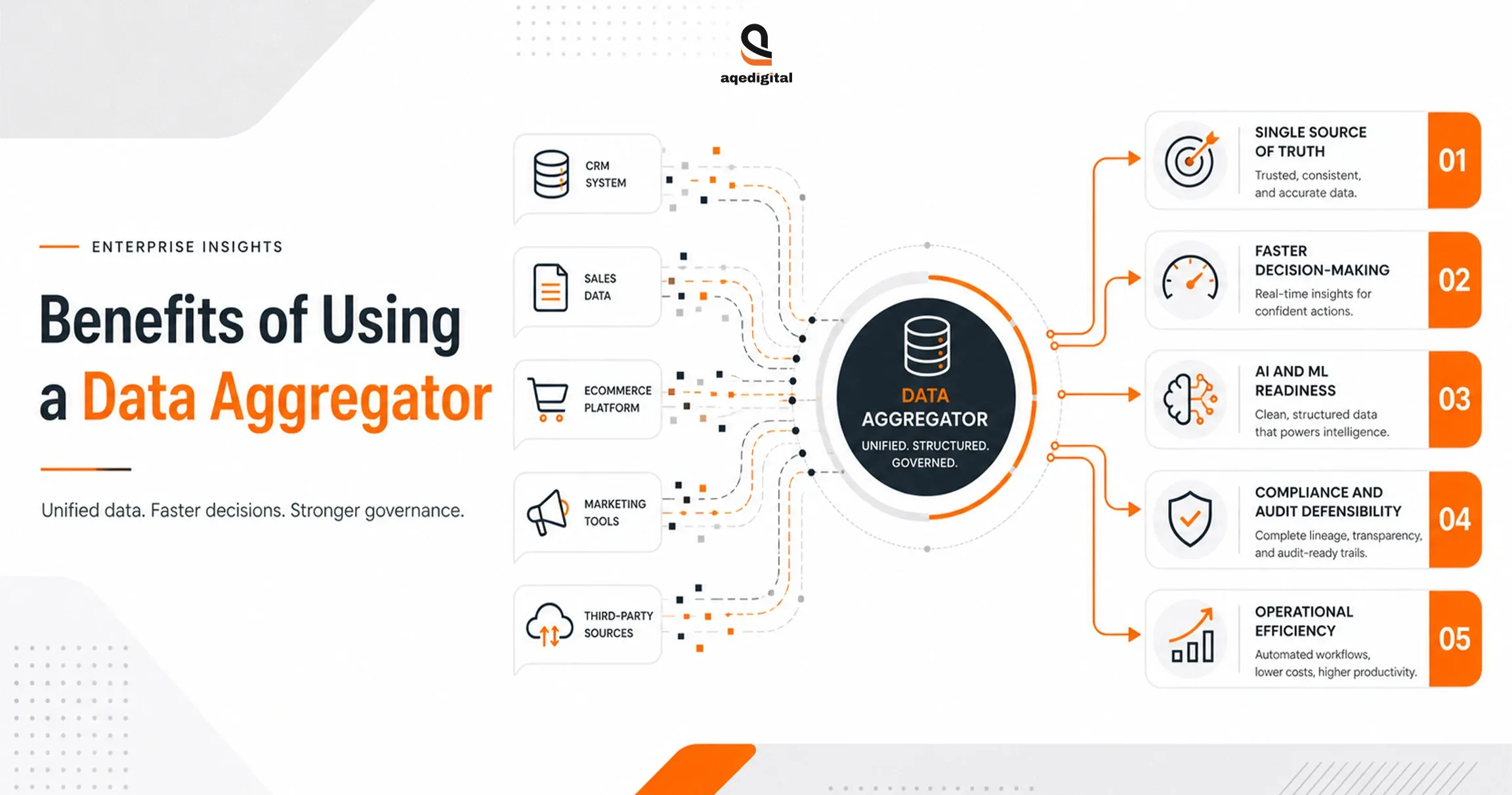
The business case for a data aggregator is not theoretical. The operational benefits are measurable across five categories.
Single Source of Truth
Siloed data creates contradictory reporting. Finance reports one revenue figure. Sales reports another. The discrepancy is not a calculation error. It is an architectural failure. A data aggregator establishes a canonical, governed dataset that all teams pull from. Disagreements move from "whose number is right" to "what does the data tell us."
Faster Decision-Making
McKinsey research shows organizations with strong data integration and aggregation practices make decisions up to five times faster than peers running on fragmented inputs. Speed matters most when market conditions shift or operational anomalies emerge.
AI and ML Readiness
A 2025 McKinsey survey found 88% of organizations are now running AI in at least one business function. Every one of those deployments depends on clean, structured input data. The data aggregator is the prerequisite quality layer.
A model trained on un-aggregated, inconsistent data produces unreliable outputs. The data conversion and tagging services that AQe Digital provides often sit directly upstream of a client's AI feature pipeline, normalizing and structuring data before it enters model training or inference.
Compliance and Audit Defensibility
GDPR, CCPA, SOX, and the CFPB's Rule 1033 all require demonstrable data lineage: the ability to trace where a data point originated, how it was transformed, and who accessed it.
A data aggregator with built-in governance controls automatically produces this audit trail. Without one, compliance audits become manual reconstruction exercises, expensive and error-prone.
Operational Efficiency
Businesses that deploy structured data aggregation pipelines report a 30% improvement in operational efficiency, with a more than 80% reduction in reporting time in documented cases.
Analysts stop exporting and reconciling. They start analyzing.
Data Aggregator vs. Data Integration: Key Differences
This distinction causes more vendor confusion than almost any other concept in the modern data stack. Get it wrong, and you buy a tool that solves a different problem than the one you have.
| Data Aggregator vs Data Integration Key Differences Overview | ||
| Feature | Data Aggregator | Data Integration |
| Primary Purpose | Collects and consolidates data from multiple systems into a unified view for analytics and reporting. | Connects, transforms, and synchronizes data across enterprise applications and databases. |
| Core Function | Focuses on gathering, organizing, and summarizing data from diverse sources. | Manages complete ETL/ELT workflows including extraction, transformation, cleansing, and loading. |
| Output | Provides analytics-ready datasets, dashboards, and consolidated business insights. | Delivers standardized and connected enterprise-wide data ecosystems. |
| Business Use Case | Used for BI reporting, customer analytics, market monitoring, and operational visibility. | Used for enterprise automation, application interoperability, and centralized data management. |
Data aggregation is a transformation step. It takes data that has already been ingested and applies summarization logic, such as roll-ups, groupings, and metric calculations. The output is summarized, insights-ready data optimized for reporting and analytics consumption.
Data integration is a broader umbrella process. It covers the full ETL or ELT pipeline: extracting data from sources, transforming it into a target schema, and loading it into a destination system.
The output is a unified, cohesive dataset that can be further transformed or queried at any level of granularity, not just aggregated views.
Aggregation is one operation within the transformation stage of an integration pipeline. You can run aggregation without a full integration platform. You cannot run a complete data integration process without some form of aggregation occurring at the transformation stage.
When is Data Aggregation-Only Tooling Sufficient?
When your sources are already normalized, and your primary output is BI dashboards or KPI reporting.
When do you need full integration?
When you are moving data across systems, synchronizing production databases, or building pipelines that feed multiple downstream consumers at different granularity levels, AQe Digital's teams have built both.
The engineering approach depends entirely on the client's source architecture and output requirements.
How to Choose the Right Data Aggregation Software
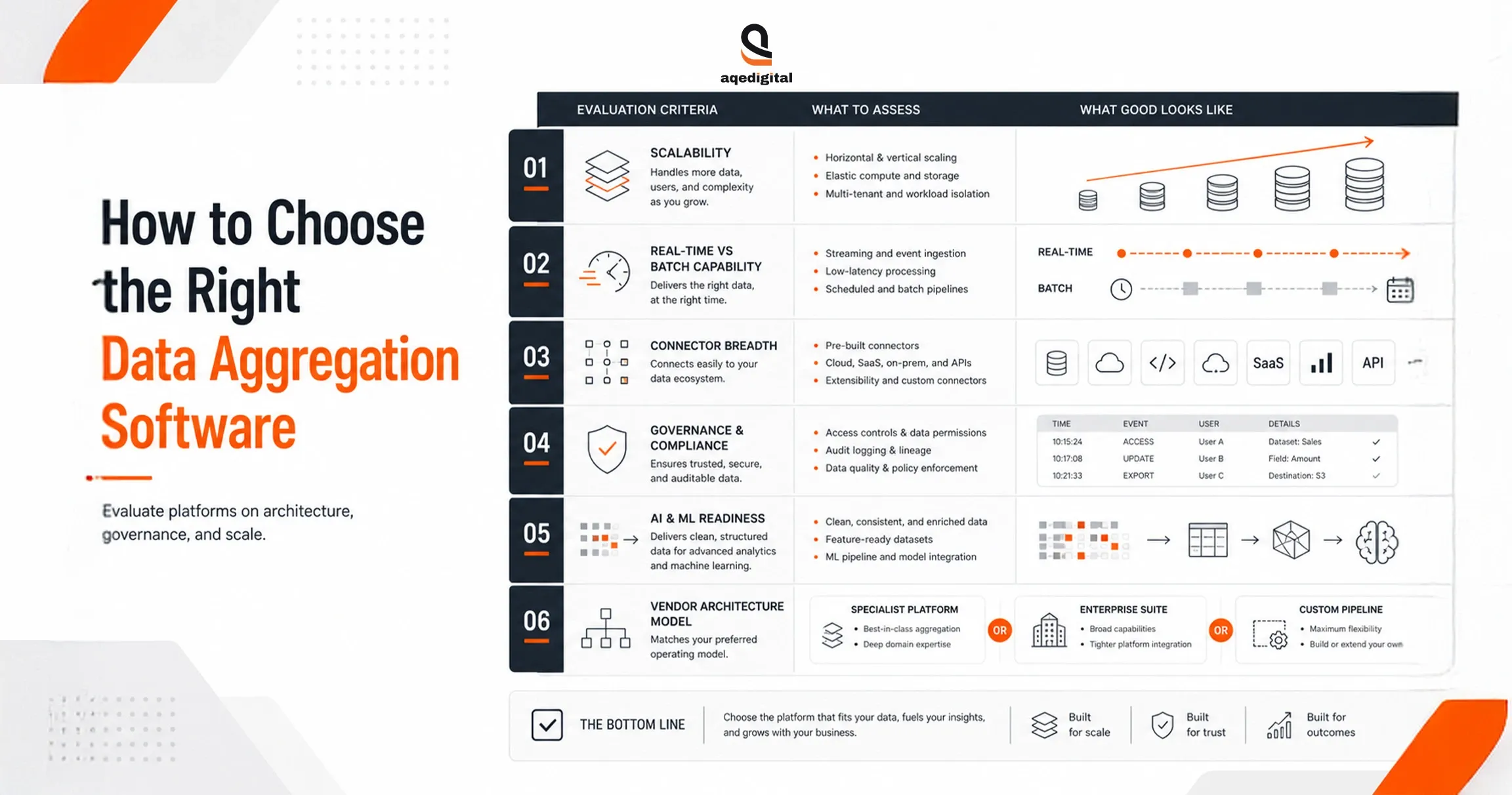
The data aggregation software market ranges from single-domain specialists to full-stack enterprise platforms. Evaluation criteria matter more than brand recognition. A platform optimized for financial data aggregation is a poor fit for a manufacturing IoT pipeline.
Scalability
Your chosen data aggregator must handle current volume and scale, and accommodate projected growth, without requiring architectural re-engineering at every threshold. Ask vendors for documented performance benchmarks at 10x your current data volume.
Real-Time vs. Batch Capability
Not all platforms support both modes. Fraud detection pipelines require sub-second aggregation. BI reporting can tolerate nightly batch runs. Confirm that your primary use case aligns with the platform's operational model before scoping an implementation.
Connector Breadth
Prebuilt connectors to the source systems in your stack determine integration cost and time-to-value. A data aggregator with 300 prebuilt connectors, covering your CRM, ERP, SaaS tools, and databases, will deploy faster and require less custom engineering than one requiring bespoke connections to every source.
Airbyte, Fivetran, and Matillion are commonly referenced for connector breadth in enterprise environments.
Governance and Compliance Features
Data lineage tracking, consent state management, audit logs, and field-level access controls are mandatory in regulated industries. Evaluate these before pricing. A platform without governance features shifts compliance burden onto your engineering team.
AI and ML Integration Readiness
If aggregated data feeds downstream ML models, confirm the output format, update frequency, and schema stability match what your model training pipelines require. A data aggregator that produces clean, consistently structured outputs is a competitive advantage. One that produces schema drift on every update is a liability.
Vendor Architecture Model
Single-domain specialists like Plaid handle financial data aggregation with depth that generic platforms cannot match. Enterprise integration platforms like Informatica and Talend offer broader coverage, higher complexity, and higher cost.
Custom-built pipelines give maximum control at maximum engineering investment. Match the architecture model to your team's capacity and your use case's specificity.
How AQe Digital Builds Data Aggregation Pipelines?
A data aggregator sits between raw chaos and business intelligence. Without it, organizations are not data-driven. They are data-burdened. The weight compounds with each additional ungoverned source.
GDPR, CCPA, CFPB Rule 1033: compliance is tightening. AI adoption is accelerating. Both punish weak aggregation the same way. Audit defensibility depends on lineage. Model quality depends on input quality. These are not aspirational benefits. They are infrastructure dependencies.
The aggregator you deploy today sets the ceiling for every analytics initiative, every ML model, every compliance posture your organization operates over the next three years.
AQe Digital has been engineering these foundations for more than 27 years, with production pipelines spanning manufacturing, financial services, healthcare, retail, and publishing. Governance designed in from sprint one, not retrofitted after go-live.
The engineering depth to build it right. The domain knowledge to build it for your industry. So if you are looking to ensure robust data aggregator pipelines, get in touch with our experts.