Conversational Analytics: How Enterprises Turn Questions Into Governed Decisions

Jigar Mistry
A pricing decision waits two days for one number. The data team is not slow. The request queue is simply longer than the decision window, so by Thursday somebody makes the call on instinct, and the number lands Friday to confirm a decision nobody can now reverse.
That is not a dashboard problem. It is a question-routing problem, and it is the one conversational analytics exists to close.
Rather than adding another reporting surface, conversational analytics gives a business user a way to ask a question in plain language and get back an answer that survives an audit: a number, a chart, and the metric logic that produced both.
The readiness evidence is blunt. Accenture's AI-ready data research finds only 7% of organizations qualify as "data reinventors," the group whose data foundations are mature enough to scale generative, agentic and physical AI. Everyone else is asking a language model to reason over a warehouse nobody has defined.
This guide covers what conversational analytics is, how four competing terms differ, the five-step mechanism, the trust objection your CDO raises first, a platform comparison, and a six-step rollout sequence you can fund this quarter.
What is Conversational Analytics?
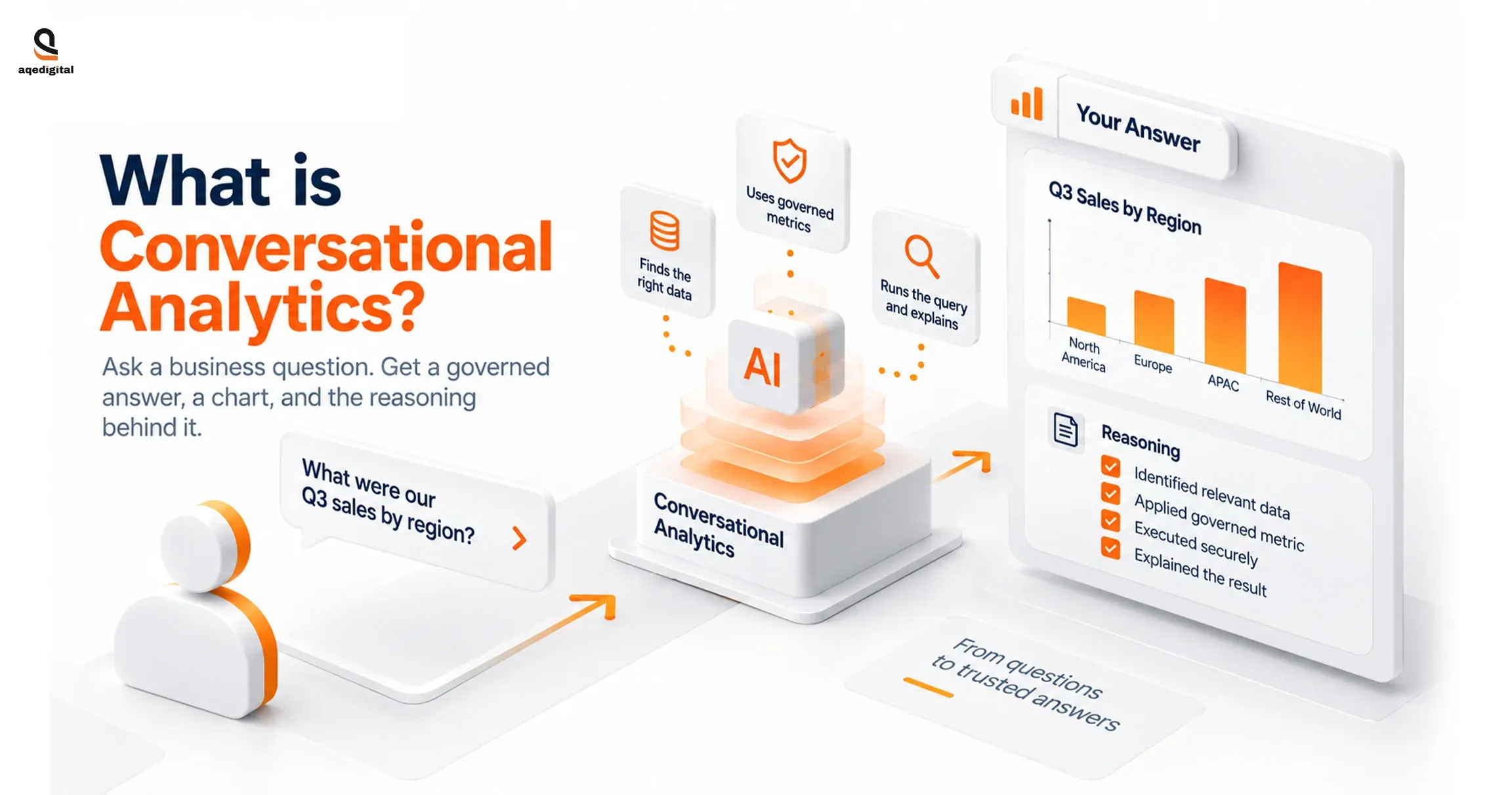
Conversational analytics is a capability inside a business intelligence platform that lets an authorized user ask a business question in natural language and receive a governed answer, a supporting chart, and the reasoning behind the result.
Two different products answer to the same name, and that confusion burns evaluation cycles. One is contact-center conversation intelligence, which analyses what customers said on calls and chats. The other is natural language business intelligence, which lets your team question the warehouse directly. This guide covers the second.
What conversational analytics is not is a chatbot bolted onto a dashboard. A chatbot retrieves documents. A conversational analytics system resolves an entity, selects a governed metric, writes the query, executes it under the asker's permissions, and explains what it did.
Before you shortlist a platform, settle which term your organization will use, because four of them are in circulation right now.
Conversational Analytics vs Conversational BI vs Generative BI: Which Term Should Enterprises Adopt?
| Conversational Analytics vs Conversational BI vs Generative BI | |||
|---|---|---|---|
| Term | What it means | Who uses the term | Example |
| Conversational analytics | Asking governed business data a question in natural language and getting an answer plus a chart | Vendor-neutral, used across BI and warehouse platforms | Ask why margin fell in the north region last quarter |
| Conversational BI | The same capability, framed as a BI platform feature | BI platform vendors and analyst coverage | Ask a Power BI semantic model for weekly pipeline |
| Generative BI | Generative AI that authors the analytics object, not only the answer | Cloud and warehouse platform vendors | Generate a full margin dashboard from one prompt |
| Natural language BI | The query interface alone, without agentic follow-up | Older BI documentation and search-driven tools | Type a question into a search bar over a dataset |
The vocabulary is messy because vendors named one capability after their own product line. Conversational analytics and conversational BI are functionally the same thing. Generative BI adds authoring, so the system builds the analysis object rather than only returning a result. Natural language BI is the older, narrower term for the query box on its own.
Pick one term and write it into your data glossary. Vocabulary drift becomes metric drift faster than most teams expect, and metric drift is exactly what a conversational analytics rollout is supposed to eliminate.
With the term settled, your CIO asks the mechanical question next. What actually happens between the typed question and the number on screen?
How Does Conversational Analytics Actually Work?
Conversational analytics runs five steps between question and answer, and only one of them involves the language model.
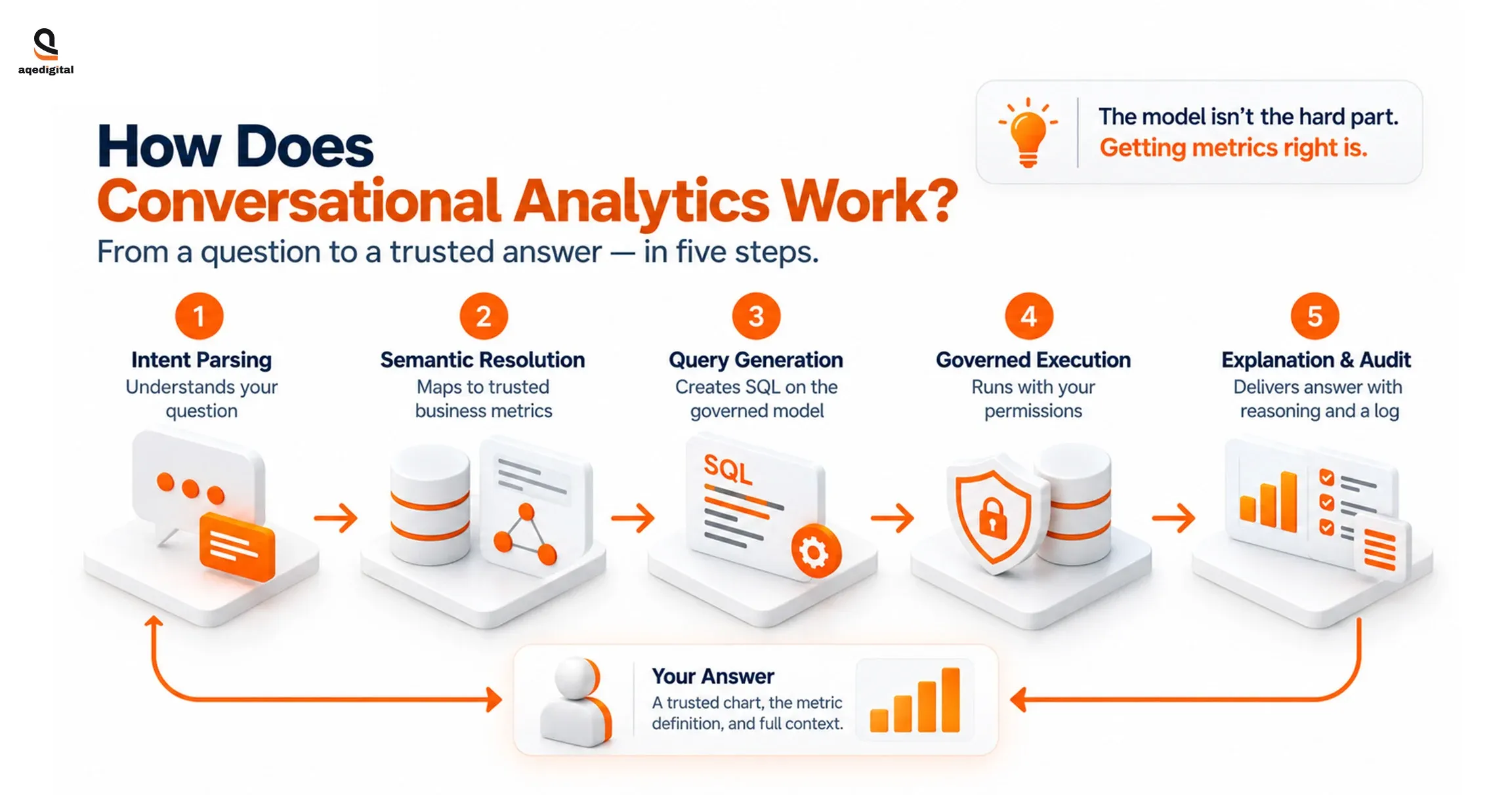
- Intent parsing. The system extracts entities, time frames and comparisons, and holds context across follow-ups so "and last quarter" still resolves correctly.
- Semantic resolution. The parsed intent maps to defined measures in a semantic layer. This is where revenue becomes one agreed calculation instead of four competing ones.
- Query generation. The system writes SQL against the resolved model, not against a raw schema it has to guess at.
- Governed execution. The query runs under the asker's row-level permissions, so a regional manager sees regional numbers and nothing further.
- Explanation and audit. The answer returns with the metric definition, the filters applied, and a logged trail of what was asked and what came back.
The model is not the hard part. The metric definition is. Every conversational analytics failure mode traces back to step two, not step one.
So if the mechanism is this clean, why did a decade of self-service dashboards not already close the gap?
Why Dashboards Still Leave the Deciding Question Unanswered
Conversational analytics earns its budget on the questions dashboards were never built to hold. Dashboards answer questions somebody anticipated. The questions that decide a quarter are the unanticipated ones, and those go straight back into the request queue that self-service was supposed to shorten.
The adoption data shows how shallow most deployments still are. Deloitte's State of AI in the Enterprise 2026, based on 3,235 senior leaders across 24 countries, found that 37% of organizations are using AI at a surface level with little or no change to existing processes, while only 34% are using it to reinvent core processes or business models.
Bolting a question box onto an unchanged reporting workflow lands you in that 37%. The interface improves. The decision latency does not.
McKinsey's State of AI global survey of 1,719 executives across 97 nations puts a sharper edge on it. Only about 6% of organizations qualify as AI high performers, attributing at least 5% of EBIT to their AI use. Nearly three-quarters of that group report fundamentally redesigning workflows, up from 55% the previous year, against roughly one-quarter of everyone else.
A dashboard is a published answer. A real decision usually needs an unpublished one, and getting it needs the workflow around the question to change, not only the query surface.
Which raises the objection every data leader makes next, and the one no vendor deck answers properly.
Can Enterprises Trust What Conversational Analytics Answers?
A conversational analytics system is trustworthy to the exact degree its semantic layer is defined, and no further. Pointed at a raw enterprise schema, a general-purpose model guesses at joins, invents filters, and returns a confident wrong number in perfect English.
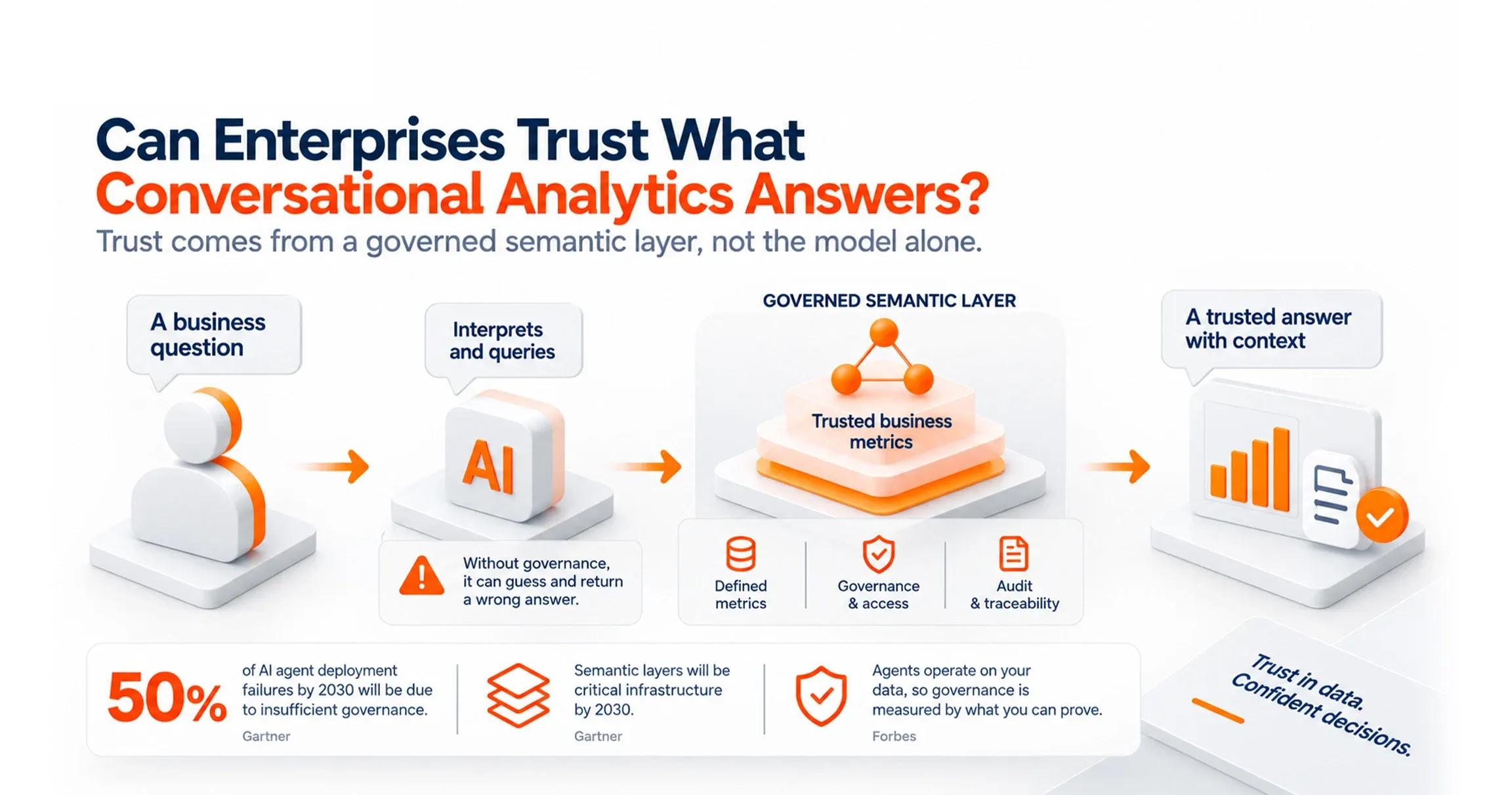
Gartner's top data and analytics predictions for 2026 put the governance risk in operational terms: by 2030, 50% of AI agent deployment failures will be caused by insufficient AI governance platform runtime enforcement for capabilities and multisystem interoperability. In the near term, Gartner expects ungoverned decisions made using LLMs to cause financial or reputational loss.
The same predictions treat the fix as infrastructure rather than tooling. By 2030, Gartner expects universal semantic layers to be treated as critical infrastructure alongside data platforms and cybersecurity, and describes building one as a non-negotiable foundation for any D&A leader supporting AI.
Writing in Forbes, technology executives make the enforcement point directly: agents operate on enterprise data rather than prompts alone, so every output is shaped by what the system is permitted to reach, and governance is increasingly measured by what an organization can prove rather than what it intended.
Here is the caveat a vendor will not volunteer. Accuracy on a demo dataset tells you nothing about accuracy on yours. Run the pilot on your own schema, with your own genuinely ambiguous metric, and count the wrong answers before you count the fast ones.
Design the system to fail safe rather than fail silent. An answer that reports a metric as undefined beats a confident number nobody can reproduce in front of an auditor.
Trust handled, the buying question moves to platforms, and this is where most evaluations pick the wrong variable.
Which Conversational Analytics Platform Fits Your Stack?
The decision does not turn on which model the vendor ships. It turns on semantic-layer maturity, theirs and yours.
| Conversational Analytics Platform Comparison | |||
|---|---|---|---|
| Platform | Native semantic layer | Where the answer lands | Best fit |
| Power BI Copilot | Yes, via semantic models | Power BI, Teams, Microsoft 365 | Microsoft-standardised enterprises |
| Tableau with Salesforce | Yes, via published data sources | Tableau, Slack | Existing Tableau estates |
| ThoughtSpot Spotter | Yes, purpose-built | ThoughtSpot and embedded apps | Search-first analytics cultures |
| Snowflake Cortex Analyst | Yes, semantic model files | Snowflake and custom apps | Warehouse-native governance |
| Databricks Genie | Yes, via Unity Catalog | Teams, APIs, notebooks | Lakehouse estates with a strong catalog |
| Looker Conversational Analytics | Yes, via LookML | Looker and Google Workspace | Google Cloud data stacks |
Every conversational analytics platform above ships a competent model. The difference between them is where the governed definition sits. Warehouse-native options keep governance where the data already lives. BI-native options reach the people who already work inside the tool every day.
Choosing the option that matches your existing governance boundary matters more than any benchmark score in a vendor deck, because the boundary is what row-level security is already written against.
The platform is only half the decision. The rollout sequence decides whether anybody still trusts the system in month three.
How Should You Roll Out Conversational Analytics?
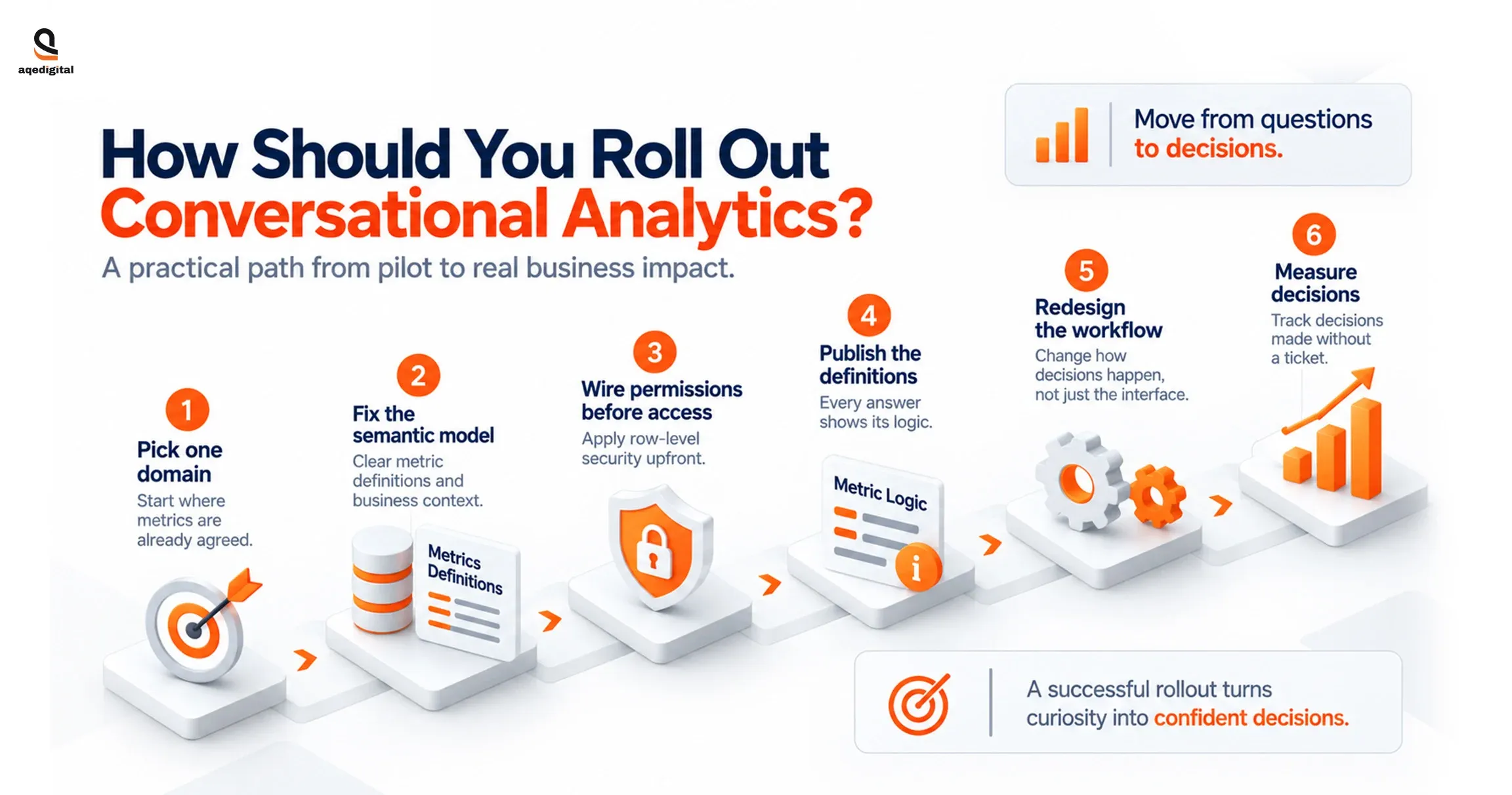
- Pick one domain. Point conversational analytics at a domain where the metrics are already agreed, such as the finance close or the sales pipeline. Not everything at once.
- Fix the semantic model first. Unambiguous column names, measures that state their own calculation, and a description on every field that a non-analyst can read.
- Wire permissions before access. Apply row-level security to the query itself, not to the response after the fact.
- Publish the definitions. Every answer carries the metric logic that produced it, so the number can be defended without calling an analyst.
- Redesign the workflow, not only the interface. This is the variable McKinsey found separating the 6% from everyone else, and it is the step most conversational analytics pilots skip.
- Measure decisions, not queries. Query volume tells you the interface is popular, not that conversational analytics is working. Track how many decisions moved without a ticket, then report that number to the sponsor who funded the work.
Accenture's research points the same way. Data reinventors embed decision intelligence across multiple core business decisions, enabling consistent and governed action, at a far higher rate than the 28% of industry peers who manage it. Reinventors also apply AI heavily to conversational reporting and insight generation, which is only viable once the data foundation underneath can support it.
Which leaves the practical question of who builds that layer.
Why AQe Digital for Conversational Analytics?
Most vendors sell you the question box. That is the easy part, and it is the part your team will judge in a demo.
- Engineering-first data foundations. AQe Digital builds the ingestion, reconciliation and semantic modelling work that decides whether the answer is right, through its AI and data solutions and data conversion and processing practices.
- Governance designed in, not bolted on. Row-level security, audit trails and named metric ownership are modelled at the semantic layer, before a single question is asked of the system.
- Stack-agnostic delivery. Power BI, Snowflake, Databricks, Tableau or Looker, selected against your existing estate and digital transformation roadmap rather than a partnership tier.
The outcome your CFO signs off on is a number they can defend in a board meeting without calling an analyst first.
Conversational Analytics Makes Your Metric Definitions Load-Bearing
The interface changed. The trustworthiness of the answer did not move at all, because it still depends on whether somebody defined the metric properly.
Every ambiguity left in your semantic model now becomes a wrong answer somebody acts on, at conversational speed, without the analyst who used to catch it on the way past. Forbes analysis of data risk in the AI era frames this as a management decision problem rather than a compliance exercise, and that is the right frame for the budget conversation too.
So the first conversational analytics project this quarter is not a vendor bake-off. It is one domain, one clean semantic model, one measured pilot. Talk to AQe Digital about a semantic-layer readiness assessment before you commit budget to a conversational analytics platform.