How to Leverage Cloud Migration Benefits With Full Potential?

Cheta Pandya
Cloud migration is reshaping how modern businesses operate. While traditional on-premises systems demand heavy maintenance, high costs, and constant oversight, today’s cloud-first environments deliver faster performance, stronger security, and unmatched scalability. The shift isn’t just technological. It’s strategic.
According to Gartner, global public cloud spending is projected to reach $723.4 billion by 2025, highlighting how quickly enterprises are moving away from legacy systems and accelerating their cloud adoption paths.
As cloud computing evolves, enterprises gain the power to move web, mobile, and desktop applications into flexible environments that support real-time data access, seamless collaboration, and round-the-clock connectivity. With IaaS and other cloud service models, businesses eliminate hardware overhead and unlock advanced computing, analytics, and storage from anywhere in the world.
This transformation goes beyond IT efficiency. It accelerates innovation, boosts productivity, and drives measurable ROI across teams and operations. And with hybrid and multi-cloud strategies becoming the new standard, businesses that migrate now gain a clear edge in agility and competitive growth.
In this guide, we’ll break down how cloud migration works, the benefits it delivers, essential strategies for a successful transition, key challenges to avoid, and why now is the right time to embrace the cloud for long-term business impact.
What Is Cloud Migration?
Cloud migration means moving your data, applications, and systems from on-premise servers to cloud platforms like AWS, Azure, or Google Cloud. What this really changes is ownership and control. Instead of maintaining physical infrastructure, you run on on-demand environments built to scale fast, stay secure, and adapt as your business grows.
This move helps organizations operate faster, collaborate easily, and innovate continuously without being limited by outdated infrastructure. It’s now a foundational step for companies that want long-term resilience in a digital-first economy. Following the best practices for cloud migration is significantly important for a Cloud Modernization Services provider to align legacy systems with modern cloud capabilities.

What Are The Key Benefits of Cloud Migration?
Cloud migration reshapes how companies scale, operate, and innovate. Below is a concise breakdown of the core benefits most authoritative sources consistently highlight.
1. Cost Efficiency
Cloud platforms remove the need for expensive hardware and ongoing maintenance. Instead, you pay only for the resources you use. This eliminates significant upfront investments and reduces over-provisioning.
How it works: Traditional systems require buying servers based on forecasts. The cloud replaces guesswork with on-demand scaling, so you adjust resources instantly as demand changes.
Pro tip: Use cost-allocation tags and automated scaling rules to prevent unnecessary spend.
2. Anywhere Access and Mobility
The cloud enables secure access to data and applications from any device or location. This supports remote teams, global operations, and real-time collaboration.
How it works: On-premises setups rely on VPNs and local servers. Cloud platforms host applications centrally, making access more straightforward and reducing downtime.
Pro tip: Enable single sign-on and multi-factor authentication to keep access seamless and secure.
3. Faster Innovation and Agility
Organizations can build, test, and launch new services quickly. The cloud supports rapid experimentation without waiting for hardware procurement or setup. This ability to build, test, and deploy faster is what enables organizations to turn ideas into outcomes, something clearly demonstrated through real-world Cloud Development initiatives executed at scale.
How it works: Provisioning environments takes minutes, not months. Teams can deploy updates continuously, supporting faster growth and shorter development cycles.
Pro tip: Create sandbox environments for prototyping to reduce risk and accelerate learning.
4. Scalability on Demand
Cloud platforms let you scale resources up or down automatically based on real-time traffic and workload needs.
How it works: Built-in load balancing and auto-scaling keep applications responsive, even during traffic spikes.
Pro tip: Use performance monitoring dashboards to identify scaling thresholds and optimize configurations.
5. Stronger Security
Leading providers use advanced encryption, monitoring, and threat detection to protect your data with enterprise-grade security.
How it works: Cloud security is layered and automated. Providers apply regular patches, monitor threats 24/7, and ensure compliance with global standards.
Pro tip: Adopt a zero-trust security model to minimize unauthorized access across users and devices.
6. Lower Maintenance Overhead
Cloud providers handle updates, patches, and hardware management. This frees internal teams to focus on strategic initiatives.
How it works: Automated updates keep systems up to date without downtime or manual intervention.
Pro tip: Establish a cloud governance framework to keep teams focused on value-driven tasks.
7. Reliable Backup and Disaster Recovery
Cloud migration ensures your data is backed up continuously across geographic regions. This protects your business from outages and data loss.
How it works: Multiple redundant locations enable fast recovery and minimize disruptions.
Pro tip: Set clear recovery time and recovery point objectives that align with business needs.
8. Sustainability and Business Continuity
Cloud providers operate energy-efficient data centers that lower carbon emissions and reduce e-waste. Built-in redundancy ensures systems stay online during disruptions.
How it works: Shared infrastructure reduces energy consumption and supports seamless failover.
Pro tip: Use sustainability dashboards available in many cloud platforms to track and reduce your environmental footprint.
The 6Rs of Cloud Migration
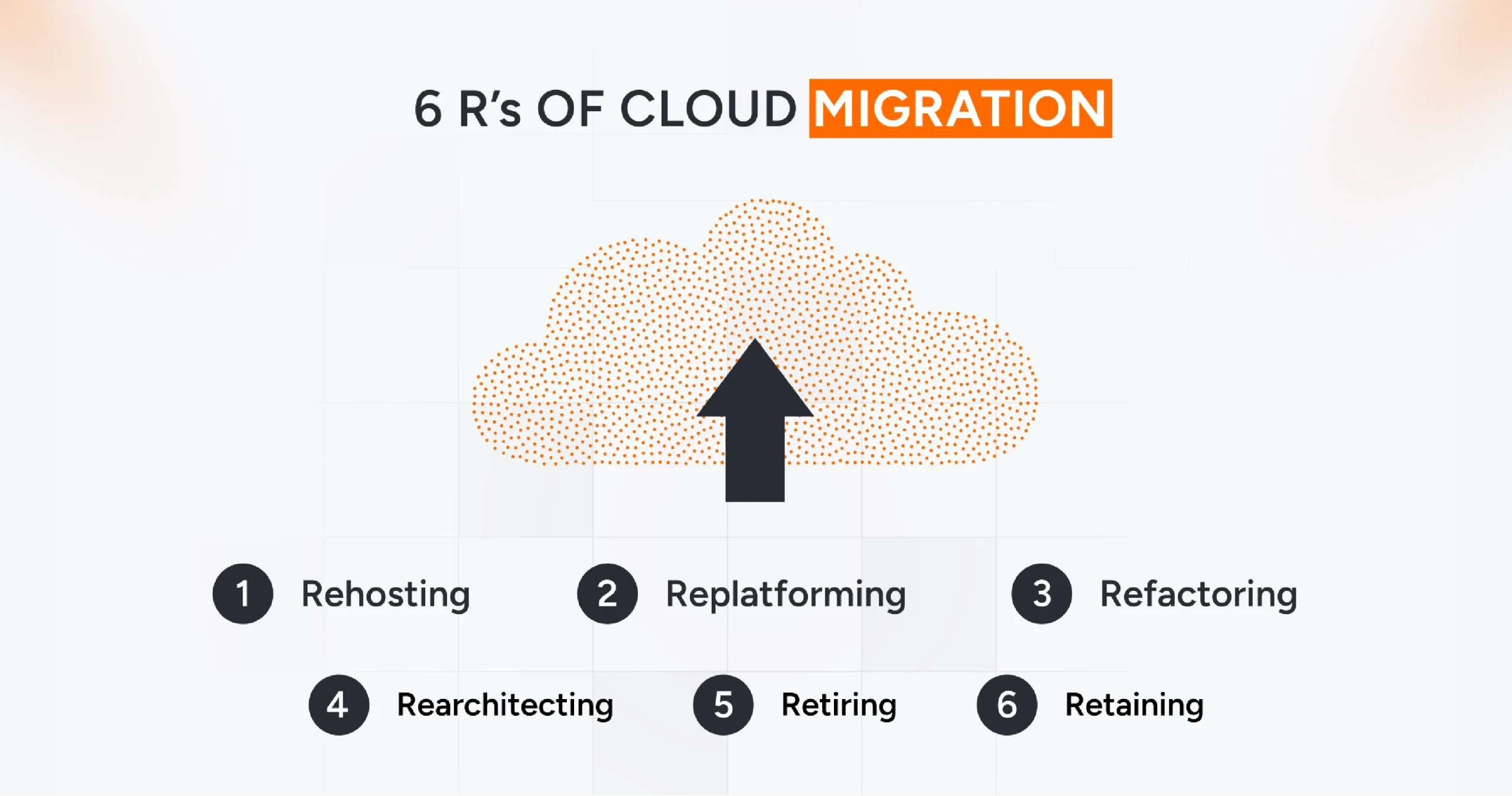
These six strategies help businesses decide which applications to migrate, modernize, or replace.
1. Rehosting
A fast “lift and shift” approach that moves applications as they are. It minimizes disruption and helps organizations migrate quickly.
Pro tip: Use automated migration tools to accelerate transfers and reduce manual errors.
2. Replatforming
This method makes minor optimizations, such as database updates or the use of managed services, without significant architectural changes.
Pro tip: Target databases and middleware first, as they benefit most from managed cloud services.
3. Refactoring
Refactoring means modifying application code to unlock cloud-native capabilities like serverless computing and microservices.
Pro tip: Prioritize apps that need rapid scaling or support high-volume transactions.
4. Rearchitecting
A complete redesign to build cloud-native systems. This approach supports long-term scalability and integrates modern technologies.
Pro tip: Use containerization early to simplify operations and improve portability.
5. Retiring
Remove outdated or redundant applications before migration to reduce costs and streamline workloads.
Pro tip: Conduct an app rationalization audit to identify low-value systems.
6. Retaining
Some applications remain on-premises due to compliance or integration constraints. A hybrid model supports controlled modernization.
Pro tip: Use dedicated connectivity options like Direct Connect or ExpressRoute to keep hybrid systems reliable.

Best Practices for Successful Cloud Migration
Migrating to the cloud is a significant step, and like any big move, success depends on preparation, strategy, and execution. While the benefits of cloud migration are undeniable, overlooking key steps can lead to unnecessary delays, downtime, or security issues. To ensure your transition is smooth, cost-effective, and future-ready, here are some proven best practices to follow.
1. Assess Your Readiness Thoroughly
Start by evaluating your current IT landscape, such as applications, workloads, and infrastructure. Identify which systems are cloud-compatible and which may need upgrades or replacements. A detailed readiness assessment helps you uncover potential issues early and ensures a smoother migration journey.
2. Set Clear Objectives and KPIs
Define what success looks like for your cloud migration, whether it’s reducing costs, improving scalability, or boosting agility, and set measurable KPIs that align with your overall business goals. This clarity helps guide decisions and keeps your migration on track.
3. Choose the Right Migration Strategy
Select the best cloud migration strategy that fits your organization’s technical maturity and long-term goals. Options like rehosting, refactoring, or replatforming each offer different advantages. Aligning the right approach with your needs ensures maximum efficiency and performance.
4. Engage All Stakeholders
Cloud migration is not just an IT initiative; it’s an organization-wide transformation. Involve leaders from IT, finance, operations, and other teams early on. Their collaboration ensures smoother adoption and better alignment with business priorities.
5. Plan for Data Governance and Security
Data security and compliance must be top priorities during migration. Establish clear policies for access control, encryption, and backup management. Strong governance practices reduce vulnerabilities and ensure regulatory compliance throughout the process.
6. Leverage Automation for Efficiency
Automation can significantly streamline your migration. Use automated tools to manage data transfers, testing, and deployments with greater accuracy. This reduces manual effort, minimizes errors, and accelerates time-to-value for your new cloud environment.
7. Test, Monitor, and Optimize Continuously
Once your migration is complete, testing shouldn’t stop. Continuously monitor application performance, resource utilization, and user experience. Regular optimization helps maintain efficiency, control costs, and ensure that your cloud infrastructure evolves with business demands.
Cloud Migration Risks and Tips to Mitigate Them
Migrating to the cloud unlocks scalability, agility, and cost-efficiency, but like any major transformation, it comes with its own set of hurdles. Understanding the key cloud migration risks early on helps you plan a smoother, disruption-free transition while maximizing the benefits your organization aims to achieve.
Let’s look at some common challenges businesses face during migration and the proven ways to overcome them.
1. Data Migration Complexities
Transferring large volumes of data from legacy systems to the cloud can be tricky. The process often involves compatibility issues, data integrity risks, and potential downtime. Without proper planning, businesses may face data corruption or loss during migration.
Mitigation Tip:
Adopt a phased migration approach using specialized tools and expert guidance. Always create comprehensive data backups and perform validation checks after each phase to ensure data integrity throughout the process.
2. Security and Privacy Concerns
Even with advanced cloud security, storing data on third-party servers raises concerns about breaches and unauthorized access. Data traveling between on-premises systems and the cloud also remains vulnerable if not properly encrypted.
Mitigation Tip:
Implement end-to-end encryption for both data at rest and in transit. Regularly audit access controls and use a zero-trust model where every user and device must be verified before access is granted.
3. Compliance Challenges
Every industry operates under unique regulations ranging from GDPR to HIPAA, which makes compliance a significant challenge during cloud migration. Data residency and sovereignty requirements can complicate where and how your information is stored.
Mitigation Tip:
Choose a cloud provider with compliance certifications that align with your industry and region. Maintain regular compliance audits and document your processes to ensure transparency and accountability.
4. Cost Management Issues
While the cloud promises cost efficiency, unmonitored usage can lead to ballooning expenses. Without governance, scaling resources on demand may quickly spiral into overspending.
Mitigation Tip:
Use the cost management dashboards offered by cloud providers to track and optimize expenses. Set usage policies, automate scaling where possible, and conduct regular audits to keep your budget in check.
5. Vendor Lock-In
Once committed to a cloud provider, switching can be costly and technically challenging due to proprietary systems and incompatible technologies. This dependence can limit flexibility over time.
Mitigation Tip:
Opt for open standards and multi-cloud strategies to keep your options open. Avoid relying too heavily on provider-specific tools, as they may limit portability in the future.
6. Skill Gaps in Teams
Managing a cloud-based environment requires new expertise that traditional IT teams may lack. This skill gap can lead to inefficient resource use or security oversights.
Mitigation Tip:
Invest in staff training and certification programs to build in-house cloud expertise. Alternatively, collaborate with managed service providers for specialized support during the transition period.
7. Ensuring Business Continuity
Downtime during migration can impact operations and customer experience. Without careful scheduling and monitoring, even a minor disruption can result in a significant incident or loss.
Mitigation Tip:
Plan migrations during off-peak hours and execute them in phases. Keep on-premises and cloud systems running in parallel until migration is complete to maintain uninterrupted service delivery.
Despite these challenges, the rewards of cloud adoption far outweigh the risks. With a well-defined strategy, the right tools, and proper governance, businesses can transform their infrastructure, enhance performance, and fully realize the long-term benefits of cloud migration that drive sustainable growth.
Conclusion
Migrating to the cloud is a strategic move that unlocks agility, scalability, and long-term value. From cost optimization to improved innovation and flexibility, the cloud migration benefits help businesses stay competitive in a fast-paced digital world. Still, this journey comes with its own set of risks, such as security concerns, downtime, and cost overruns.
The key is planning smartly, choosing the right strategy, preparing your teams, and partnering with experienced professionals like AQe Digital. When done right, cloud migration doesn’t just modernize systems; it empowers businesses to grow, adapt, and future-proof their operations. To experience and leverage the full potential of the cloud and execute a seamless cloud migration, contact us.