How Automated Product Recommendation Improves Sales and Efficiency in Retail

Joy Chauhan
Most online shoppers already know what they want. But finding it on a site with thousands of products can feel like searching for a needle in a haystack. Endless scrolling, filters that don’t work as intended, and irrelevant search results can lead to higher cart abandonment rates.
That’s precisely where recommendation engines step in. By analyzing browsing history, purchase behavior, and search activity, it recommends the most relevant products.
And this isn’t theory, it’s how leading digital platforms keep users engaged. Netflix has over 80% of its viewing driven by recommendations. Amazon’s “Frequently bought together” suggestions contribute billions in upsell revenue.
Retailers are seeing similar results. A recent study found that 55% of organizations achieved an ROI above 10% with recommendation systems proving that personalization isn’t just about convenience, but also a growth driver.
In this article, we’ll break down how automated product recommendations work and explore why they’re fast becoming one of the most valuable tools for modern retailers.
What Is Automated Product Recommendation?
Automated product recommendation is an AI-driven system. It uses machine learning algorithms and real-time data processing. This helps to deliver personalized product suggestions to customers without manual intervention. It analyzes customer behavior, purchase history, and contextual signals to predict product relevancy.
It enables retailers to scale personalization, optimize merchandising, and increase conversion rates. Ultimately, this improves operational efficiency by adapting to customer needs and market trends.
How does it matter in eCommerce?
Automated product recommendations are changing online shopping. It utilizes AI, machine learning, and real-time data to enhance the shopping experience.
- Increase Sales with Smarter Suggestions – Recommendation systems analyze customer behavior and buying patterns. They use this to suggest products customers are most likely to buy. This helps turn visitors into buyers.
- Personalize Shopping in Real-Time – Recommendations change as customers look at or buy things. This makes shopping feel personal, with no extra effort needed from store owners.
- Increase Order Value with Smart Suggestions –The system identifies complementary or higher-value products. It suggests these items at the right time, encouraging customers to buy more.
- Save Time and Work More Efficiently – Automated recommendation systems handle millions of customers. This saves time and lets teams focus on growing the business.
- Make Better Business Decisions – Recommendation systems optimize retail inventory management, marketing, and planning through data. It helps store owners make smarter choices to improve their business.

How Automated Product Recommendation Drives Personalized Shopping Experiences with AI
AI-driven product recommendation uses advanced algorithms and machine learning techniques. It analyzes a vast amount of customer data to deliver relevant product suggestions. It collects and processes multiple layers of user data, including:
Browsing Behavior
Browsing behavior captures the real-time interactions a user has with a website or app. This includes:
- Pages visited: Identifies which categories or products attract attention. For example, repeated visits to running shoes indicate interest in sportswear.
- Time spent on products: Higher dwell time on a product page often signals higher purchase intent.
- Clicks and navigation patterns: Tracks which products are clicked, added to carts, or compared.
- Search queries: Analyzing search terms allows the system to detect intent and show relevant products.
Browsing behavior data is captured via event tracking frameworks. These events feed into real-time data pipelines. This enables AI models to adjust their recommendations dynamically.
Purchase History
Purchase history provides a rich, structured dataset for predicting future buying patterns:
- Previously bought items: Identifies repeat purchases and product affinities.
- Purchase frequency: Helps the system determine how often customers buy specific products.
- Preferred brands or categories: Signals brand loyalty or category interest. The system uses it to prioritize suggestions.
- Order value patterns: AI can detect high-value customers or products to optimize upselling.
Purchase history is stored in transactional databases. It is then combined with customer profiles in a recommendation engine. Machine learning models, such as collaborative filtering or sequence-based deep learning, can detect patterns across individual and aggregated purchase behaviors.
Demographic and Contextual Data
Demographic and contextual signals help the system personalize recommendations beyond behavior:
- Location: Enables geo-targeted suggestions, regional promotions, or product availability filters.
- Device type: Adapts recommendations for mobile, desktop, or tablet, optimizing layout and display.
- Seasonality and trends: Recognizes holiday, seasonal demand, or trending products.
- Customer segment info: Age, gender, or loyalty tier can be used to further refine recommendations for relevance.
Demographic data is often integrated from CRM systems, user account profiles, or real-time devices. Modern AI systems utilize reinforcement learning to dynamically adjust product suggestions.
Automated product recommendation systems use advanced machine learning models to generate relevant suggestions. These models analyze patterns at scale, predict customer intent, and continuously refine recommendations.
Collaborative Filtering
Collaborative filtering identifies patterns across multiple users. It works on the principle that customers with similar behavior or preferences will be interested in similar products. There are two main types:
- User-based: Finds users with comparable shopping behavior and recommends products they have purchased.
- Item-based: Analyzes items frequently purchased or viewed together, suggesting products based on frequency.
This approach excels at uncovering hidden relationships between products and users.
Content-Based Filtering
Content-based filtering focuses on product features and the individual user’s past interactions. A set of features, such as category, brand, price, or style represents each product. System matches these features with the user’s previous behavior.
For example, if a user frequently buys running shoes. The system recommends new running shoes or sportswear with similar attributes. This method is particularly effective for introducing users to new or niche products.
Hybrid Models
Hybrid recommendation models combine collaborative filtering and content-based filtering. By integrating multiple algorithms, these systems can:
- Improve accuracy by reducing biases inherent in a single approach.
- Handle new users or products better through content analysis, leveraging collective behavior data.
- Adapt dynamically to evolving customer patterns, ensuring recommendations remain relevant and timely.
Modern automated product recommendation engines often employ additional layers of AI. These are deep learning, natural language processing, and reinforcement learning. It enhances prediction accuracy, captures contextual signals, and optimizes for business objectives. These objectives are all about maximizing conversion or average order value.
👉 Must Read: AI in Retail: The Simple & Effective Way to Boost Your Store Experience
How AI Personalizes Product Recommendations in Real Time
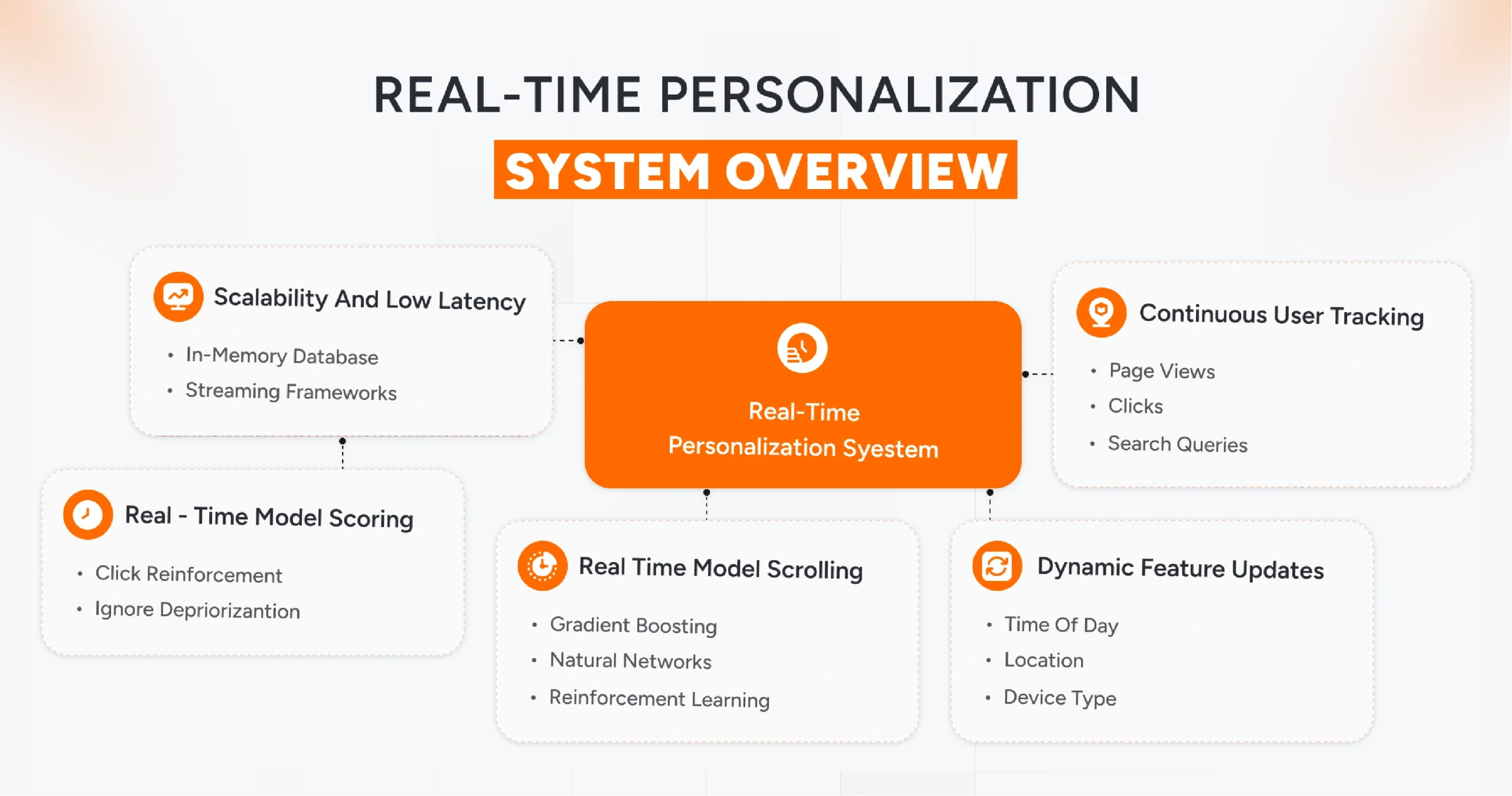
Unlike static recommendation lists, these systems adapt dynamically to a customer’s behavior as it happens, ensuring that every suggestion is relevant to the user’s current context and intent.
Technically, this involves several layers of data collection and processing:
Continuous User Tracking
The system monitors user interactions in real time, capturing events such as page views, clicks, search queries, product comparisons, and even hover behavior. This streaming data is fed instantly into the recommendation engine.
Dynamic Feature Updates
As each interaction occurs, the system updates user profiles and contextual features. For instance, it considers not only the products the user has browsed but also session-specific factors like time of day, location, device type, and ongoing promotions. These features are critical for making recommendations that are personalized and actionable in the moment.
Real-Time Model Scoring
Advanced AI models, such as gradient boosting, neural networks, or reinforcement learning algorithms, power AI-Powered customer Insights to score products against the updated user profile continuously. This scoring predicts the likelihood of interaction or purchase for each candidate product, ranking them to display the most relevant suggestions first.
Instant Feedback Loop
Every customer action provides immediate feedback to the system. For example, if a user clicks on a recommended product, the model reinforces similar suggestions; if they ignore it, the system deprioritizes similar items. This feedback loop ensures that recommendations evolve and improve with each session.
Scalability and Low Latency
Implementing real-time personalization at scale requires efficient data pipelines and high-speed computation. Many eCommerce platforms rely on in-memory databases, streaming frameworks (like Apache Kafka), and optimized AI inference pipelines to serve personalized recommendations within milliseconds, even under high traffic.

Best Product Recommendation Tools for Retail Growth
Modern advanced product recommendations are powered by a combination of AI, machine learning, and data analytics tools that make personalized shopping experiences possible at scale. Retailers today rely on a variety of product recommendation tools and algorithms to deliver relevant suggestions efficiently and accurately. Some most popular based on their usage are:
Key Algorithms Behind Automated Product Recommendations
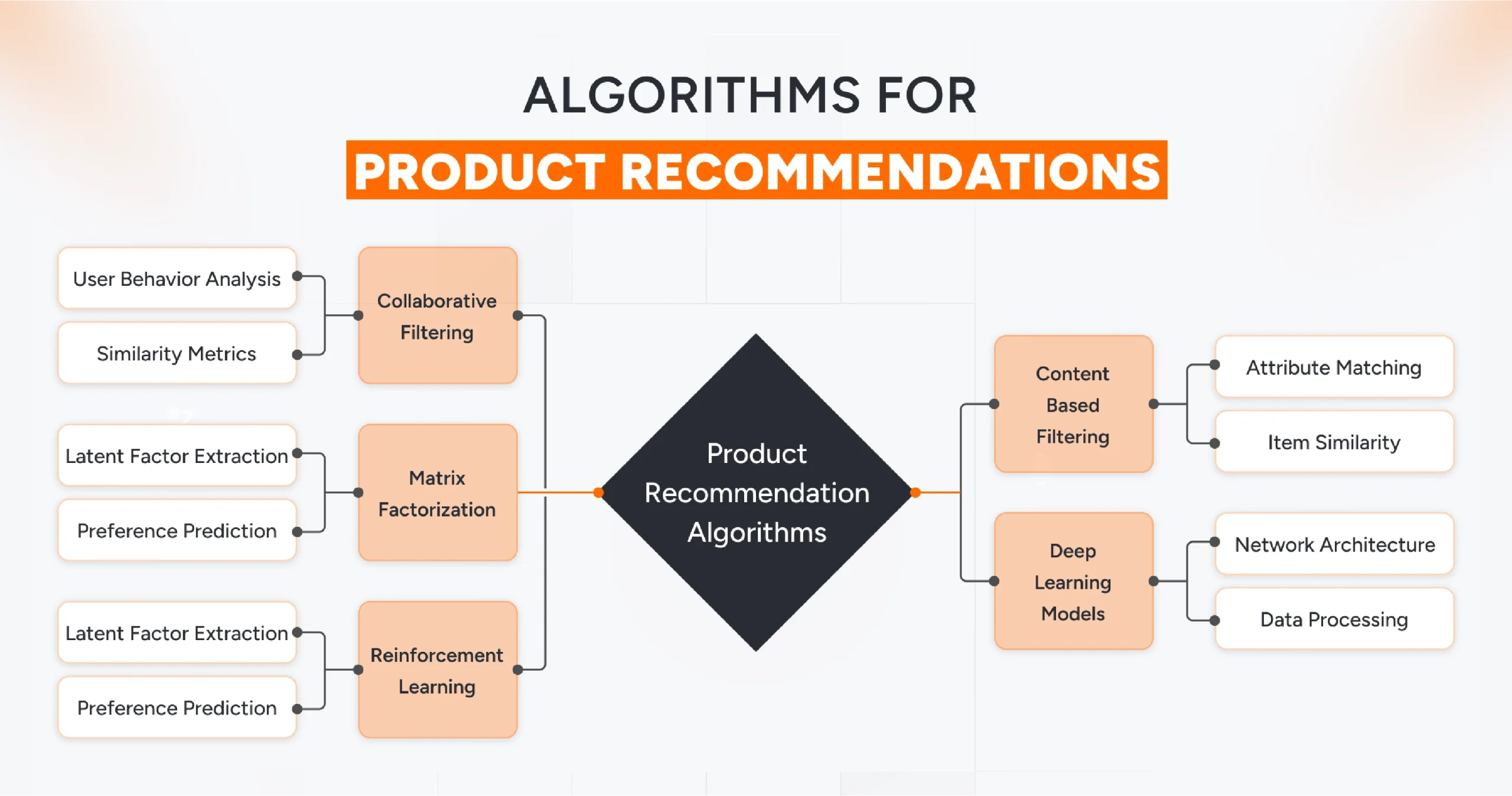
Effective product recommendation tools are designed to deliver more than basic “similar item” suggestions. They ensure recommendations are accurate, scalable, and capable of adapting in real time to customer behavior.
- Collaborative Filtering: Suggests products based on similar users’ behaviors.
- Content-Based Filtering: Recommends items with attributes similar to previously interacted products.
- Matrix Factorization: Breaks down user-product interactions into latent factors to predict preferences.
- Deep Learning Models: Neural networks capture complex relationships in large datasets for highly accurate recommendations.
- Reinforcement Learning: Continuously learns from user interactions to optimize recommendations over time.
For retailers, this enables the delivery of advanced product recommendations that enhance personalization, increase engagement, and drive higher conversions while efficiently handling large product catalogs and high volumes of user interactions.
How To Design Effective Recommendation Systems for Business Growth
Before building an automated recommendation engine, it’s critical to understand where it fits within the broader machine learning lifecycle.
Every recommendation model moves through a series of stages – from defining business goals to data preparation, model training, deployment, and continuous optimization. This lifecycle ensures your AI system evolves with customer behavior and market trends rather than staying static.
An effective recommendation system design is the backbone of personalized eCommerce experiences. It defines how customer data is collected, processed, and transformed into actionable insights that influence buying decisions.
Building a product recommendation system with AI personalization requires retailers to design a solution that can collect, process, and learn from customer interactions at scale. Here is a structured approach that AI software development services recommend:
1. Data Collection and Integration
The foundation of any recommendation engine is data. Retailers must capture and unify information such as:
- User behavior data: browsing history, clicks, cart activity, search queries.
- Transaction data: purchase history, frequency, product returns.
- Product metadata: category, brand, attributes, price, and stock availability.
- Contextual data: device type, time of interaction, location.
This data is typically ingested through ETL pipelines into a centralized data warehouse or data lake for processing.
2. Feature Engineering and Data Processing
Raw data needs to be cleaned, normalized, and transformed into features that machine learning algorithms can use. Examples include:
- User profiles with demographic and behavioral vectors.
- Item embeddings that capture product similarities.
- Session-level data for real-time recommendations.
Advanced pipelines often use distributed processing frameworks like Spark or cloud-native tools to handle high volumes of streaming data.
3. Choosing the Right Recommendation Models
Retailers can adopt different AI-driven models depending on scale and personalization needs:
- Content-Based Filtering: Matches products to users based on product attributes and user profiles.
- Collaborative Filtering: Identifies patterns in user-item interactions (e.g., “users like you also bought this”).
- Deep Learning Models: Use embeddings, neural collaborative filtering, or sequence models (RNNs, Transformers) to predict intent and personalize in real time.
- Hybrid Systems: Combine multiple methods to balance accuracy, scalability, and diversity.
4. Real-Time Recommendation Serving
Once trained, models need to be deployed in a way that can respond instantly to customer actions. Retailers typically:
- Use APIs and microservices to deliver recommendations.
- Implement ranking layers that order results by relevance, probability of conversion, or profitability.
- Employ caching strategies for frequently requested products to minimize latency.
5. Feedback Loop and Continuous Optimization
AI-powered recommendation systems improve over time through feedback:
- Positive signals: clicks, conversions, repeat visits.
- Negative signals: ignored items, short session exits, abandoned carts.
Using this data, models are retrained regularly or even updated in near real time using online learning techniques, ensuring that recommendations remain relevant as customer behavior evolves.
6. Personalization at Scale
Personalization is achieved by dynamically adapting recommendations to each shopper. This may include:
- Dynamic product ranking: prioritizing products based on individual preferences.
- Context-aware suggestions: tailoring recommendations based on time, device, or location.
- Multi-channel delivery: ensuring consistency across web, mobile apps, and even in-store booths.
AI-Powered Product Recommendations with AQe Digital
Most retailers recognize that personalization is important, but building a recommendation engine that actually delivers can be overwhelming. At AQe Digital, we take care of the complex parts like data pipelines, AI models, and cloud scaling, so you can focus on engaging with your customers.
With us, retailers looking to stay ahead of shifting customer demands can dominate retail with predictive analytics & AI, to unlock more innovative personalization, stronger engagement, and measurable growth. The result is an AI-powered recommendation system that adapts in real time, improves sales performance, and grows with your business.
At AQe Digital, we bring together technology and strategy to help retailers deliver personalization that truly drives results. Here’s how we make it happen:
- Tailored System Design: We understand that no two retailers are alike. That’s why we design recommendation engines that fit seamlessly with your existing eCommerce setup, covering everything from data integration to live deployment.
- Smarter AI Models: Our systems leverage collaborative filtering, deep learning, and hybrid approaches to generate recommendations that are accurate, timely, and customer-centric.
- Real-Time Personalization: We enable dynamic recommendations that respond instantly to customer activity—whether they’re browsing, searching, or completing a purchase.
- Scalable and Reliable Architecture: Built on cloud-native foundations, our systems can easily manage large product catalogs and millions of users without compromising performance.
- Actionable Insights: Beyond building the engine, we equip you with intuitive dashboards and testing tools, so you can track performance, measure ROI, and keep optimizing.
Wrap Up
Personalization is no longer optional in eCommerce. Customers expect brands to understand their preferences and guide them toward the right products without effort. Automated product recommendations make this possible by using AI to turn raw customer data into meaningful, real-time insights.
For retailers, this means more than just higher sales. It creates a shopping experience that feels intuitive, relevant, and customer-first. Businesses that embrace retail IT solutions now will not only increase conversions but also build stronger relationships with their customers in the long run.
Building such systems, however, requires more than just algorithms. It demands expertise in data strategy, AI software development solutions, and seamless integration with existing platforms. AQe Digital ensures that retailers not only implement recommendation engines but also optimize them for accuracy, scalability, and measurable results. Connect with us today!