AI Orchestration in 2026: The Complete Guide to Platforms, Frameworks & Tools

Priyanka Wadhwani
Artificial intelligence has become part of everyday business operations, and it’s quite obvious that your business is likely running more AI tools today than earlier.
AI has become mainstream across industries and businesses, as 78% of organizations now use AI in at least one business operation, as per the report by McKinsey.
For many businesses, the challenge is no longer adopting AI. It is managing an increasing number of AI models, applications, and automation workflows that operate independently.
As AI adoption continues to accelerate, many organizations still depend on manual processes to move information between different tools. Over time, fragmented workflows create operational bottlenecks, inconsistent results, and unnecessary complexity that limit the true value of AI investments.
Instead of managing isolated AI applications, businesses can coordinate models, data, and workflows through a unified orchestration layer with AI orchestration.
What Is AI Orchestration?
AI orchestration is the practice of coordinating multiple AI models, tools, and workflows so they work toward one shared outcome, instead of running as separate, disconnected systems.
At a technical level, orchestration typically handles:
- Routing: Deciding which model or tool handles which part of a task.
- Data handoff: Passing structured output from one system into the input of the next.
- Error handling: Catching failures and deciding what happens next, instead of letting the whole process break.
- State management: Keeping track of what has already happened, so the system does not repeat steps or lose context.
Most single AI tools are stateless, meaning they do not retain any memory once a task ends. Orchestration is what gives a multi-step process continuity across those steps.
How AI Agent Orchestration Differs From AI Orchestration
AI orchestration focuses on coordinating AI models, enterprise applications, APIs, and business workflows to ensure processes execute efficiently from start to finish. It manages how different systems exchange information and automate business operations.
AI agent orchestration goes a step further by managing multiple autonomous AI agents that can reason, make decisions, and collaborate to accomplish a shared objective. In addition to workflow management, it coordinates how these agents interact throughout the execution process.
Key capabilities of AI agent orchestration include:
- Intelligent task delegation to assign work to the most suitable AI agent.
- Shared memory and context so agents can build on previous outputs.
- Conflict resolution to validate and reconcile different agent responses.
- Fallback mechanisms to recover from failed tasks or unexpected execution issues.
In simple terms, AI orchestration connects workflows, while AI agent orchestration ensures multiple intelligent agents work together efficiently within those workflows. This distinction becomes increasingly important as organizations build enterprise-scale, multi-agent AI systems.
Benefits of AI Orchestration for Businesses
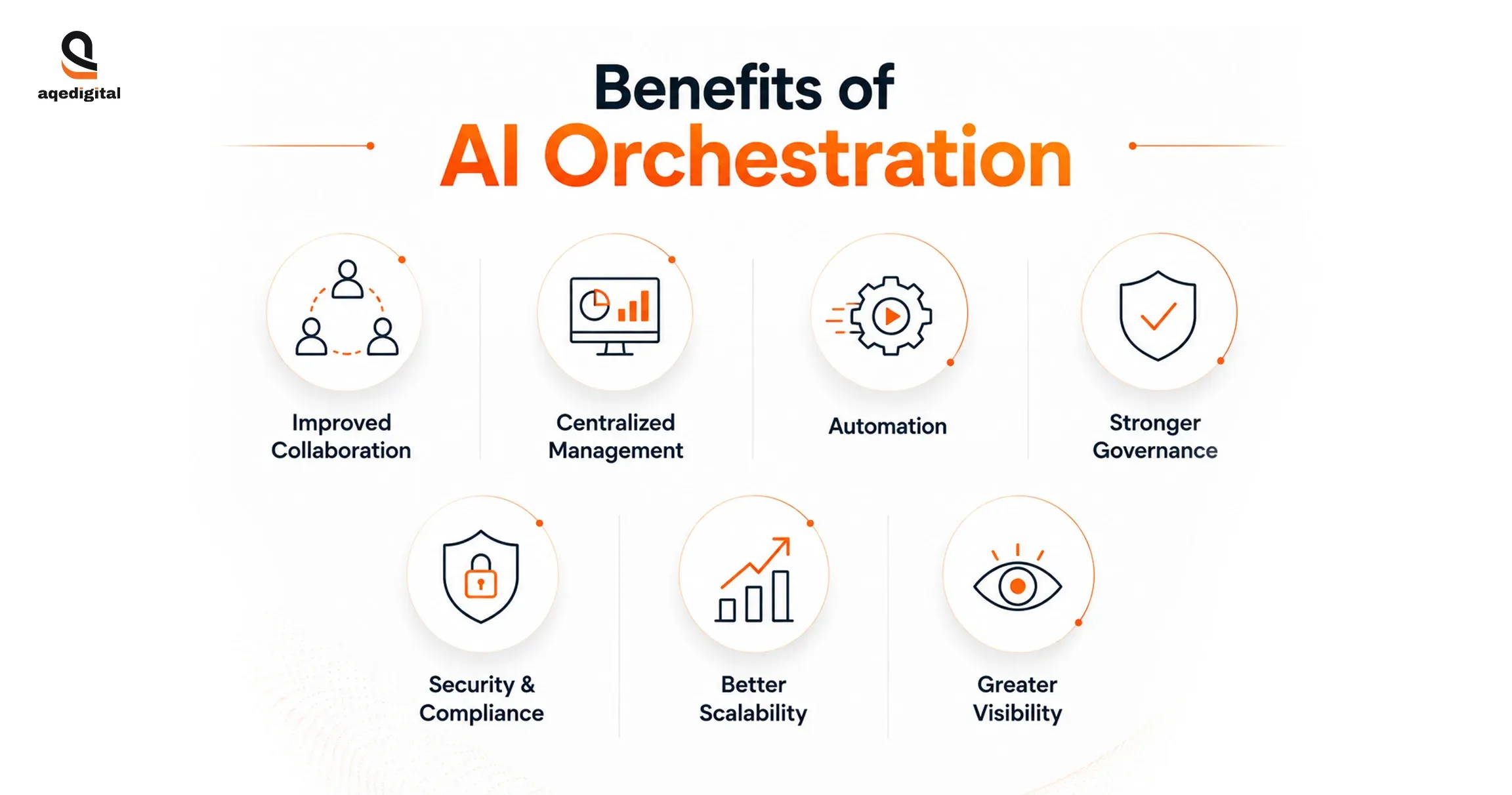
As organizations deploy AI across multiple business functions, managing isolated models and disconnected workflows becomes increasingly difficult. McKinsey estimates that generative AI could contribute $2.6–4.4 trillion in annual economic value, making efficient AI management increasingly important for businesses.
Improved Collaboration Between Multiple AI Agents
Modern enterprises rarely rely on a single AI model to complete complex business processes. Customer support, document processing, software development, and decision-making often require multiple AI agents to perform specialized tasks before producing a final outcome.
With AI agent orchestration, these agents can communicate, exchange context, and coordinate tasks automatically. Instead of operating independently, each AI agent contributes to a larger workflow, reducing redundant processing and improving the quality of business outcomes. This collaborative approach enables organizations to automate sophisticated workflows while maintaining consistency across every stage of execution.
Centralized Workflow Management Across Enterprise Systems
As AI adoption grows, organizations often deploy different AI services across departments, creating disconnected workflows that are difficult to monitor and maintain.
AI orchestration software provides a centralized control layer where businesses can manage AI models, APIs, enterprise applications, automation rules, and data pipelines from a single environment. When combined with comprehensive AI and Data solutions, organizations can improve data consistency while enabling intelligent automation across business functions.
Faster Automation with Reduced Manual Intervention
Many organizations still rely on employees to transfer information between AI applications, validate outputs, or manually trigger the next step in a business process.
AI orchestration eliminates these repetitive activities by automating task sequencing and data exchange between systems. Information flows automatically across AI models, enterprise applications, and business workflows, reducing operational delays while allowing employees to focus on higher-value responsibilities.
As automation becomes more intelligent, businesses can process larger workloads without proportionally increasing operational costs.
Stronger Governance, Security, and Compliance
As AI becomes part of business-critical operations, organizations need greater control over how AI models access data, make decisions, and interact with enterprise systems.
AI orchestration software enables centralized governance by enforcing authentication policies, managing permissions, monitoring workflow execution, and maintaining detailed audit logs. This structured approach helps organizations comply with regulatory requirements while reducing operational risks associated with unmanaged AI deployments.
Better Scalability for Enterprise AI Initiatives
AI projects often begin as isolated pilots before expanding across multiple departments and business functions. Without proper coordination, this growth can create fragmented architectures that become increasingly difficult to scale.
Organizations using AI agent orchestration tools can introduce new AI models, automate additional workflows, and integrate emerging technologies without redesigning their entire AI ecosystem. A modular orchestration layer allows businesses to scale AI capabilities while maintaining flexibility, operational consistency, and long-term architectural stability.

Greater Visibility into AI Performance and Business Outcomes
Managing multiple AI models without centralized monitoring makes it difficult to understand how individual workflows contribute to overall business performance.
AI orchestration platforms provide detailed insights into workflow execution, response times, resource utilization, model interactions, and operational bottlenecks. These analytics help organizations optimize AI performance, improve decision-making, and continuously refine automation strategies based on measurable business outcomes rather than isolated model performance.
Businesses investing in AI-ML development services often reach a stage where orchestrating multiple models, applications, and enterprise workflows becomes essential for achieving long-term scalability.
Do You Actually Need an AI Agent Orchestration Platform?
Not every business does. Here is a straightforward way to evaluate it.
Signs you likely need one:
- You are running more than two or three AI tools that need to share data with each other.
- Someone on your team is manually moving output between AI systems on a regular basis.
- You have tried building your own agents, but they fail silently and go unnoticed until a customer is affected.
- You need an audit trail of what each agent did and why, for compliance or quality checks.
- Your workflow has multiple decision points, not just a single task.
Signs you likely do not need one yet:
- You are using one AI tool for one clear, well-defined task.
- Your current automation setup, such as Zapier or Make, is handling the workload without issues.
- You do not yet have the internal team or budget to maintain something more complex.
A common mistake is adopting an AI agent orchestration platform before the workflow itself has been mapped out. That is usually where projects stall, not because the technology fails, but because there was no clear definition of what a finished, working system was supposed to look like.
Top AI Agent Orchestration Frameworks to Know
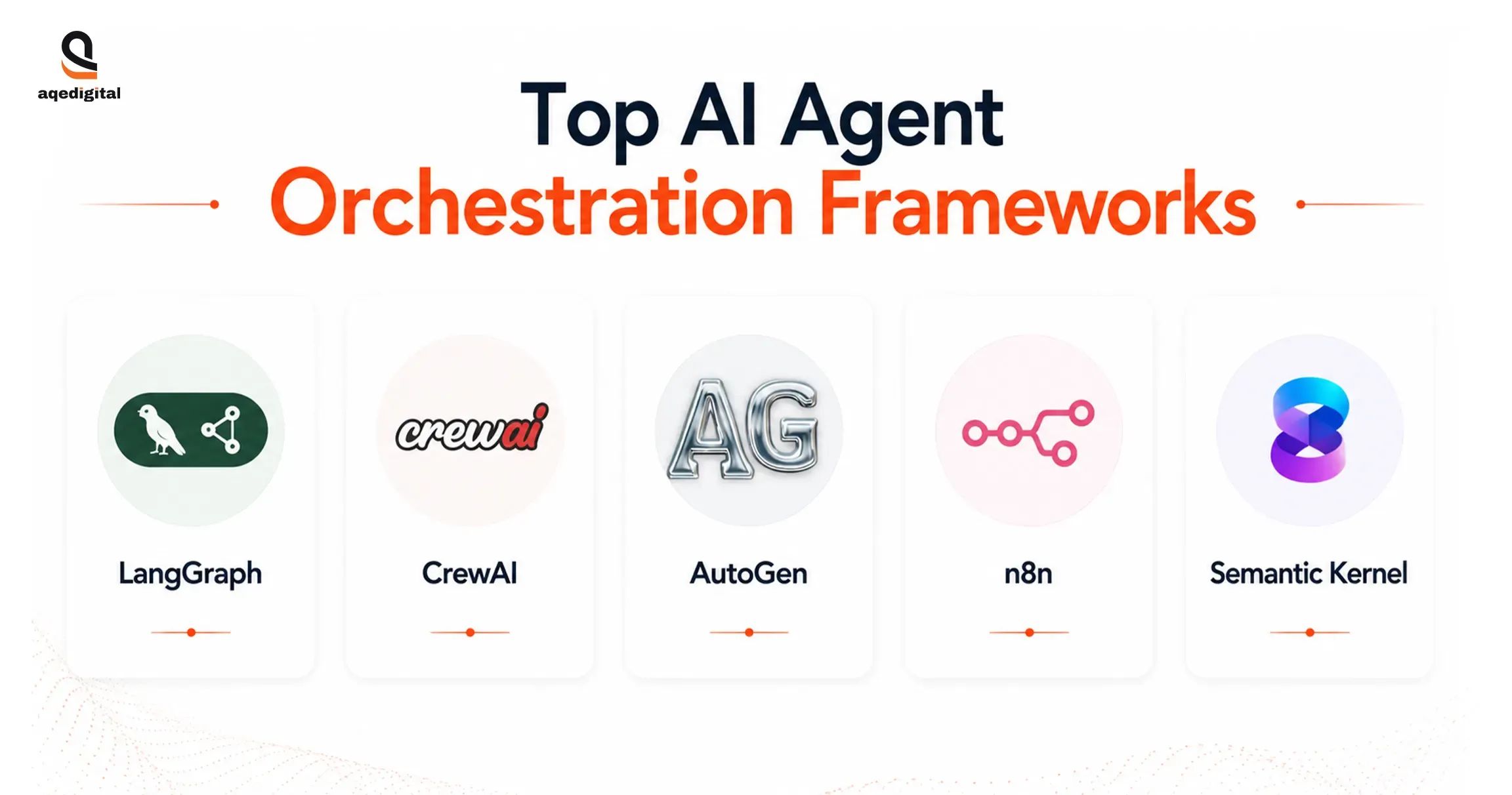
For teams building this in-house, these are the AI agent orchestration frameworks getting the most attention in 2026:
- LangGraph: Works well for teams already using LangChain. It treats a workflow as a graph, which makes it easier to manage agents that need to loop back, pause, or branch based on conditions.
- CrewAI: Built around the idea of roles. Agents are defined as researchers, writers, and reviewers, and CrewAI manages how work moves between them.
- AutoGen: Backed by Microsoft. Well suited to setups where agents need back-and-forth exchanges to solve a problem, rather than passing data in a single direction.
- n8n: A lower-code option that works as a middle ground for teams familiar with traditional automation but newer to agent-based workflows.
- Semantic Kernel: Built for teams already inside the Microsoft ecosystem, with easier integration into existing enterprise tools.
The right choice of framework depends on how a team already works, how much control is needed over agent behavior, and how comfortable developers are with custom logic versus pre-built templates.
Understanding AI Workload Orchestration
There is a layer beneath agents that many teams overlook: AI workload orchestration.
This is not about how agents make decisions. It is about the infrastructure underneath, making sure models have the computing power, memory, and scheduling required to run reliably and at a reasonable cost.
This typically includes:
- Compute scheduling: Assigning GPU or processing resources to the models that need them most, when they need them.
- Load balancing: Distributing requests across multiple models or servers so no single one becomes overwhelmed.
- Cost optimization: Using a smaller, less expensive model for simple tasks and reserving larger models for complex ones.
- Autoscaling: Automatically increasing or decreasing resources based on current demand.
Best AI Orchestration Software in 2026
A shortlist of AI orchestration software worth evaluating, depending on the use case:
| AI Agent Orchestration Tools | |
| Tool | Best For |
| LangGraph | Custom, code-first agent workflows |
| CrewAI | Role-based teams of agents |
| Orkes / Conductor | Enterprise-level workload orchestration |
| Zapier + AI Actions | Non-technical teams, simpler workflows |
| n8n | Mid-complexity workflows, self-hosted flexibility |
Should You Build or Buy Your AI Orchestration Tools?
For organizations embedding AI capabilities into customer-facing software, combining orchestration with experienced product engineering services helps ensure AI features are scalable, maintainable, and aligned with broader product architecture.
Building an orchestration system in-house is appealing on paper. Full control, no dependence on a vendor. But it typically requires:
- Engineers who understand both AI models and distributed systems are a fairly rare combination.
- Ongoing maintenance, since these frameworks update frequently, sometimes in ways that break existing setups.
- Time, realistically three to six months before seeing a real return on the investment.
For many businesses, particularly smaller ones, that investment does not make practical sense.
This is exactly why AI agents, orchestration tools, and managed implementation services exist. Instead of hiring a full team and spending months learning through trial and error, a working system can be in place within weeks, built by people who have already encountered the failure points that have not yet been discovered internally.
Conclusion
As AI ecosystems become more dynamic, organizations that prioritize flexibility, governance, and interoperability today will be better positioned to adapt to tomorrow's innovations without repeatedly rebuilding their technology stack.
At AQe Digital, we help organizations design and implement scalable AI orchestration solutions that integrate seamlessly with existing enterprise systems while supporting future growth. Our expertise combines strategic consulting with practical implementation to deliver AI ecosystems that are reliable, secure, and business-focused.
Contact us to explore the right AI orchestration strategy for your organization and to build an AI ecosystem that scales with your business.