AI in Investment Banking: Use Cases, Benefits, and Roadmap to Implement It

Priyanka Wadhwani
99% of banks are experimenting with AI. Only 3% have embedded it enterprise-wide. Investment banking firms are leveraging AI to transform operational automation. Using AI, investment banks and companies can fast-track their due diligence process. AI can help analyze data across thousands of contracts, calculate EBITDA, and IRR.
Such benefits have attracted many global investment banks to shift to AI. In fact, Deloitte projects that the top 14 global investment banks can lift front-office productivity by 27% to 35%. However, knowing the right use cases is important for any investment bank and firm. Because using AI in investment banking requires enormous capital.
This piece focuses on what AI in investment banking actually means, what its use cases are, and a roadmap for implementing it.
What AI in Investment Banking Actually Means in 2026
Investment banking artificial intelligence stopped being a pilot category eighteen months ago. Capital markets firms lead all of financial services at 68% AI adoption, and 86% of corporate and private equity leaders already run generative AI in deal workflows. JPMorgan put $20 billion of its $105 billion 2026 technology budget into AI infrastructure alone.
Investment banking's AI story isn't chatbots anymore. It's Agentic AI and systems that reason through multi-step workflows and execute entire tasks inside human guardrails. Sell-side teams now compile CIMs and pitchbooks fast. VDR agents validate diligence lists against room contents, cross-reference contracts, and draft cited Q&A responses for buyers.
Wealth management shifted too. Advisors use AI to sit in on client calls, extract action items, and draft follow-ups automatically. But the sharper story sits underneath: opacity, not accuracy, is now the binding constraint. A model a Chief Compliance Officer can't explain is legally dead on arrival.
Where AI Actually Pays Across the Investment Banking Value Chain
AI's ROI curve isn't flat across banking. It's steepest wherever generation is hard but verification is easy, and nowhere is that gap wider than document-heavy front-office work.
Pitchbook drafting proves the point. JPMorgan's LLM Suite built a five-page CEO-ready deck in roughly 30 seconds, work that used to eat analyst nights, per CNBC. VDR diligence runs the same logic: agents read thousands of contract pages, flag DRL gaps against the request list, and draft cited Q&A answers before a human opens the file.
Middle-office compliance shows it too. Citigroup used generative AI to parse, segment, and summarize 1,089 pages of new Basel III capital rules, compressing weeks of legal review into hours, per Bloomberg. That's not automation replacing judgment. It's automation clearing the reading list so judgment moves faster.
The pattern holds wherever output is heavy and validation stays cheap.
The Quantified Benefits Of AI in Investment Banking Actually Returns
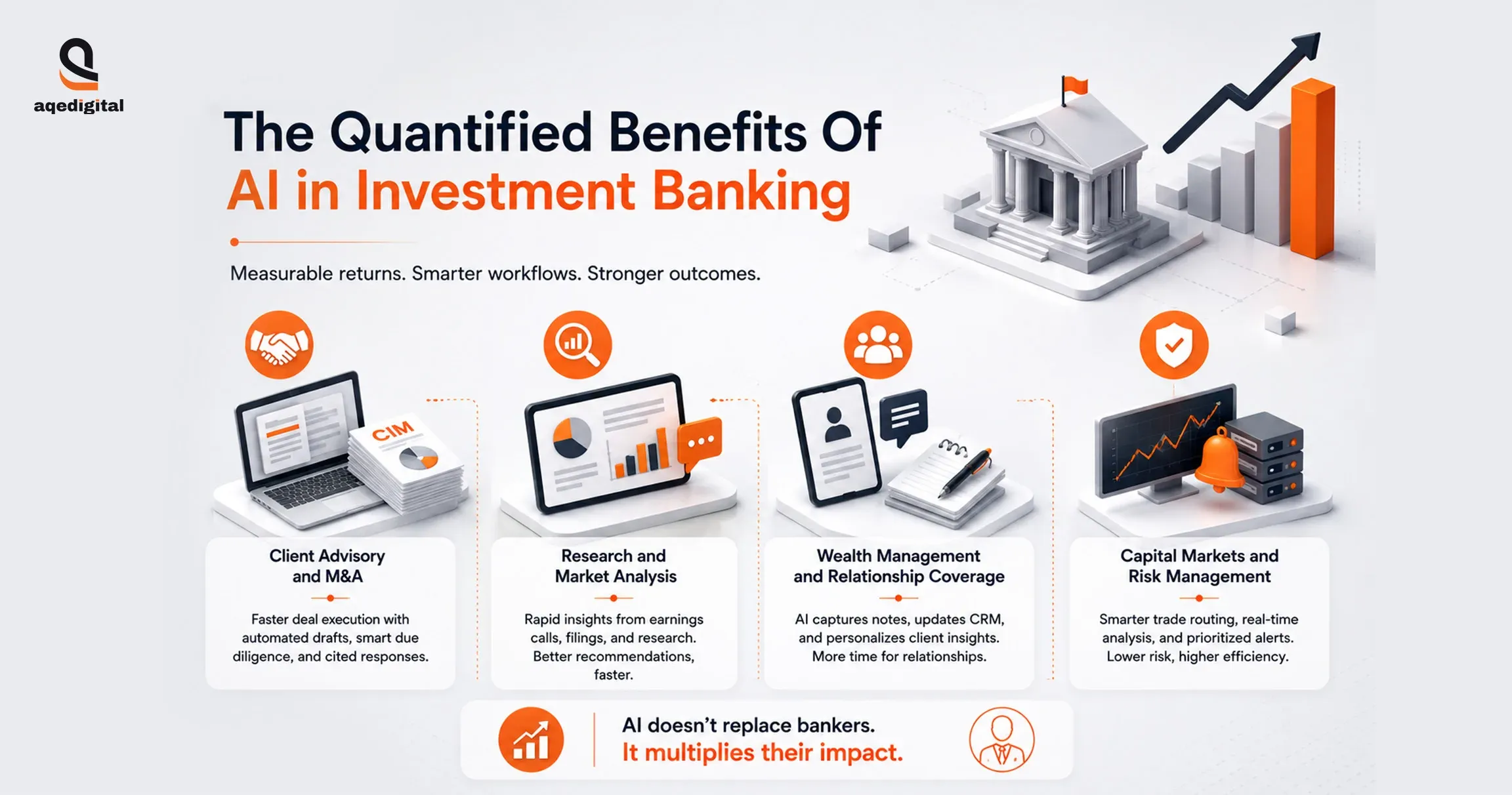
Investment banks are generating measurable returns from AI by turning labor-intensive, qualitative work into faster, automated workflows. Rather than replacing bankers, AI boosts productivity by shifting time from repetitive tasks to strategic advisory and client relationship management.
1. Client Advisory and M&A
AI accelerates deal execution by automating first drafts of marketing materials, Confidential Information Memorandums (CIMs), and comparable company analyses using data extracted from unstructured documents. Within virtual data rooms, it speeds due diligence by reviewing contracts, validating request lists, and drafting cited responses to buyer queries.
2. Research and Market Analysis
AI rapidly synthesizes earnings calls, regulatory filings, and research libraries, helping analysts identify management insights and market sentiment in minutes. This significantly reduces research time and enables faster, more informed investment recommendations.
3. Wealth Management and Relationship Coverage
AI assistants capture meeting notes, update CRM records, and generate personalized client summaries. By reducing administrative work, they allow wealth managers and relationship advisors to serve more clients while maintaining a high level of personalization.
4. Capital Markets and Risk Management
Machine learning optimizes trade routing, analyzes real-time market activity, and prioritizes compliance alerts. By reducing false positives and identifying risks earlier, AI improves operational efficiency while leaving critical strategic decisions to human professionals.
AI in Investment Banking: Key Use Cases
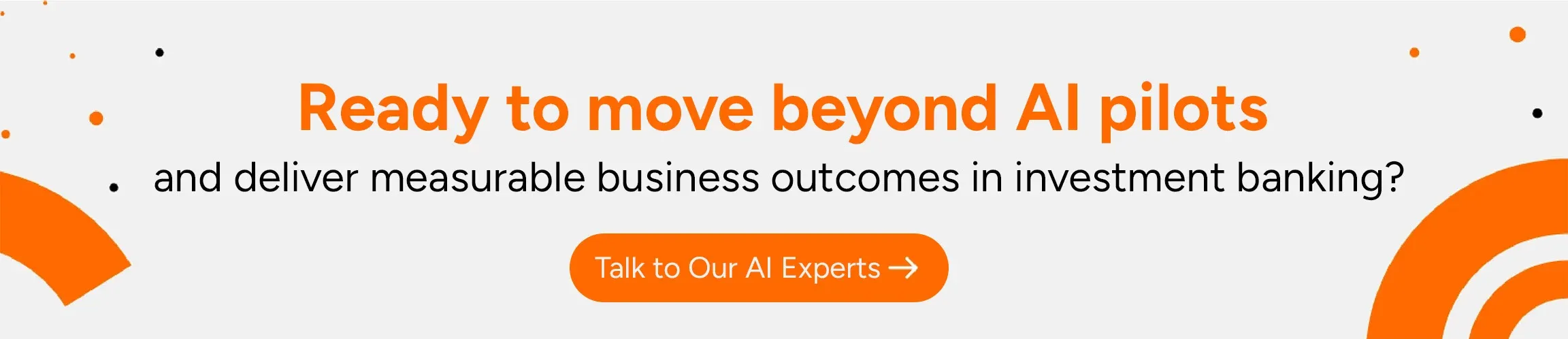
Here are some key use cases of using AI in investment banking operations.
Front-Office and Deal-Making Workflows
Artificial intelligence is transforming front-office operations by automating time-intensive tasks across the deal lifecycle. AI can generate first drafts of pitchbooks, teasers, and Confidential Information Memorandums (CIMs) by extracting financial data from unstructured documents, allowing bankers to focus on deal strategy and client engagement.
AI also accelerates due diligence by reviewing contracts, validating diligence request lists, identifying inconsistencies, and drafting source-backed responses within virtual data rooms. In valuation, it automates comparable company analysis, precedent transaction research, and financial model preparation using data gathered from multiple sources.
Research and Market Analysis
AI helps investment banking teams analyze earnings calls, regulatory filings, research reports, and market data in minutes instead of hours. Analysts can quickly identify trends, summarize key insights, and prepare client-ready research, enabling faster decision-making and more informed investment recommendations.
Client Relationship Management and Wealth Advisory
AI enhances client coverage by automating meeting documentation, generating summaries, updating CRM systems, and preparing follow-up communications. It also supports personalized investment strategies by analyzing market themes and helping advisors create customized recommendations based on client preferences and market opportunities.
Capital Markets and Trading
In trading operations, AI improves execution by optimizing order routing, analyzing market conditions, and supporting hedging strategies. Machine learning models process market data in real time to improve trade execution, manage liquidity, and reduce transaction risk while assisting traders in making better-informed decisions.
Middle and Back-Office Operations
AI streamlines compliance, regulatory monitoring, and operational processes by analyzing complex regulations, summarizing policy updates, and highlighting potential compliance risks. It also assists with legacy system modernization by translating older codebases into modern architectures and generating technical documentation.
For document-heavy operations, intelligent document processing automates the classification, validation, and routing of forms, onboarding documents, and financial records. This reduces manual effort, improves processing accuracy, and increases operational efficiency across the banking value chain.
AI for Compliance in Banking: SR 26-2, DORA, the EU AI Act and FINRA Rule 3110
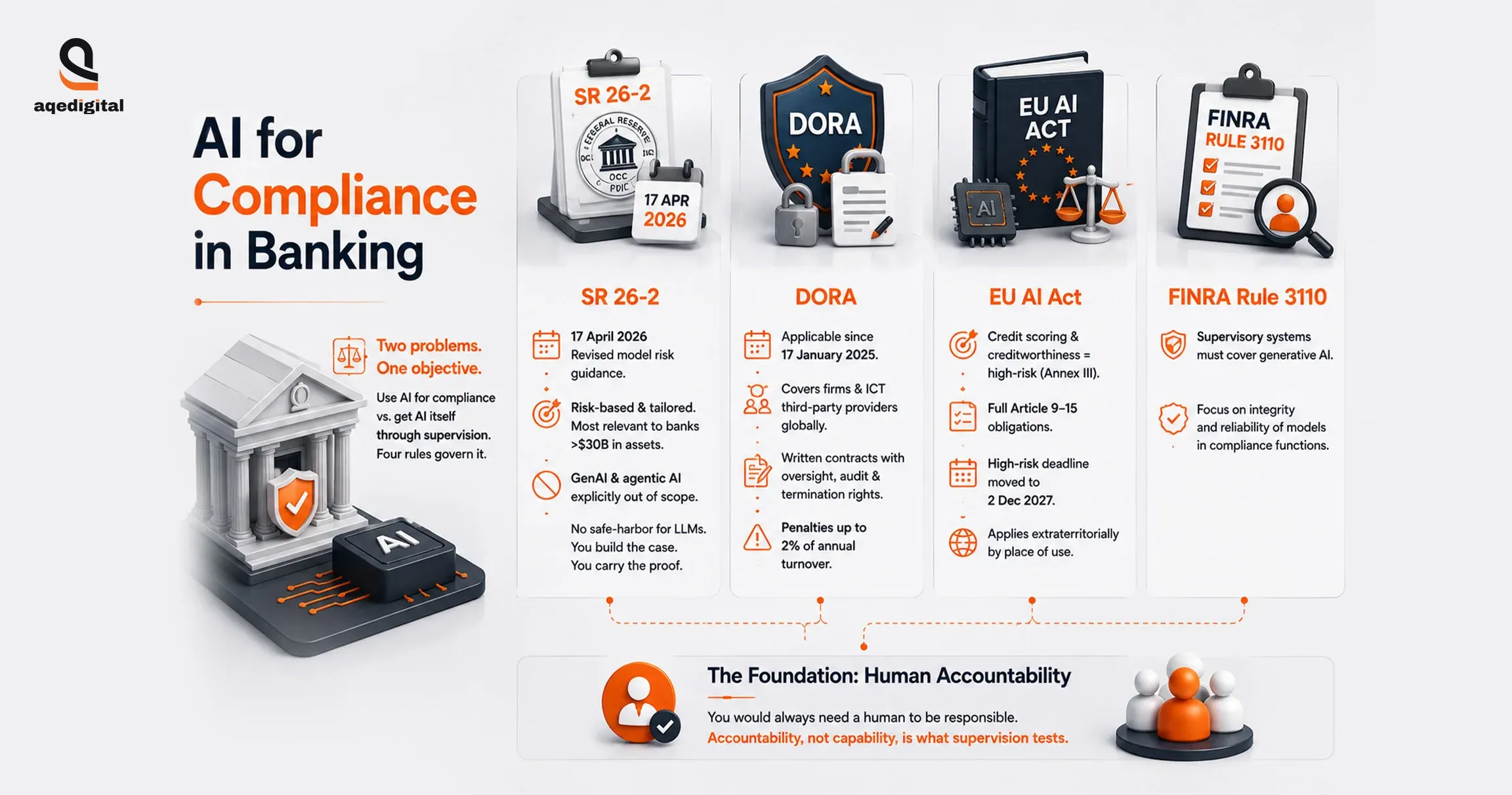
AI for compliance in banking is two separate problems that get discussed as one. Using AI to do compliance work is the easy half. Getting the AI itself through supervision is the half that stops programs, and four instruments now govern it.
1. SR 26-2.
On 17 April 2026, the Federal Reserve, OCC, and FDIC issued revised model risk management guidance superseding SR 11-7, which had stood since 2011. It is risk-based and tailored, and scoped as most relevant to banks above $30 billion in assets. The consequential part is what it leaves out.
Generative and agentic AI are explicitly out of scope, and banks are expected to govern them under existing risk practices while the agencies prepare a request for information. There is no safe-harbor validation path for an LLM right now, so you construct the governance case, defend it to your regulator, and carry the burden of proof yourself.
2. DORA.
Fully applicable since 17 January 2025, DORA covers banks, investment firms and their ICT third-party providers regardless of where the provider is headquartered. It mandates written contracts carrying oversight, audit and termination rights, with penalties reaching 2% of annual turnover for critical providers.
Every AI vendor in your stack is an ICT third party. If your procurement team signed a standard SaaS agreement for an LLM in 2024, that contract is the first thing to reopen.
3. EU AI Act.
Annex III classifies creditworthiness and credit scoring of natural persons as high-risk, alongside pricing in life and health insurance, which triggers the full Article 9 to 15 obligation set for anyone building in either domain, including firms delivering Insurance Software Development Services into EU markets.
The Digital Omnibus approved in June 2026 moved the high-risk deadline from 2 August 2026 to 2 December 2027, pending Official Journal publication. That is breathing room, not a reprieve, and the Act applies extraterritorially by place of use.
4. FINRA Rule 3110.
FINRA requires supervisory systems reasonably designed to cover generative AI, with weight on the integrity and reliability of any model used in a compliance function.
Underneath all four sits one design rule a credit risk sanctioner put better than any framework document: you would always need a human to be responsible. Accountability, not capability, is what supervision actually tests.
AI Tools for Investment Banking: What Is Actually in Production
Buying is the default in this layer, and cost is not the reason. These categories consolidated before most banks finished writing their requirements. Ranking AI tools for investment banking against each other is the wrong exercise, because they sit in different parts of the chain.
| Investment Banking AI Tools Landscape | |||
|---|---|---|---|
| Tool | What it does | Where it fits in the value chain | Notable adoption |
| AlphaSense | Search over filings, transcripts, expert calls and broker research | Origination, research | 7,000+ enterprises, 90% of top investment banks |
| Rogo | Agentic finance work inside Excel, PowerPoint and the firm's warehouse | Production, valuation | 35,000+ professionals at 250+ institutions, Rothschild, Jefferies and Lazard among them |
| Hebbia Matrix | Reasoning over unstructured document sets, VDRs and CIMs, plus FlashDocs for slides | Diligence, production | Banks, private equity and credit funds. No published roster |
| Intapp DealCloud | Deal CRM with AI for data hygiene, warm introductions and pipeline forecasting | Origination | 2,650+ firms including Raymond James and Alvarez & Marsal |
| Daloopa | Deterministic extraction of fundamentals with auto-updating model links | Valuation, modeling | 6,000+ public companies, 14 years of history |
| FactSet Pitch Creator | Pitchbook slides built from FactSet data into bank-branded templates | Production | Teams where FactSet is already the data layer |
| Nasdaq Verafin | AML and fraud detection run by agentic digital workers | Surveillance | 2,700+ institutions holding $11 trillion in assets |
| Nasdaq SMARTS | Trade surveillance and market abuse detection with embedded AI | Surveillance | Exchanges, brokers and banks |
| Quantexa | Entity resolution and graph analytics for AML, KYC and fraud | Surveillance, onboarding | HSBC since 2017, Standard Chartered |
| Silent Eight | AI adjudication of sanctions and AML alerts | Surveillance | Tier-1 banks |
Now the objection is that this category will not print in its own material. Models hallucinate historical financials in ways nobody catches by scanning, with line items off while the subtotals still tie, so auditing cell by cell can cost more than typing the numbers would have. Read that as a scoping instruction, not a reason to stay out. Buy the retrieval. Put deterministic extraction underneath anything feeding a live model.
What decides procurement here is contractual rather than functional. Every tool above is an ICT third-party provider under DORA, so oversight, audit and termination rights settle more outcomes than any feature comparison. Choosing the tool is a fortnight of work. Wiring it into your entitlements model, your data lineage and your supervisory evidence is the line item that runs over.
A 4-Phase Roadmap to Implement AI in Investment Banking
Zero of the eight pages ranking for this query publish a sequence with timelines. Here is one, built backward from the 95% failure rate rather than forwards from a use-case list.
| AI Implementation Roadmap | ||
|---|---|---|
| Phase | Duration | What happens |
| 1. Strategy and use-case prioritization | 4 to 8 weeks | Pain points mapped across the chain, ranked by value, complexity and risk, until three workflows carry a named business owner |
| 2. Operating model, data strategy and build vs buy | 8 to 12 weeks | Data quality and lineage assessed, build vs buy settled |
| 3. Scoped pilot with measurable KPIs | 6 to 12 weeks | Deployment into two or three teams against hard numbers: time per document, alert review workload, onboarding cycle time |
| 4. Governance, scale and continuous improvement | Ongoing | Model inventory, supervisory evidence, retraining cadence, expansion into adjacent workflows |

Build vs Buy: How to Decide
The answer is rarely uniform across a bank. Run each workflow through the matrix rather than settling it once at platform level, because the right call for a research assistant is the wrong call for the deal file.
| Build vs Buy Decision Matrix | |||
|---|---|---|---|
| Dimension | Build | Buy | Which wins when |
| Proprietary deal context | Model sees your deal history, coverage notes and CRM | Vendor sees public corpora plus whatever you upload | Build, wherever the answer depends on context only your firm holds |
| DORA third-party obligations | Burden stays internal | Written contracts with oversight, audit and termination rights | Build on paper. Buy once you price the internal run team honestly |
| Time to first value | Quarters, longer if the data work is still open | Weeks in settled categories | Buy, and it is not close |
| Model risk defensibility | You construct the governance case and defend it | You inherit vendor documentation, then defend it anyway | Neither. SR 26-2 leaves generative AI out of scope, so the burden is yours either way |
| Total cost over three years | Platform, infrastructure and recalibration, repeated annually in a regulated firm | Subscription plus integration, until renewal reprices against your usage | Buy through year two. The gap closes in year three at scale |
Getting AI in Investment Banking Past the Pilot Stage
The use-case list is commodity. Your team assembled its own version months ago. What separates the 3% of banks embedded enterprise-wide from the 95% whose pilots return no measurable P&L impact has nothing to do with model choice. It is whether the data estate was fixed first, whether the governance case was constructed rather than inherited, and whether anyone named a KPI before the pilot started.
Two numbers bracket this piece. Front-office productivity upside of 27% to 35% on one side, a 95% pilot failure rate on the other. AI in investment banking stopped being a capability question somewhere around 2024. It is a sequencing question now, and the sequence runs data estate, governance case, KPI, then model.
AQe Digital works on that part. Our AI and Data Solutions team fixes the estate first, and AI ML Development Services builds and validates the model against a number your CFO can audit. If you are comparing AI tools for investment banking without a clear answer on data lineage or your DORA vendor position, that comparison is premature. Bring us the pilot that stalled, and we will tell you which phase it failed in.