AI Consulting Services: How to Choose the Right Partner for Enterprise AI Transformation

Jigar Mistry
What enterprises are missing right now when integrating AI-based technologies is the right execution approach. And this is why only 22% of organizations have been successful in implementing AI in their systems. But which execution path is right, and who can guide enterprises?
This is where AI consulting services help enterprises accelerate the adoption, build the right architecture, and modernize legacy systems. It becomes especially important as more and more organizations are spending anywhere between $30-$40 billion in AI implementation only to see 95% of them fail before reaching the production stage.
So, what can enterprises do to avoid this failure rate?
Taking cues from the organizations that are winning the AI race, organizations need to focus on the architecture rather than just spending on LLM APIs. Especially finding a partner that can restructure their data foundations and operating model is important.
This article provides a definitive buyer's framework for enterprise AI transformation. It breaks down what the category actually contains, the four partner archetypes and their real rate bands, eight objective scoring criteria to evaluate delivery capability, the critical red flags to watch for, and the exact sequence to run before signing any statement of work.
Why Choosing an AI Consulting Partner is More Important Now?
AI supply is at an all-time high. What this means is there are many LLM providers, and enterprises are often confused about which is the right one for their projects. One LLM is great at coding while others excel at content generation. This fragmentation leads to enterprises spending more on evaluating, running pilots, and understanding the use cases.
The best approach here is to find an AI consulting agency that can help understand key use cases where implementing AI makes sense. Then again, you also have many different AI consulting companies, and choosing the right partner becomes crucial. Especially when the AI consulting services market is growing at a CAGR of 25.6% and is expected to reach $73.89 in revenue by 2034.
But before you look for criteria to compare different AI consulting services, it’s important to understand what you will get from such a service.
What AI Consulting Services Actually Include?
Enterprise AI consulting goes far beyond writing prompts or just selecting LLMs. An AI consulting service offers your enterprise digital strategy, application development, analytics consulting, and cognitive integrations.
| What AI Consulting Services Actually Include? | |
|---|---|
| Service Line | What a Credible Deliverable Looks Like |
| AI Strategy and Use-Case Prioritization | A ranked backlog of enterprise use cases mapped against business value, technical feasibility, and speed-to-market, complete with explicit executive sponsorship and defined financial KPIs. |
| Data Readiness and Data Engineering | A comprehensive data audit, active metadata workflows, cleansed ingestion pipelines, and a NIST-aligned data readiness score ensuring models train on valid inputs. |
| Model Development and MLOps | A deployed production model or RAG pipeline equipped with automated regression suites, drift detection monitoring, version control, and fallback routing. |
| AI Governance and Compliance | A compliance mapping matrix aligned with the EU AI Act, ISO/IEC 42001, and NIST AI RMF, including access controls, bias audits, and immutable audit logs. |
| Change Management and Enablement | A structured workforce enablement plan, role-based training modules, workflow redesign documentation, and adoption tracking dashboards. |
AI Strategy and Use-Case Prioritization
AI consulting companies help you figure out which use cases to prioritize. This includes assessing existing operations and determining what functions will best benefit from AI implementations. Plus, they also help you with data on whether a specific implementation is economically viable, and how to save more with the right approach matching your financial goals.
Data Readiness and Data Engineering
Your data is not ready, and the model cannot fix that. What this means is you audit what actually exists, correct the errors, and retire what expired. Then again, no tooling does this cleanup for you.
Model Development and MLOps
Building the model is the short part. Keeping it correct for eighteen months is the work. So instrument it, alarm on drift, and rehearse the fallback before launch. Then again, monitoring assembled from four overlapping tools is how drift goes unnoticed.
AI Governance and Compliance
Governance gets treated as documentation. It is exposure. What this means is four controls ship as behavior, not policy: access control, privacy boundaries, scheduled bias testing, and an immutable audit log. Then again, these slow the build. The trade: a slower launch against a defensible one.
Change Management and Enablement
A deployed tool and an adopted one are not the same thing. So you run role-specific training, rewrite your process docs, and track completed work instead of logins. Then again, training on a workflow that is still changing teaches a version that expires.
4 Types of AI Consulting Partners Your Enterprise Needs to Partner With
Knowing which services you need is only half the decision. The other half is which type of partner delivers them, and that is where budgets actually leak. Pay strategy rates for routine coding, and you burn capital on brand. Hand company-wide governance to an offshore development shop and it fails, because you asked a build team to make judgment calls it was never structured to make.
So the axis is not price per hour. It is a match between the problem's shape and the partner's structure.
Four partner archetypes, their real rate bands, and the problem each one is actually built for.
| 4 Types of AI Consulting Partners Your Enterprise Needs to Partner With | |||
|---|---|---|---|
| Partner Type | Typical Rate Band | Best Fit | Structural Weakness |
| MBB & Strategy Firms (McKinsey, BCG, Bain) | $500–$1,000+/hr (AIDOLS Research 2026) | Board-level strategy, executive buy-in, business model reinvention | Most expensive tier. Senior partners pitch, junior staff run the day-to-day |
| Big 4 & Global Systems Integrators (Deloitte, Accenture, PwC) | $400–$800/hr (blended team $480–$580/hr, Alice Labs 2026) | Large rollouts that must connect into SAP, Oracle, and other legacy estates | Slow to adapt, heavy management layers, high blended cost |
| Specialist AI Boutiques | $200–$500/hr (AIDOLS Research 2026) | Fast prototypes, custom builds, direct access to senior specialists | Small teams. Cannot field hundreds of engineers across countries at once |
| Nearshore & Offshore Delivery Partners | $60–$170/hr (Alice Labs 2026) | Defined coding, testing, and data-cleaning work on a budget | Built to execute, not to define. Cannot rescue a poorly framed problem |
Knowing the archetype tells you what a firm charges. It does not tell you whether they ship. Every AI consulting agency in every tier will show you a polished pitch, so the archetype filter gets you to a shortlist and no further.
So the axis moves again. Not who they are, but how they execute.
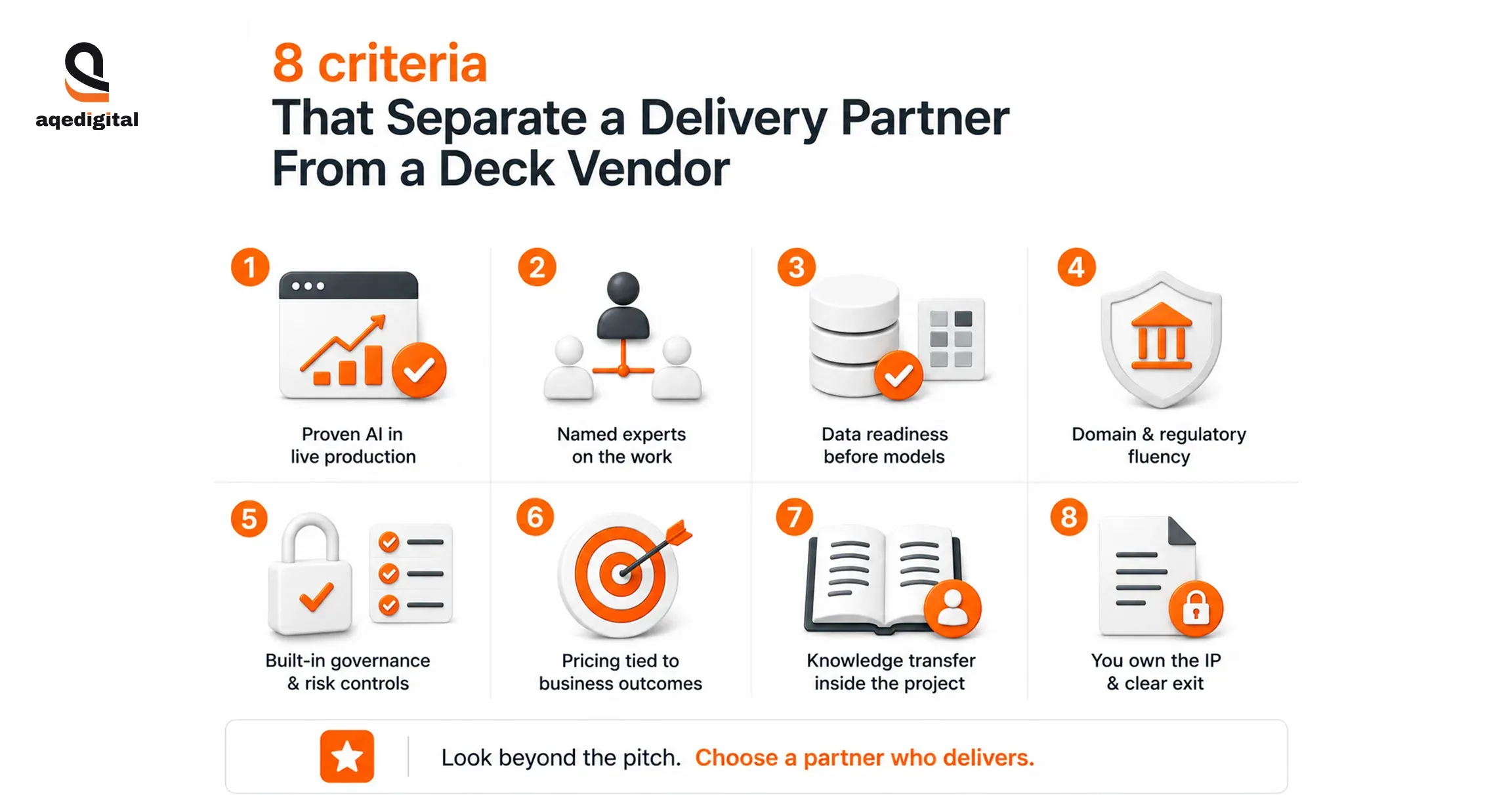
What separates a partner who puts working software into production from a vendor who hands you a strategy deck comes down to eight delivery criteria you can score before signing.
8 Criteria That Separate a Delivery Partner From a Deck Vendor
Here are some of the key criteria to choose the best partner for AI implementations.
1. Production evidence, not demo evidence
MIT's Project NANDA found that 60% of organizations evaluated custom enterprise AI tools, 20% reached pilot, and only 5% reached production. The same study found pilots built through vendor partnerships reached full deployment at 66%, against 33% for internal builds, roughly twice as likely to succeed.
What this means is buying artificial intelligence consulting services improves your odds, but only if the firm has crossed that line before. Demos are cheap to stage. Sustained live operation is not.
- What to ask: "Can you show me an AI system you built that has been running in live production with real users for at least six months?"
- What a good answer sounds like: A specific case study with the deployment timeline, user adoption metrics, and how they handled system failures or model drift in a live environment.
- What a bad answer sounds like: A lab prototype, a tightly controlled beta, or a system that has not launched yet.
2. Who actually staffs the engagement
The most common grievance in enterprise consulting is the bait-and-switch. Senior partners sell the vision, junior associates execute the daily work.
But complex AI integration needs experienced hands writing code and structuring data, not managing a status spreadsheet. The names on the pitch deck and the names on the commits should overlap.
- What to ask: "Who are the exact, named individuals assigned to our project, and what is the ratio of senior architects to junior developers?"
- What a good answer sounds like: A roster of named engineers and data scientists, confirmed availability, and a guarantee the senior experts stay hands-on through the sprint.
- What a bad answer sounds like: Vague assurances about "access to our global talent pool," or refusing to name team members in the contract.
3. Data engineering depth before model talk
Your system is only as reliable as the data feeding it. Gartner reports 63% of organizations either lack or are unsure they have the right data management practices for AI, and predicts 60% of AI projects unsupported by AI-ready data will be abandoned through 2026. Cloudera and Harvard Business Review Analytic Services found only 7% of enterprises call their data completely ready for AI, with 56% naming siloed data as their top obstacle.
So any AI consulting company that opens with a model recommendation is answering a question you have not reached yet.
- What to ask: "How do you evaluate our data readiness before we decide which AI model to use?"
- What a good answer sounds like: A mandatory data audit phase checking missing values, silos, and security permissions before any coding begins.
- What a bad answer sounds like: Recommending a foundational model or platform before looking at how your data is actually stored.
4. Domain and regulatory fluency in your vertical
Generic models break on contact with healthcare, finance, and defense. The failure is rarely technical. It is that the model does not know what your industry means by a word.
Especially understanding your workflows, your terminology, and the compliance standards governing your sector separates real AI technology consulting from a generic build shop.
- What to ask: "How do you adapt an AI system to comply with our industry's specific regulatory and workflow constraints?"
- What a good answer sounds like: Direct experience with frameworks like HIPAA or SOC 2, and a clear explanation of how they design data filters so sensitive information never leaks into public models.
- What a bad answer sounds like: Claiming the solution is inherently secure out of the box, without asking what you are obligated to comply with.
5. Governance and risk controls as a deliverable
Risk arrives with the system, not after it. McKinsey's State of AI Trust 2026 found nearly two-thirds of respondents cite security and risk concerns as the top barrier to fully scaling agentic AI, and 74% identify inaccuracy as a highly relevant risk.
What this means is guardrails are architecture, not policy documents written in the final week.
- What to ask: "What specific guardrails do you build in to prevent hallucinations, secure data access, and allow human overrides?"
- What a good answer sounds like: Automated regression testing, prompt filtering, and alignment with the NIST AI Risk Management Framework or the EU AI Act, built into the software itself.
- What a bad answer sounds like: Suggesting your internal IT or legal team handles risk right before go-live.
6. Commercial model tied to outcomes, not artifacts
Gartner found that organizations with successful AI initiatives invest up to four times more of their revenue in data and analytics foundations, while only 39% of technology leaders are confident their current AI investments will positively impact financial performance.
So the question is not what the AI consulting service delivers. It is what the contract pays for.
Then again, outcome-based pricing narrows your vendor pool. Fewer firms will sign it, and the ones that do will negotiate harder on scope. That is a fair trade for shared exposure.
- What to ask: "Is your pricing tied to a working business outcome, or to delivering documents and code?"
- What a good answer sounds like: Final milestone payments tied to measurable business metrics such as reduced cycle times or higher accuracy rates, not project completion.
- What a bad answer sounds like: A proposal built on billable hours or a strategy report, with no commitment to what the system produces.
7. Knowledge transfer and the dependency test
A consultant should build your capability, not your dependency. And the difference shows up in the timeline, because handover written into the schedule survives, while handover promised for later does not.
- What to ask: "How would you review what we have already built, and how do you ensure our team can run this system without you?"
- What a good answer sounds like: Documented training sprints and code-handoff sessions scheduled inside the project timeline, not after it.
- What a bad answer sounds like: Offering to manage the system indefinitely on a high monthly retainer, with no transition plan for your staff.
8. IP ownership and the exit clause
Custom AI tangles ownership fast. The model, the training data, the fine-tuning artifacts, and the prompts can each end up under a different clause.
But before you sign with any provider of AI consulting services, it is worth knowing what you legally walk away with.
- What to ask: "Who owns the models, the fine-tuning artifacts, the prompts, and the data pipelines when the engagement ends?"
- What a good answer sounds like: A contractual guarantee that you retain full ownership of all custom code, tuned weights, and data, with a defined offboarding process.
- What a bad answer sounds like: Vague terms letting the vendor reuse your custom logic for other clients, or refusing to hand over the model architecture on exit.
Good criteria still get beaten by a good sales team. A vendor who cannot deliver knows exactly which words make a buyer relax, and most of those words cost nothing to say. So the last filter is not what a firm claims. It is what its proposal quietly avoids.
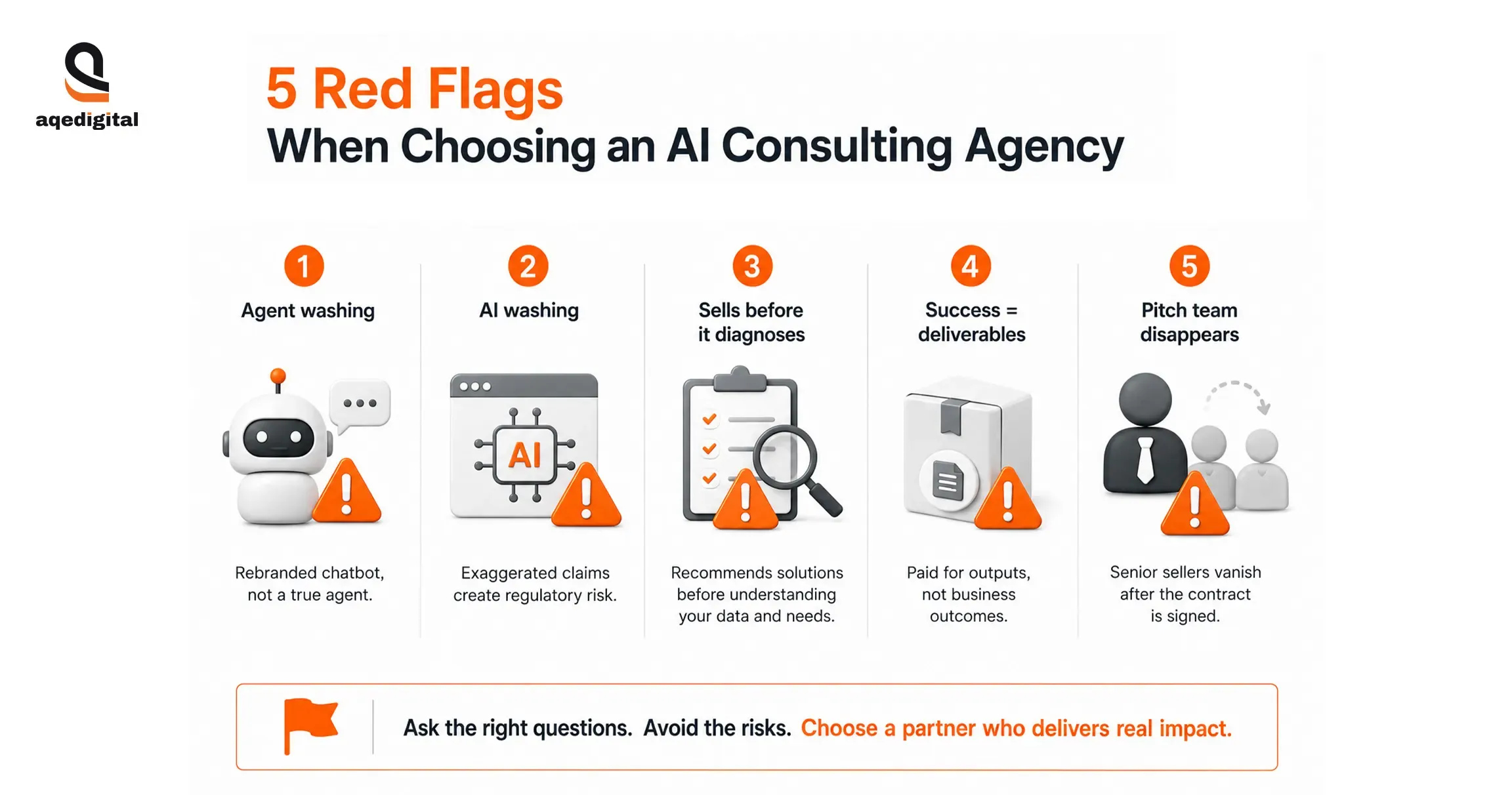
What are the red Flags While Selecting an AI Consulting Agency?
Before evaluating what a vendor promises to build, enterprise buyers must screen for the warning signs that separate genuine engineering partners from firms selling slideware, marketing hype, or regulatory liability.
Agent washing
Agent washing is when a vendor takes an ordinary chatbot or a simple automation script and sells it as an autonomous agent.
What this means is the label changed, and the software did not. A real agent plans a multi-step goal, carries it out, and corrects itself when a step fails. A rebranded chatbot answers one prompt at a time and waits for you.
Then again, in a demo the two look almost identical, because a scripted path hides the difference. You only see it when the process goes off-script.
- The question that exposes it: "Can you show me this system planning a goal, executing several steps, and self-correcting without a human prompting each stage?"
AI washing and the regulatory exposure it creates for you
AI washing is a firm overstating how much of the technology is genuinely theirs. Sometimes the model is a third-party product with a new name on it.
But the risk does not stay with the vendor. If you repeat their claim in your investor updates, your marketing, or your compliance filings, you are the one making the statement. Regulators treat exaggerated AI claims as misrepresentation, and the liability lands on whoever published it.
So verification is not paperwork. It is protection.
- The question that exposes it: "What independent, third-party verification can you provide for these AI claims before we reference this technology in our own disclosures?"
A proposal that sells before it diagnoses
This one is easy to spot once you know the shape. The firm names the model, the platform, and the tooling before anyone has looked at your workflows or your data.
What this means is they are not solving your problem. They are placing their standard solution and hoping the fit is close enough.
A real AI consulting company investigates first, because the constraints that decide the design are inside your systems, not inside their catalog.
- The question that exposes it: "What do you need to learn about our data, our users, and our existing systems before you finalize this recommendation?"
Success defined as deliverables rather than outcomes
Watch how the proposal defines done. "We will build three predictive models" is a description of effort. "We will cut cycle time" is a description of value.
And the difference decides who carries the risk. Deliverable-based success means the vendor gets paid whether or not the business improves, so every incentive points at shipping artifacts rather than moving numbers.
Then again, outcome-linked contracts take longer to negotiate. Fewer firms will sign one, and the scope conversation gets sharper. That friction is the point.
- The question that exposes it: "Which operational business metrics, not model accuracy, will the final milestone payment depend on?"
The pitch team that never appears again
The classic bait-and-switch. Senior partners win the account, then junior staff inherits the delivery once the contract is signed.
What this means is you evaluated one team and hired another. And with artificial intelligence consulting services, the gap matters more than in ordinary software work, because the difficult judgment calls sit in the build itself.
- The question that exposes it: "Will you name the exact people executing the day-to-day integration, and what is their senior-to-junior ratio on comparable projects?"
Final Thoughts
The 95% failure rate is not a technology problem. It is a selection problem that shows up eighteen months later as a stalled pilot and a written-off budget.
What this means is the decision that determines the outcome happens before any code exists. It happens in how you frame the problem, which archetype you match it to, and what the contract actually pays for. A partner cannot rescue a badly framed engagement, and the strongest model in the world cannot outrun a data foundation nobody audited.
This is where AQe Digital can help you with the right engagement model and LLM choice that fits your requirements. Connect with our experts now.