How AI Clinical Decision Support Systems Are Transforming Patient Outcomes In 2025?

Vishal Panchal

Chief medical information officers, CTOs, and clinical operations directors across the globe are facing pressure to deliver accurate diagnostic data. Plus, a rise in operational costs, overloaded clinician schedules, and complex, siloed patient data systems are posing a significant challenge for them. This is where AI clinical decision support systems (CDSS) come into play.
It offers streamlined data-backed recommendations for patient care. Plus, clinicians can leverage AI for clinical workflow optimization to reduce schedule overloads. However, the most significant impact of using an AI clinical decision support system is the accuracy of diagnostic data. An AI model at Harvard Medical School has an accuracy of 94% and can detect 11 types of cancer.
The key question for many healthcare leaders is implementation. And this is where finding the right AI healthcare solution becomes crucial. This article focuses on the reasons why you need to optimize clinical workflows, the role of AI in healthcare workflow optimization, and how to choose the right AI solution.
Let’s start with why first!
Why Clinical Workflows Matter More Than Ever?
Clinical workflows are a sequence of multiple activities that healthcare providers conduct to deliver patient care. It encompasses everything from administrative tasks to patient data management, patient registration, lab tests, treatment planning, billing, and follow-ups.
However, clinical workflows in healthcare systems often have complexities leading to delays, miscommunication, and overwhelming paperwork. Using AI for clinical workflows, clinicians and hospital chain directors can streamline operations and reduce complexities.
And yet, there are healthcare service providers and leaders with reservations on the role of AI in clinical workflow optimizations.
What’s Holding Healthcare Service Providers From Adopting AI in Clinical Decision Support?
Healthcare service providers have reservations about adopting AI due to a lack of trust, issues of data quality, interoperability, clinical workflow misfit, and regulatory compliance requirements.
Some of the key barriers to the adoption of AI in clinical decision support systems are,
- Lack of clinician trust- Most clinicians resist the black-box outputs by off-the-shelf AI models, which are not trained on specific data.
- Data quality, completeness, and interoperability- Customizing healthcare data analytics needs an AI model trained on specific information. Data needs to be normalized, longitudinal, and structured for optimal diagnostic accuracy.
- Integration issues and clinical workflow misfit- Non-alignment of the clinical decision support systems with the organic flow of diagnosis, patient journey, and operational roadmap.
- Regulatory requirements- FDA regulations and diagnostic pathway alignment issues with the healthcare AI automation are key barriers to AI adoption in clinical decision support systems.
Despite all these reservations, many leading healthcare service providers and hospital chains are now investing in AI-based clinical decision support systems. The key reason is the smarter clinical workflow that AI offers, ensuring optimal efficiency for healthcare service providers.
What Is The Role of AI in Clinical Practice For Smarter Workflows And Better Patient Outcomes?
AI clinical decision support systems help clinicians and healthcare service providers augment decision-making and automate the flow of clinical tasks. It helps in forecasting patient health deteriorations hours in advance to help clinicians make key treatment decisions. Plus, if you are a clinician, AI helps rank cases, lab, and imaging results based on the urgency. This reduces the delays in emergency treatment.
A key benefit of using AI-based healthcare data analytics for clinical decision making is workflow routing. AI insights can help you determine the exact roles responsible for the next set of treatments. So if you need to assign specific medical tasks within a team, such as checking vitals and prepping a patient for surgery, AI clinical decision support systems can help pharmacists.
Understanding the role of AI in healthcare automation helps you customize clinical decision support systems. However, knowing the technologies at the core of such a system is also essential. It enables you to know how the system works exactly.
How Practical AI Is Driving Change in Clinical Decision Support
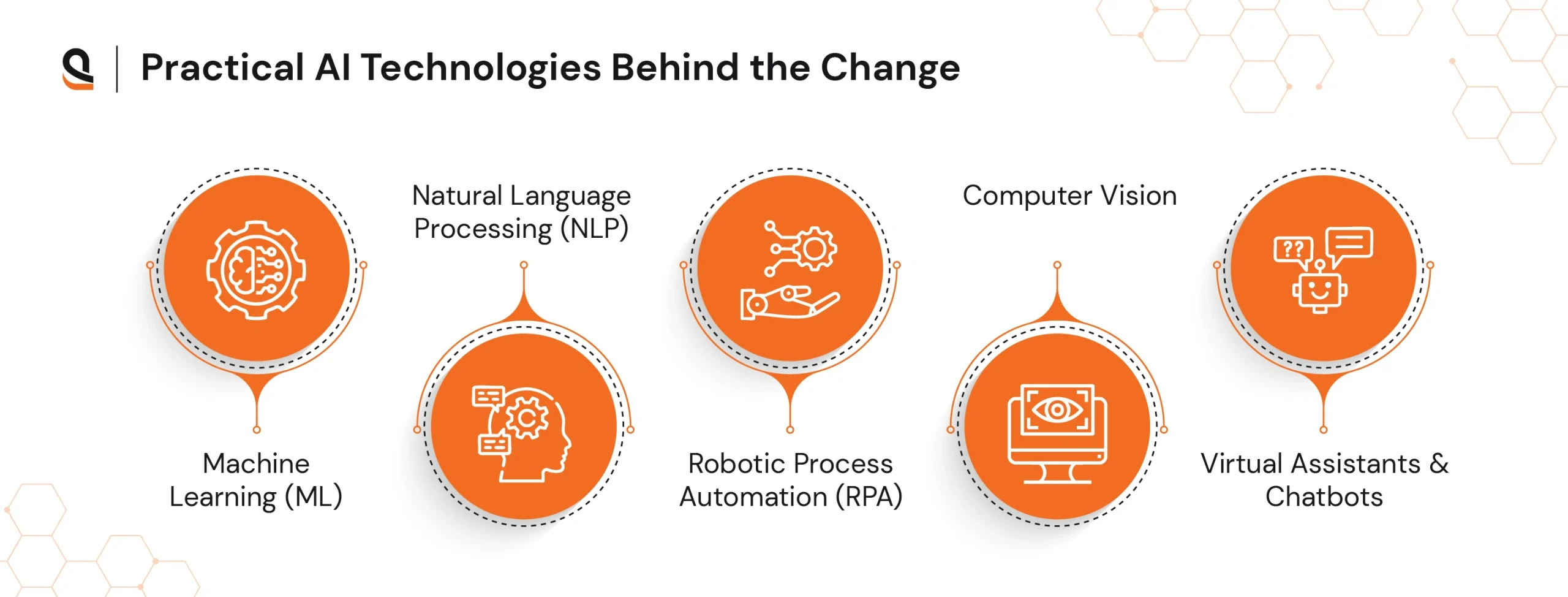
Healthcare providers are using several AI-driven tools that fit directly into clinical routines. These technologies are transforming everything from diagnoses to admin work:
- Machine Learning (ML): Helps spot patterns in patient data and predict health risks early, contributing to better outcomes.
- Natural Language Processing (NLP): Makes it easier to work with unstructured data like handwritten notes or scanned documents.
- Robotic Process Automation (RPA): Handles repetitive tasks like scheduling and data entry, giving staff more time for patient care.
- Computer Vision: Assists in analyzing medical images, helping detect issues that the human eye may miss.
- Virtual Assistants & Chatbots: Help patients with appointment booking, reminders, and basic queries, reducing admin overload.
How AI-Based Healthcare Solution Helps With Clinical Workflow Optimizations?

AI-based healthcare solutions can help automate key clinical activities and offer diagnostic intelligence.
Some of the key areas where AI clinical decision support systems help are,
- Image analysis- AI models fine-tuned to clinical data can help analyze X-rays, MRIs, CT scans, and other such imaging results. It helps detect subtle abnormalities and improve diagnosis accuracy.
- Medical pattern identification- Analyzing the diagnostic patterns across patients and cases, AI can help find gaps. Plus, it can create a genetic profile, lifestyle choice pattern, and treatment response patterns to help clinicians make smarter decisions.
- Personalized treatment plans- AI-based clinical decision support allows doctors and clinicians to assess drug interaction risks, patient response to treatments, and to select personalized diagnostic pathways.
By combining advanced healthcare data analytics with secure, real-time automation, AI helps providers deliver faster, smarter, and more coordinated care.
Other key benefits of healthcare solutions backed by AI are,
Eliminate Data Silos with a Unified Clinical Data Dashboard
Tired of toggling between EHRs, lab reports, pharmacy portals, and insurance systems? Our platform consolidates all clinical data into a single, secure clinical data dashboard, improving visibility and decision-making at every stage of the care journey.
Real-Time AI Dashboard for Healthcare Staff
Empower your team with a real-time AI dashboard for healthcare that displays vitals, appointments, medications, and alerts in one place: no delays, no guesswork—just actionable insights delivered instantly.
Built-In AI for Clinical Decision Support
Clinicians often face critical decisions with incomplete information. Our LangChain-powered AI in healthcare acts as an intelligent assistant, suggesting medications, surfacing risks, enhancing triage decisions, minimizing errors, and improving patient safety.
Automate Routine Tasks and Save Hours
From sending alerts to populating patient summaries, our solution uses AI in healthcare management to automate repetitive tasks, freeing up your staff to focus on what truly matters: patient care.
Smarter Insights with Patient Care Analytics
Our healthcare analytics dashboard turns raw data into meaningful insights. Identify care gaps, track outcomes, and optimize operations with built-in patient care analytics that are easy to access and act on.
Predictive Power: How AI Is Changing Decision-Making
One of the most powerful uses of AI in healthcare is predictive analytics using past and current data to anticipate future events. With help from machine learning and healthcare data analytics, providers can make faster, more accurate decisions across a range of tasks.
Real Benefits in Action:
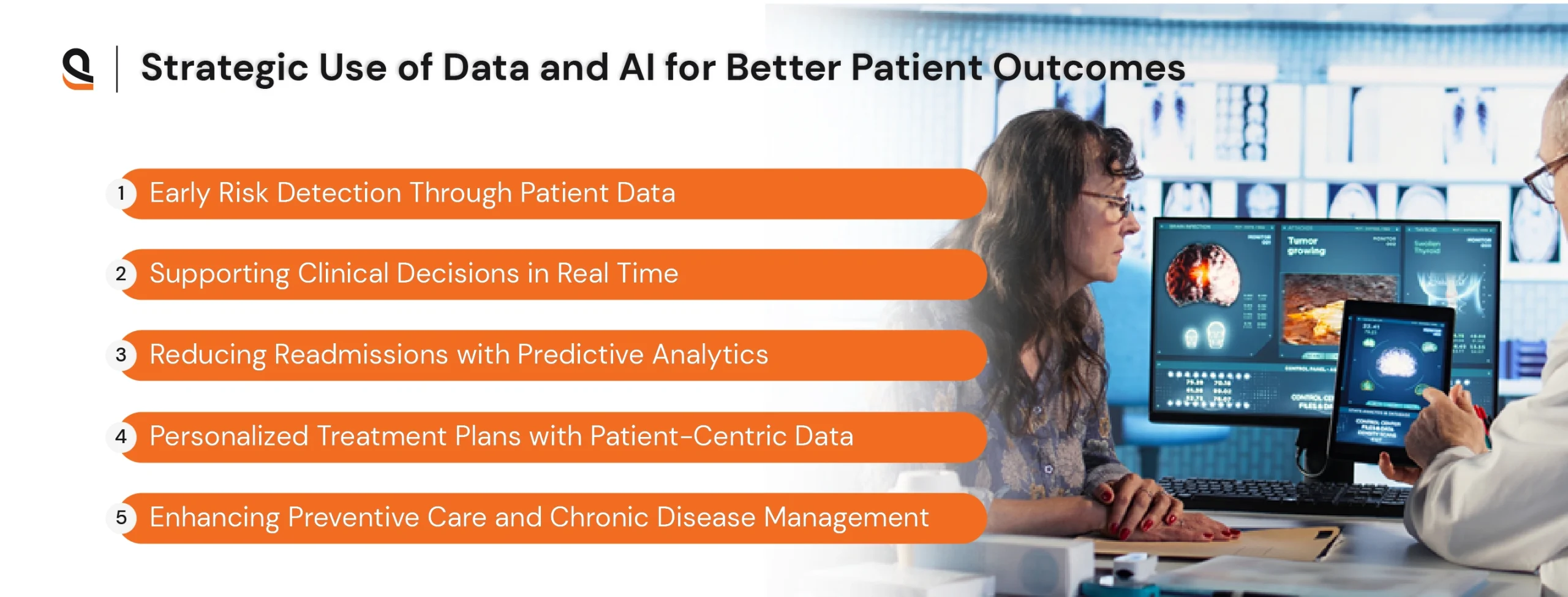
☑ Early Risk Detection: Algorithms can predict the likelihood of conditions like heart disease or kidney failure before symptoms appear.☑ Personalized Treatment Plans: Predictive models help categorize patients based on risk, guiding more targeted interventions.
☑ Better Resource Management: Forecasting patient volume helps hospitals plan staffing and equipment use more efficiently.
☑ Reduced Readmissions: By flagging patients at risk of readmission, care teams can take proactive steps to keep them healthier at home.
Platforms that include a healthcare analytics dashboard or AI for clinical decision support make it easier for teams to understand patient trends and respond quickly, showcasing the real healthcare data analytics benefits without digging through complex spreadsheets or scattered records.
As a CIMO or CTO of a hospital chain or a clinician looking to adopt an AI clinical decision support system for your clinic, understanding the importance of a healthcare solution. By now, you must have that understanding, but now comes the most significant question- “How to choose a healthcare solution for AI-based CDS?”
Tips To Find The Best Healthcare Solution For AI-based CDS
Here are some key tips that you can use to find the optimal solution for automating clinical workflows in healthcare.
- Evaluate how well the AI-based CDS integrates with existing EHR systems to ensure seamless workflow automation without disrupting current operations.
- Choose solutions that comply with HIPAA and GDPR standards to protect patient data while automating clinical decisions.
- Select systems with intuitive interfaces that minimize training time for healthcare staff, enhancing adoption in busy clinical environments.
- Look for solutions that can scale with your organization’s growth and allow customization to fit specific workflow needs.
- Ensure the provider offers robust ongoing support, regular updates, and AI model retraining to keep the system effective over time.
- Calculate the total cost of ownership against potential ROI, focusing on how automation reduces errors and improves efficiency.
- Choose CDS that supports standards like FHIR for easy data exchange across different healthcare platforms.
- Implement small-scale pilots to assess real-world performance in automating workflows before full deployment.
- Research peer reviews and case studies from similar healthcare settings to validate the solution’s effectiveness.
How AQe Digital’s Healthcare Solutions Help Enhance Patient Outcomes?
Empower clinical decision-making, optimize workflows, and elevate patient outcomes with our intelligent, AI-powered healthcare solutions.
Predictive AI for Risk Stratification and Early Intervention
Using advanced healthcare data analytics, our platform identifies patients at risk of deterioration or readmission, allowing for earlier, more targeted interventions that prevent complications and hospital returns.
Personalized Care Plans Driven by AI in Healthcare
No two patients are the same. Our AI in healthcare enables clinicians to develop personalized treatment plans based on real-time clinical indicators, history, and evolving conditions, leading to more effective and individualized care delivery.
Engagement Tools that Drive Better Health Outcomes
With real-time updates, care coordination tools, and an AI dashboard for healthcare communication, patients and families stay informed, involved, and engaged in the care process, improving adherence and satisfaction.
Outcome Monitoring with Patient-Centric Analytics
Track progress, compare benchmarks, and measure recovery trends using our healthcare analytics dashboard. These insights empower care teams to optimize treatment strategies and improve clinical effectiveness continuously.
Data-Driven Decisions That Improve Quality of Life
Our AI for clinical decision support ensures that every care recommendation is based on the most current and complete clinical data, helping providers deliver safer, faster, and more accurate care across the board.
Conclusion
Hospital management is a complex process that involves multiple departments, human intervention, techs, and tools. Maintaining a seamless clinical workflow is inevitable for better patient outcomes and streamlined administration. Relying on outdated systems and tools can lead to mismanagement and compromised patient care. Integrating AI and data analytics services can help healthcare transform clinical workflows and significantly improve patient outcomes. AQe Digital’s AI-driven healthcare solution is built focusing on all the challenges and objectives of healthcare providers.
From early detection and personalized treatment plans to optimized resource management and reduced administrative burden, our healthcare solution does it all. Book a demo or a free consultation with our experts to know more about our solution and how it can help you achieve maximum patient outcomes and streamline clinical workflows.