How to Choose the Right AI Chatbot Development Company for an Enterprise?

Priyanka Wadhwani
According to Gartner, chatbots will handle roughly 25% of all enterprise customer service interactions by 2027. Yet McKinsey's AI adoption research consistently finds that 70% of enterprise AI initiatives stall before reaching production. The gap between those two numbers isn't a technology problem. It's a vendor selection problem.
Choosing the wrong AI chatbot development company doesn't just waste a line item in the budget. It produces a bot that degrades quietly after month three, erodes customer trust in the channel, and forces an expensive rebuild cycle that takes longer than the original build.
The evaluation criteria that separate capable providers from generic vendors aren't obvious from a demo or a features checklist. This guide breaks down exactly what to look for before you sign.
Why Most AI Chatbot Development Projects Fail Before They Go Live
Chatbot projects don't usually fail because the underlying technology doesn't work. They fail because the AI chatbot development company building the system didn't have the depth to handle production conditions.
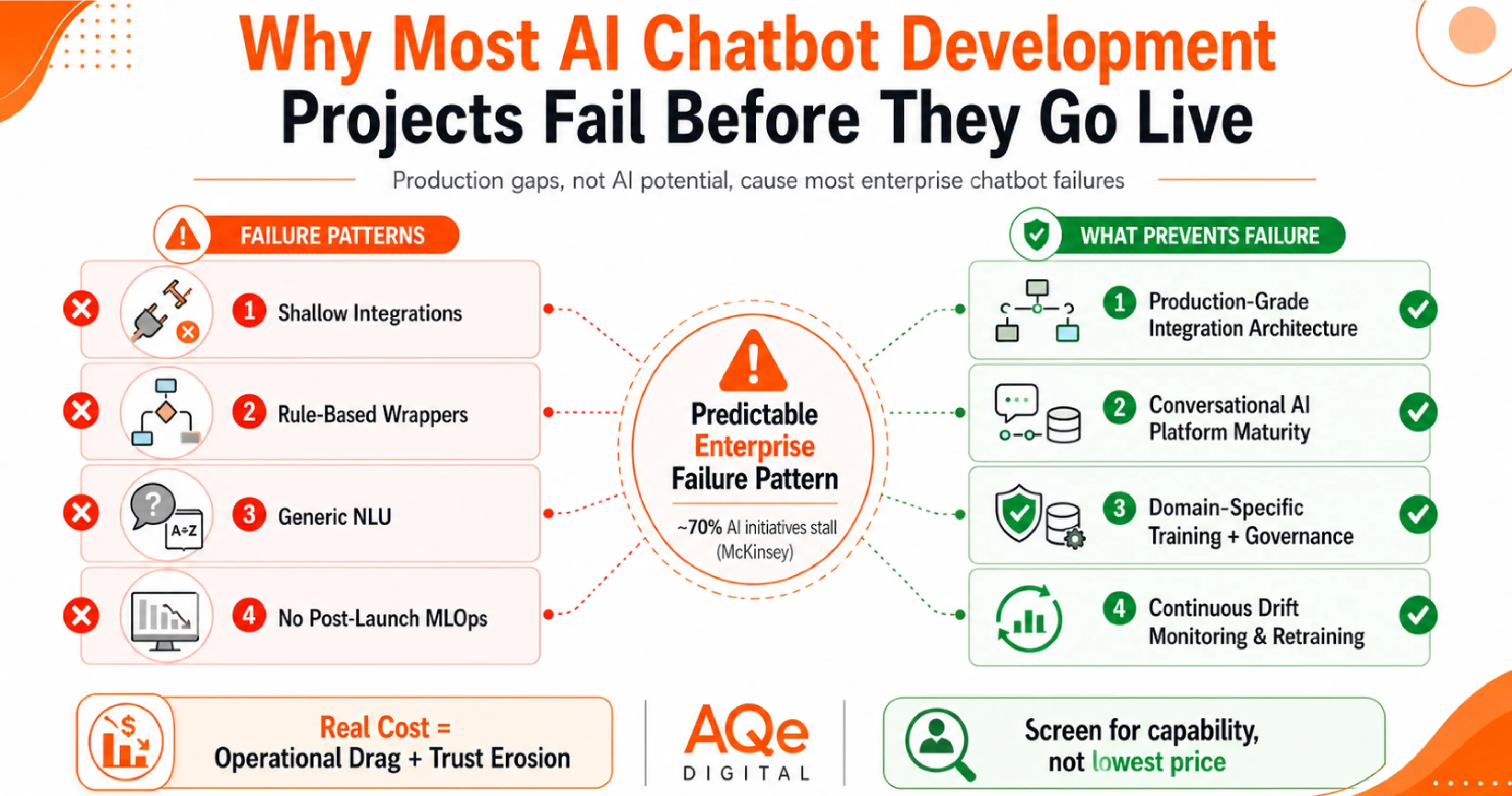
The Enterprise AI Chatbot Failure Pattern is Predictable
Shallow CRM integrations that break under load. Rule-based decision trees packaged as AI. NLU models trained on generic data that can't recognize your domain's vocabulary. Post-launch support that evaporates the moment the contract closes.
The McKinsey Global AI Survey puts the enterprise AI stall rate at 70%. Chatbot development follows the same distribution. The projects that survive have one thing in common: the vendor had genuine production experience, not just controlled pilot history.
The Real Cost is Operational Drag, Not the Vendor Invoice
A failed enterprise AI chatbot deployment doesn't just cost the build fee. It costs retraining cycles, data re-ingestion, API rewrites, and customer interactions logged as unresolved while the system underperforms.
More importantly, it costs the trust recovery. When a chatbot fails to meet user expectations at scale, the channel itself loses credibility. Rebuilding that trust takes two to three times as long as building the original system correctly.
Enterprises that evaluate an AI chatbot development company based solely on price consistently hit this wall. Capability screening upfront avoids it entirely.
5 Dimensions That Separate Capable AI Chatbot Development Companies From Others.
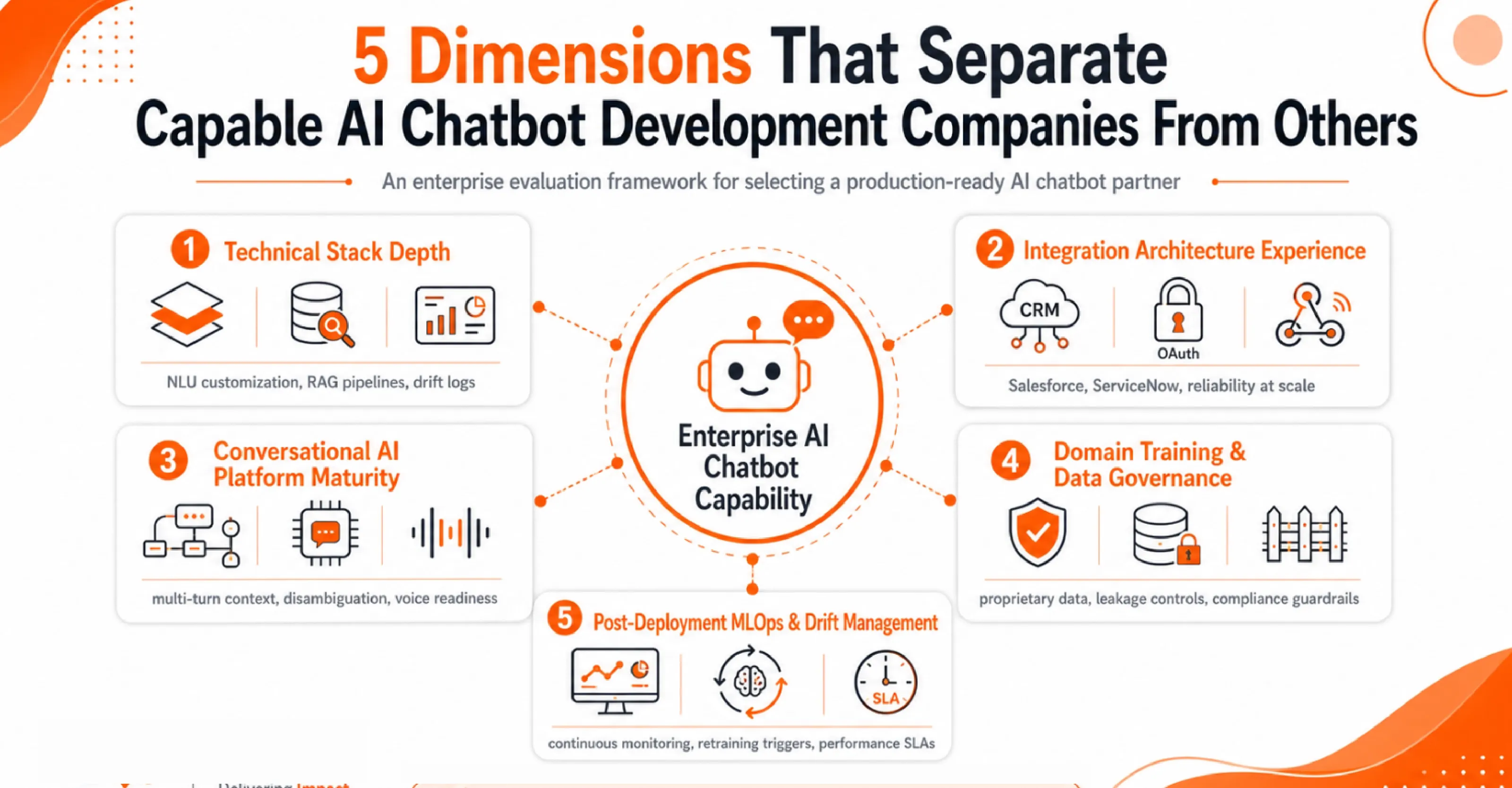
1. Technical Stack Depth for Enterprise AI Chatbot Infrastructure
Any vendor will list platform familiarity: Dialogflow, Rasa, Azure Bot Framework, and Botpress. Platform familiarity is table stakes. What distinguishes a credible AI chatbot development company is the ability to go below the platform layer.
- Can they customize NLU models for your specific domain vocabulary?
- Can they architect retrieval-augmented generation (RAG) pipelines for enterprise knowledge bases with real-time data?
- Can they build enterprise AI and data engineering systems that operate on live, messy production data without hallucinating?
A provider that cannot show you live production metrics from a current deployment, not a demo environment, is a provider that's still learning on your contract.
Ask for post-deployment performance dashboards with intent accuracy rates, session volumes, and model drift logs before you evaluate anything else.
2. Integration Architecture Experience
Your enterprise AI chatbot will not operate in isolation. It connects to CRM platforms (Salesforce, HubSpot), ticketing systems (ServiceNow, Zendesk), ERPs, and internal knowledge bases.
Integration failure, not NLP failure, is what kills most enterprise chatbot projects in the first six months.
A credible AI chatbot development company has case studies on integration architecture, not just API connection diagrams. Ask about their experience with OAuth 2.0 authentication flows, webhook reliability under high concurrency, and how they handle data consistency when a downstream system experiences downtime.
For organizations running structured customer interactions across messaging channels, their experience in building WhatsApp-based conversational AI workflows is worth evaluating as a signal of the depth of real integration.
3. Conversational AI Platform Maturity vs Rule-Based Wrappers
The difference between a rule-based chatbot and a genuine conversational AI platform isn't subtle. Rule-based systems handle linear, predetermined flows. They break the moment the user's language deviates from the defined path.
Conversational AI platforms handle intent switches, context carry-over across multi-turn dialogue, disambiguation, and graceful recovery from misfires without dropping state.
Evaluate whether the vendor builds on top of a conversational AI platform or duct-tapes pre-built flows together and sells it as AI.
For enterprise AI chatbot deployments that include inbound voice handling, the requirements extend further: speaker diarization, real-time response generation, and NLU capabilities that handle natural speech patterns. If your roadmap includes voice, verify platform compatibility now, not after the build.
4. Domain-Specific Training and Data Governance
Generative AI chatbot development is not just about selecting a base model and pointing it at your data. Custom AI chatbot solutions require domain fine-tuning, prompt engineering, retrieval pipeline design, and guardrails built around your actual knowledge corpus.
An insurance chatbot trained on general web data will confidently provide wrong policy information. A healthcare chatbot without compliance-aware guardrails creates liability exposure on every interaction.
Ask whether the vendor has experience ingesting proprietary datasets, what governance controls they apply to prevent data leakage during training, and how they build retrieval layers that update when your knowledge base changes. In regulated industries, these are not preferences; they are prerequisites.
5. Post-Deployment MLOps and Model Drift Management
Models decay. Conversation patterns shift as your product lines change, your market evolves, and your users develop new ways of asking the same questions. An AI chatbot development company that delivers and disappears is a liability, not a partner. The bot you launch on day one is not the bot your users need at month twelve.
Ask for their MLOps framework in specific terms: how often they monitor for model drift, what threshold triggers a retraining cycle, whether clients get dashboard access to performance metrics, and what the SLA looks like when the bot's confidence falls below a defined floor.
For organizations running growth automation alongside chatbot deployment, the MLOps framework also determines how well the chatbot feeds qualified signals into downstream workflows.
Website Chatbot vs Enterprise AI Chatbot: The Evaluation Criteria Diverge Significantly
Applying website-level vendor criteria to an enterprise AI chatbot build is one of the most common and expensive selection errors in chatbot procurement. The complexity tiers are genuinely different, and the evaluation framework should reflect that.
Deployment complexity reference:
| Recommended AI Chatbot Deployment by Business Need | |||
| Deployment Type | Chatbot | Enterprise AI Chatbot | Timeline |
| Website FAQ / Lead Capture | Simple CMS embed, pre-built flows | Not required | 6 to 10 weeks |
| Single-Channel Support Bot | Platform-native builder | Custom NLU if volume exceeds 500 sessions/day | 8 to 14 weeks |
| Multi-Channel Enterprise Bot | Not adequate | RAG pipeline + CRM integration + MLOps | 14 to 20 weeks |
| Regulated Industry (BFSI, Healthcare, Legal) | Not compliant | SOC 2 / HIPAA-aware build with audit trails | 16 to 24 weeks |
For enterprise AI chatbot builds handling thousands of concurrent sessions across support, sales, and HR functions, the criteria shift entirely: infrastructure reliability, session state management, concurrency limits, audit trail completeness, and role-based access controls (RBAC).
Three indicators reliably point toward the enterprise build: concurrent session volume above 500 per day, the need for personalized responses drawn from account data pulled at runtime, and regulatory requirements for conversation logging and audit trails.
Due Diligence Questions to Ask Any AI Chatbot Development Company Before Signing
Standard RFP questions don't surface the capability gaps that matter in enterprise AI chatbot projects. These questions do.
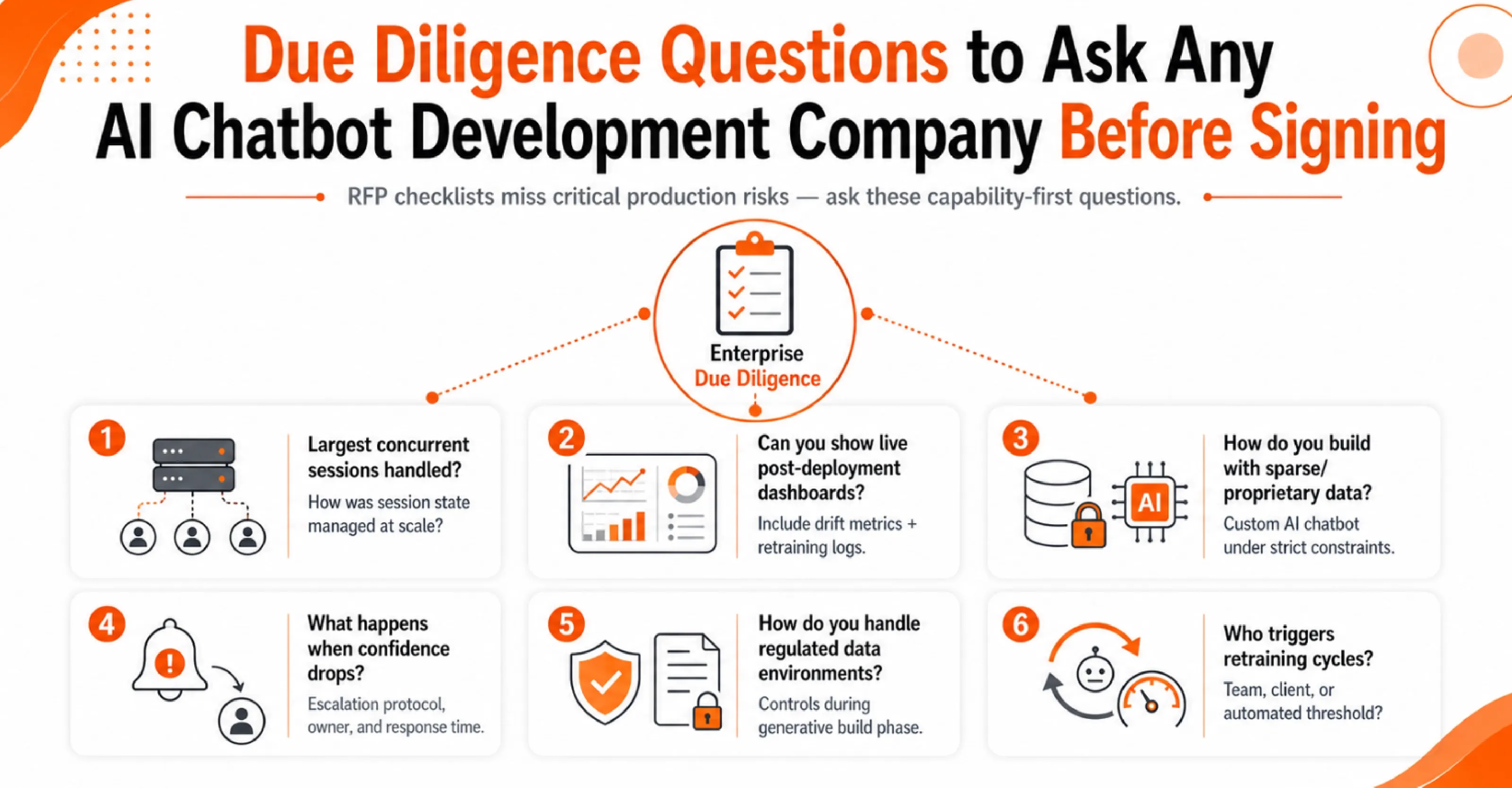
- What is your largest concurrent session deployment, and how did you architect session state management at that scale?
- Can you show us a post-deployment performance dashboard from a current client that includes model drift metrics and retraining event logs?
- How do you build a custom AI chatbot solution when training data is sparse, proprietary, or protected by compliance requirements?
- What is your escalation protocol when the chatbot's confidence score falls below your defined floor? Who gets notified, and how fast?
- How do you handle regulated data environments during the generative AI chatbot development build phase?
- What does your retraining cycle look like, and who triggers it: your team, your client, or an automated threshold?
An AI chatbot development company that cannot answer these questions fluently hasn't run production at enterprise scale. That may be acceptable for a simple website bot. It is not acceptable for infrastructure to handle your customer support, sales qualification, or internal operations.
How AQe Digital Approaches AI Chatbot Development Services: What 27 Years of Enterprise Integration Actually Buys You
AQe Digital has been building enterprise software since 1997. That history matters in chatbot development for one specific reason that most vendors can't claim: the hard problems in enterprise
AI chatbot deployment are not chatbot-specific.
They are integration problems. Data quality problems. Governance problems. Organizational change management problems. AQe Digital has been solving those problems across manufacturing, insurance, healthcare, and BFSI environments since before most current chatbot vendors existed.
Most chatbot vendors have never survived a client's ERP migration. AQe Digital has managed dozens since 2001. That institutional memory is what keeps enterprise chatbot integrations stable at year three, not just at launch.
AQe Digital's Enterprise AI Chatbot Build Framework
AQe Digital's AI chatbot development services follow a phased architecture framework with defined milestones and measurable checkpoints:
- Weeks 1 to 3: Domain scoping and data audit. We assess training data volume and quality, map integration touchpoints, and identify compliance requirements before writing a line of code.
- Week 8: Pilot deployment with real user traffic. Not a sandbox demo. A controlled production environment with live sessions, monitored intent accuracy, and documented failure modes.
- Week 16: Full production rollout with MLOps monitoring active. Retraining triggers are defined and automated. Clients receive dashboard access to drift metrics and escalation logs.
No production deployment leaves our team without a measurable baseline for intent accuracy and a defined retraining trigger.
That's not a process preference. It's the minimum standard for an enterprise AI chatbot that performs at month twelve the way it performed at launch.
Vertical Depth for Enterprise AI Chatbot Deployments
The enterprise AI chatbot deployments AQe Digital has delivered aren't generic. In manufacturing, we've built chatbots that integrate with shopfloor monitoring systems to surface equipment status and escalation alerts in real time.
In insurance, we've built compliance-aware chatbots with an audit trail that is complete for regulatory review. In healthcare, we've built patient-facing bots with HIPAA-compliant data handling and escalation protocols integrated into clinical workflows.
For BFSI organizations, Hospitality Revenue Management and workflows integrated alongside chatbot deployment mean the bot doesn't just answer questions. It feeds qualified signals into the downstream pipeline management in real time.
AQe Digital vs Generic Vendor: The Moat in Concrete Terms
Capability comparison across six dimensions: Evaluation Dimension
| How AQe Digital Differs from Generic Chatbot Vendors | |||
| Evaluation Dimension | Generic Chatbot Vendor | AQe Digital Approach | Why It Matters |
| Production Proof | Demo environments only; no live metrics shared | Post-deployment dashboards with intent accuracy, session volume, and drift logs | A vendor that can't show live numbers hasn't run production at scale |
| Integration Depth | Logo lists; surface-level API connections | OAuth 2.0 flows, webhook reliability under load, ERP/CRM edge-case handling since 2001 | Integration failures—not NLP failures—cause most enterprise chatbot projects to fail |
| Stack Transparency | Generic platform list (Dialogflow, Botpress) | Disclosed RAG pipeline, fine-tuning methodology, MLOps tooling, and retraining triggers | You need to know what you're buying, not just the brand name on top of it |
| Domain Training | Base model with minimal customization | Proprietary dataset ingestion, prompt engineering, guardrails, and compliance-aware retrieval layers | A base model trained on enterprise data without guardrails becomes a liability, not an asset |
| Post-Launch Ownership | Disappears at contract close | Weekly drift monitoring, defined retraining triggers, client dashboard access, and SLA-backed escalation | The chatbot you launch today won't be the chatbot users need twelve months from now |
| Founding Context | 3 to 7 years old; limited enterprise integration history | 27 years of enterprise software delivery; experienced across ERP migrations, API deprecations, and CRM overhauls | Institutional memory keeps integrations stable in year three, not just year one |
Conclusion
Choosing an AI chatbot development company isn't a vendor selection exercise. It's a multi-year infrastructure decision. The provider you choose determines integration depth, conversation quality, compliance posture, and the pace at which your chatbot evolves after launch. A well-built enterprise AI chatbot that performs reliably at month twelve is worth three times as much as a flashy demo that degrades by month four.
Evaluate on production history, MLOps maturity, domain training capability, and post-deployment ownership. Not on demo quality, platform badge count, or headline price. AQe Digital has been building and maintaining enterprise software for more than 27 years now. That record is available to review, not just to claim.