AI Agent vs AI Assistant vs Chatbot: What Exactly Does Your Business Need?

Priyanka Wadhwani
AI is moving beyond systems that simply answer questions. Businesses are increasingly exploring AI systems that can reason, use tools, automate workflows, and complete tasks with limited human intervention.
That shift has made terms such as AI agent, AI assistant, chatbot, conversational AI, and agentic AI increasingly common in technology discussions.
However, these technologies are not interchangeable. An AI assistant may help a user complete a task, while an AI agent can potentially plan and execute multiple steps toward a defined goal.
AI agents are moving quickly from experimentation toward enterprise adoption. McKinsey's 2025 survey found that 62% of organizations were at least experimenting with AI agents, while 23% were already scaling agentic AI somewhere in the enterprise.
Understanding the difference matters when businesses evaluate AI investments, because choosing the wrong architecture can create unnecessary costs, limited automation, or capabilities that do not match the intended use case.
What Is an AI Agent?
An AI agent is an AI-powered system designed to pursue a goal by interpreting information, planning actions, using available tools, and executing tasks with varying degrees of autonomy.
Unlike a conventional conversational system, an agent can determine what actions are required after receiving a broader objective rather than needing instructions for every individual step.
How AI Agents Work
Understanding how AI agents work requires looking beyond the underlying large language model.
A typical agent combines several components that allow it to interpret a goal, reason about possible actions, access relevant information, use tools, and evaluate results.
For example, an employee could ask an agent to analyze customer feedback, identify recurring complaints, create a summary, and update a business system.
The agent may determine the required sequence, retrieve information through APIs, process the results, and complete the requested actions instead of simply describing how someone could do them.
Key Capabilities of AI Agents
AI agents can potentially:
- Break complex objectives into smaller tasks
- Use APIs, databases, applications, and other tools
- Maintain context across multiple steps
- Make decisions based on defined goals and available information
- Execute actions rather than only generating responses
- Coordinate multiple systems or specialized agents
The level of autonomy still depends on the system's architecture, permissions, guardrails, human oversight, and quality of the underlying models.
What Is an AI Assistant?
An AI assistant is designed primarily to help users interact with information, applications, or tasks through natural language.
It generally responds to a user's instructions, provides information, generates content, summarizes material, or assists with specific activities.
This makes assistants highly useful for productivity, research, writing, scheduling, knowledge retrieval, and other user-directed workflows.
AI Assistant Capabilities and Limitations
AI assistants can be highly capable without being fully autonomous.
They can draft documents, summarize meetings, answer questions, analyze information, generate code, and interact with selected applications when appropriate integrations are available.
However, their limitations become clearer when a task requires independent planning, continuous execution, multiple system interactions, or decisions across several steps.
The distinction is therefore not simply about intelligence. It is primarily about autonomy, workflow control, tool access, and responsibility for completing an outcome.
What Is a Chatbot?
A chatbot is a conversational software application designed to interact with users through text or voice.
Traditional chatbots often rely on predefined rules, decision trees, or scripted responses, while modern chatbots can use large language models to understand more flexible natural-language requests.
A chatbot might answer frequently asked questions, provide product information, help users navigate services, or handle straightforward customer support conversations.
Modern conversational systems can be significantly more sophisticated than traditional rule-based bots, but conversation alone does not make a system an AI agent.

AI Agent vs AI Assistant vs Chatbot: Key Differences
The easiest way to understand the difference is to compare what each system is primarily designed to accomplish.
| AI Agent vs AI Assitant vs Chatbot: Key Differences | |||
|---|---|---|---|
| Capability | AI Agent | AI Assitant | Chatbot |
| Primary Purpose | Achieve defined goals | Assist users with tasks | Conduct conversation |
| Autonomy | High to variable | Usually user-directed | Usually limited |
| Planning | Can plan multi-step workflows | Generally follows user instructions | Usually follows predefined flow |
| Tool usage | Can actively use multiple tools | May use connected tools | Usually limited |
| Task execution | Can execute actions independently | Often assists with actions | Usually handles conversational requests |
| Memory | Can maintain task or session context | May retain user context | Often limited or session-based |
| Decision-making | Can make bounded decisions | Provides recommendations or responses | Usually follows defined logic |
| Best suited for | Complex workflows and automation | Productivity and personal assistance | Support and routine interactions |
AI Agent vs AI Assistant: What Is the Real Difference?
The AI agent vs AI assistant distinction mainly comes down to who controls the workflow.
An assistant generally waits for the user to request the next action. An agent can receive a broader objective and determine the sequence of actions required to accomplish it.
For example, an assistant could help you draft a sales report after you provide the necessary information.
An agent could potentially retrieve sales data, identify performance changes, compare them with previous periods, generate the report, and send it to authorized recipients based on defined rules.
AI Assistant vs AI Agent: Which Should You Choose?
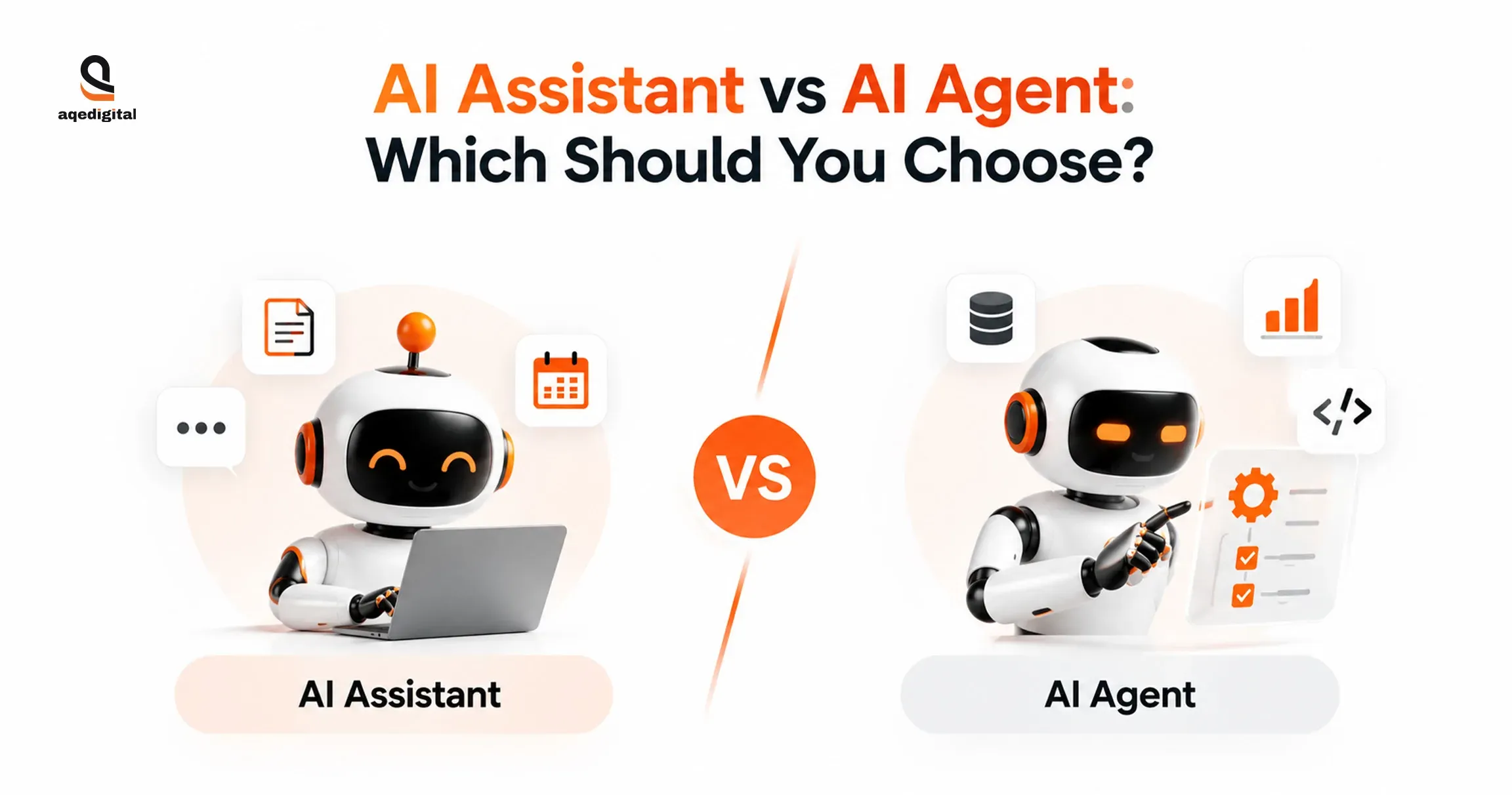
Choose an assistant when users need interactive support, information, recommendations, content generation, or controlled task assistance.
AI agent is an ideal choice when the business needs multi-step automation, tool orchestration, goal-driven execution, or workflows that can operate with limited intervention.
The decision should therefore be based on the workflow rather than the popularity of a particular AI technology.
AI Agent vs AI Assistant: Where Each Fits Best
The AI agent vs assistant comparison becomes clearer when looking at practical business requirements.
AI Assistants Work Well For
- Employee productivity support
- Content generation
- Knowledge retrieval
- Meeting summaries
- Research assistance
- Code suggestions
- User-directed business tasks
AI Agents Work Well For
- Multi-step workflow automation
- IT operations
- Data analysis workflows
- Software development tasks
- Customer service orchestration
- Business process automation
- Cross-system task execution
AI Agents vs AI Assistants: Why the Distinction Matters for Businesses
The difference becomes commercially important when organizations move from AI experimentation to operational automation.
An assistant can increase individual productivity by helping employees complete tasks faster.
An agent can potentially redesign how a process itself operates by coordinating multiple actions across systems.
That means businesses should evaluate whether they need human-centered assistance or outcome-oriented automation before investing in an AI solution.
AI Agent vs Chatbot: How Are They Different?
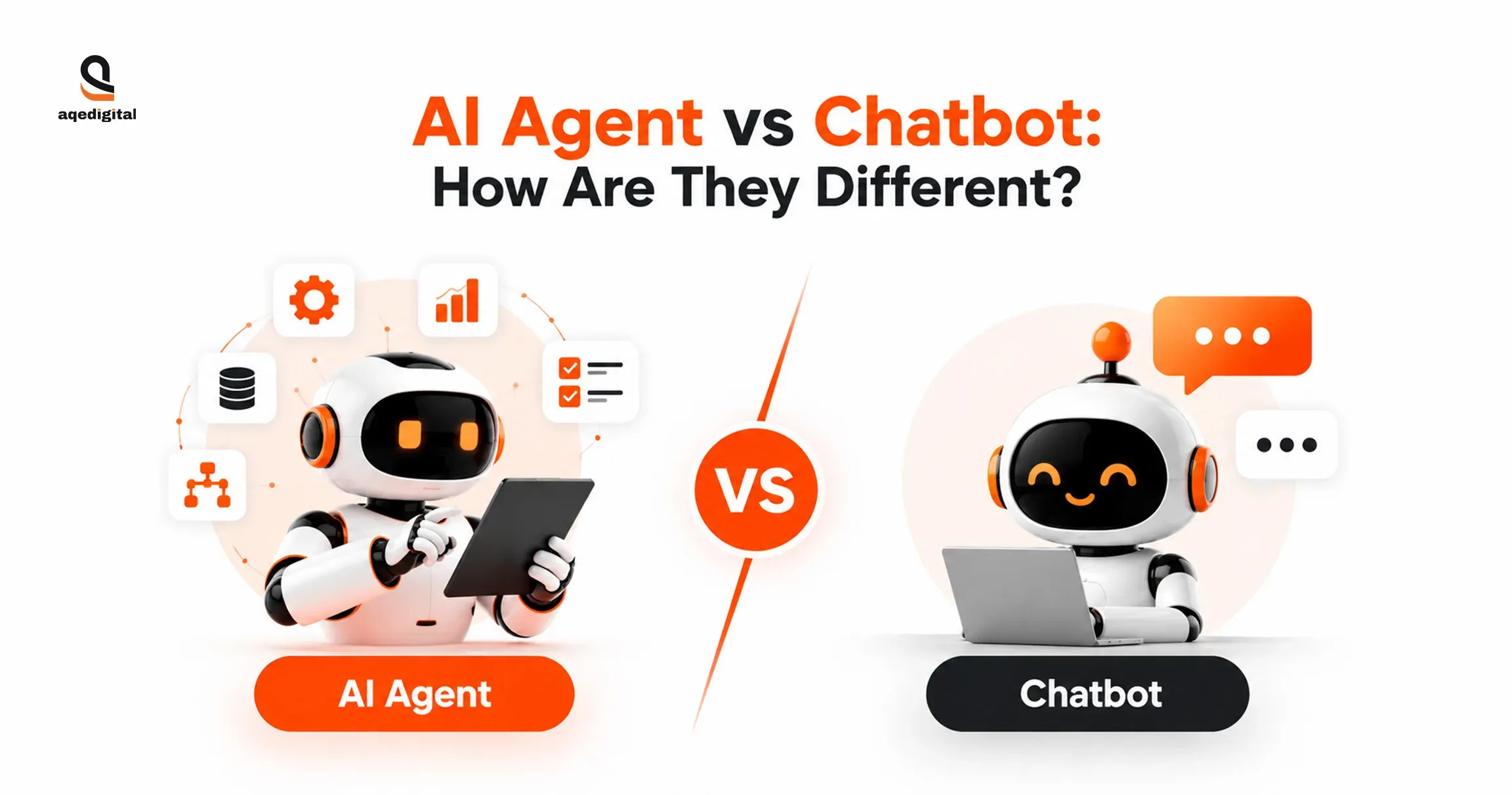
The AI agent vs chatbot comparison is similar but focuses more strongly on autonomy and execution.
A chatbot is primarily a conversational interface. An agent is primarily an execution-oriented system that may use conversation as one way to receive instructions.
For example, a customer-service chatbot might answer a question about an order status.
An AI agent could potentially retrieve the order, identify a delivery problem, check relevant policies, create a support case, and initiate an approved resolution.
The important distinction is that the agent is designed to perform a workflow, while the chatbot is primarily designed to manage an interaction.
Chatbot vs Conversational AI: Are They the Same?
The chatbot vs conversational AI distinction is slightly different from the agent comparison.
Conversational AI is a broader technology category covering systems that understand and respond to human language through text or voice.
A chatbot is one type of conversational AI application.
Modern conversational AI can power customer service bots, virtual assistants, voice interfaces, enterprise knowledge systems, and even conversational front ends for AI agents.
Therefore, a chatbot can use conversational AI, while an AI agent can also use conversational AI as its user-facing interface.
OpenClaw and the Emerging AI Agent Landscape
The OpenClaw AI agent framework is an example of the broader movement toward agent systems that combine models with tools, sessions, memory, routing, and external interfaces.
OpenClaw's documentation describes it as a self-hosted gateway connecting messaging channels and other interfaces to AI coding agents, with capabilities including tools, skills, memory, sessions, and multi-agent routing.
Its architecture illustrates an important point: an agent is not simply an LLM placed behind a chat window.
The surrounding runtime determines how the system receives context, accesses tools, maintains sessions, routes tasks, and controls what actions an agent can perform.
For businesses evaluating agent architectures, this distinction is critical because model capability alone does not determine the reliability of an AI agent.
When Should Your Business Use an AI Agent, Assistant, or Chatbot?
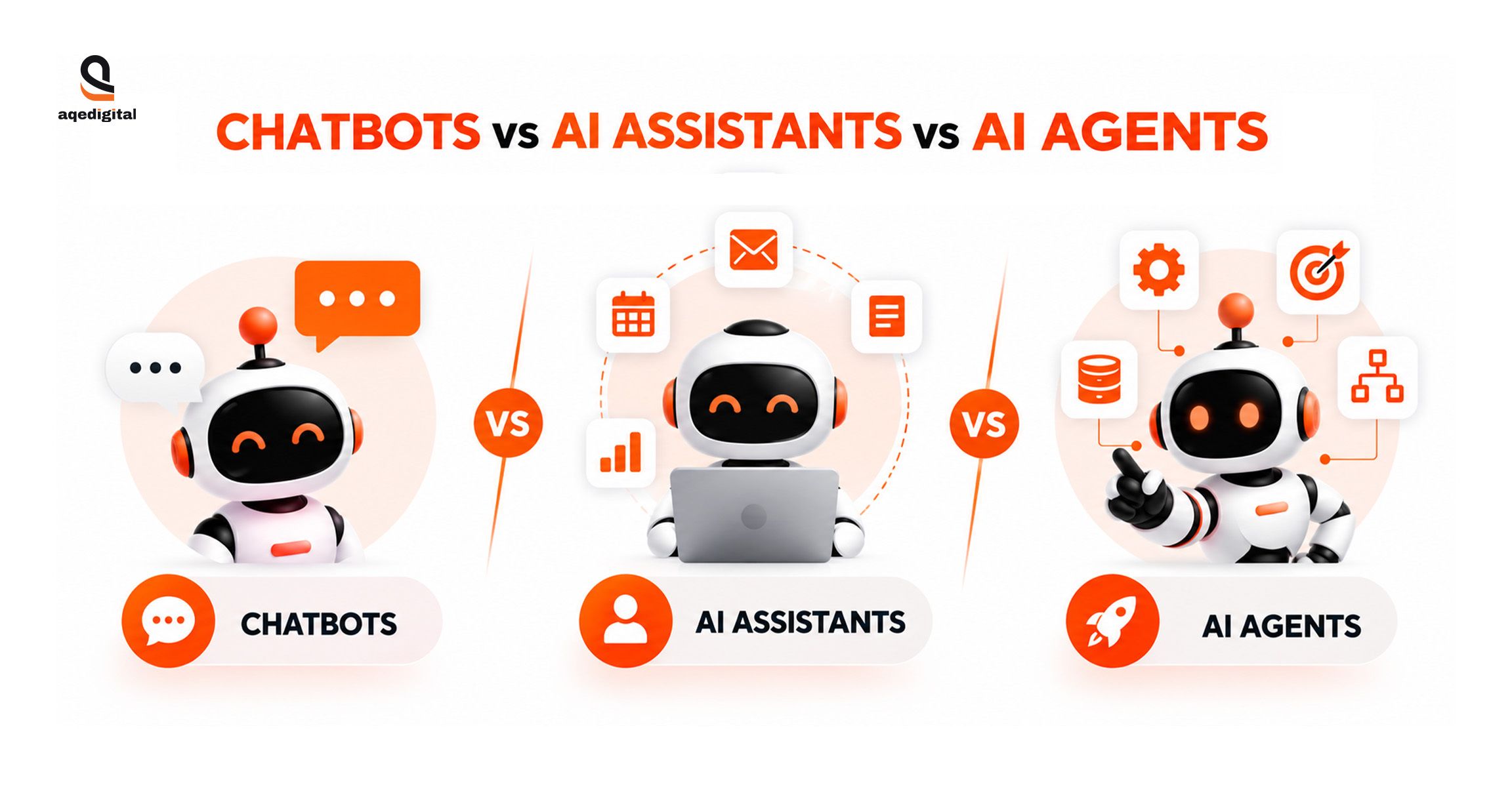
The right choice depends on the complexity and autonomy required by the business workflow.
Choose an AI Agent When
Your process involves multiple steps, external systems, decisions, and a defined business outcome.
Examples include automated research, IT operations, lead qualification, software development workflows, financial analysis, and complex customer-service processes.
Choose an AI Assistant When
Employees or customers need intelligent support while retaining control over the next action.
Assistants are particularly useful when the user needs recommendations, information, content generation, analysis, or productivity support.
Choose a Chatbot When
The primary requirement is structured or conversational interaction with customers or employees.
Customer FAQs, basic support, product discovery, appointment assistance, and simple service navigation can often be handled effectively through chatbot solutions.
What Businesses Should Consider Before Implementing AI
Stanford's 2025 AI Index found that organizational AI use rose from 55% in 2023 to 78% in 2024, while generative AI use in at least one business function increased from 33% to 71%.
This rapid adoption makes architecture decisions increasingly important as businesses move from experimentation toward production use cases.
Considerations businesses need to take are:
Business Objective
Start with the outcome you want to improve rather than selecting an AI technology first.
Workflow Complexity
Determine whether the process requires conversation, assistance, automation, or autonomous execution across multiple steps.
System Integration
Evaluate whether the solution needs access to CRMs, ERPs, databases, APIs, communication platforms, or internal applications.
Security and Permissions
Define exactly what the AI system can access, modify, approve, or execute.
Greater autonomy requires stronger controls because an agent may have permission to perform real actions.
Human Oversight
Not every decision should be automated. Define where human approval, escalation, or review remains necessary.
Accuracy and Observability
Monitor outputs, actions, failures, tool calls, and business outcomes rather than evaluating the AI system only through conversational quality.
Scalability
Consider how the solution will perform when users, workflows, data sources, and autonomous tasks increase.
A successful pilot should have a path toward production architecture rather than becoming another isolated AI experiment.
How AQe Digital Can Help You Build the Right AI Solution
Choosing between an agent, assistant, or chatbot should begin with your business workflow, not with a technology trend.
AQe Digital can help organizations assess use cases, design AI-enabled architectures, integrate intelligent systems with existing applications, and build solutions aligned with operational and business requirements.
AI Strategy and Use-Case Identification
Identify where AI can create measurable value and determine whether an agent, assistant, chatbot, or combined architecture best fits the workflow.
AI Agent Development
Design AI agents capable of using tools, processing information, coordinating workflows, and executing defined tasks with appropriate guardrails.
Conversational AI and Assistants
Build intelligent interfaces that help employees and customers access information, complete tasks, and interact naturally with business systems.
Enterprise Integration
Connect AI capabilities with APIs, databases, CRM platforms, enterprise applications, and existing technology ecosystems.
Secure AI Architecture
Implement appropriate authentication, authorization, data controls, monitoring, human oversight, and governance for enterprise AI deployments.
Scalable AI Solutions
Build AI systems that can evolve from individual use cases into broader enterprise workflows as adoption and business requirements grow.
Which AI Technology Is Right for Your Business?
There is no universal winner in the AI agent vs AI assistant debate because both technologies solve different problems.
Chatbots remain valuable for conversational interactions, assistants can enhance human productivity, and AI agents can automate increasingly complex workflows.
The strongest strategy is to start with the business process, identify the level of autonomy required, and then select the architecture that provides the right balance of capability, control, security, and cost.
For organizations moving from AI experimentation toward production-grade solutions, the real opportunity lies in designing AI around measurable business outcomes rather than simply adding a conversational interface.
Conclusion
The difference between an AI agent, AI assistant, and chatbot ultimately comes down to autonomy, workflow complexity, and the outcomes your business expects.
Assistants can strengthen productivity, chatbots can simplify conversations, while agents can execute increasingly complex processes across connected systems.
At AQe Digital, our AI and software engineering team helps businesses identify practical AI opportunities and build secure, scalable solutions around their workflows and goals.
Contact us to discuss your AI requirements and get the best AI solutions for all your business objectives and challenges.