AI Agent Development Services: What Enterprises Should Expect From Discovery to Production

Priyanka Wadhwani
Enterprises are now relying on artificial intelligence (AI) to take action rather than just using it for simple conversation.
A customer service agent that only summarizes a complaint still leaves an employee responsible for opening the CRM, checking the order, reviewing the policy, and deciding what happens next. An AI agent can potentially coordinate those steps, retrieve the required information, make decisions within defined boundaries, and trigger actions across business systems.
That shift explains why enterprises are moving from standalone generative AI experiments toward agentic systems that can execute multi-step workflows.
McKinsey's State of AI survey found that 62% of respondents said their organizations were at least experimenting with AI agents, while 23% reported scaling an agentic AI system somewhere in the enterprise. Yet most organizations remain in experimentation or pilot stages.
The gap is important.
Building an AI agent prototype is increasingly accessible. Building one that can operate reliably inside an enterprise environment is a much larger engineering and business challenge.
That is where the right AI agent development company becomes valuable.
Enterprise-grade agent development involves more than choosing a foundation model. It requires workflow discovery, architecture design, data access, tool integration, security controls, evaluation, deployment, monitoring, and continuous optimization.
Why Enterprises Are Moving From AI Assistants to AI Agents
Traditional AI assistants primarily respond to user requests.
AI agents can go further by interpreting objectives, planning actions, using tools, accessing approved information, and completing multiple steps toward a defined outcome.
For example, a customer-support agent could receive a request about a delayed shipment and potentially:
- Retrieve the customer's account
- Check the order management system
- Verify shipment status
- Review the applicable service policy
- Determine whether compensation is permitted
- Prepare or issue an approved response
- Update the support ticket
- Escalate exceptions to a human employee
The important distinction is not simply that an agent generates better text.
It is that the agent can participate in the workflow itself.
What Enterprises Should Expect From AI Agent Development Services?
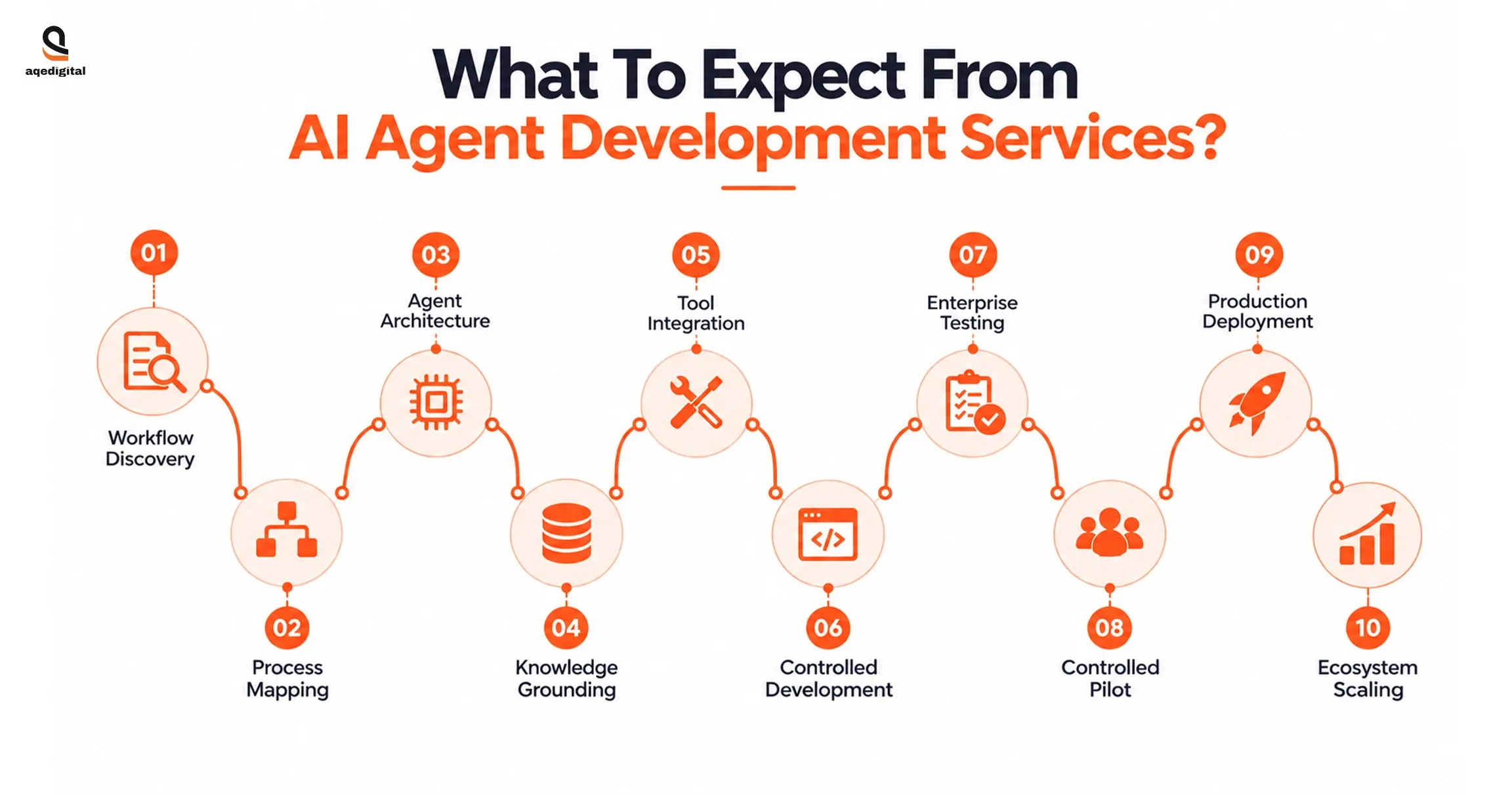
A credible AI agent development company should not begin by proposing a model or framework.
The engagement should begin by understanding where an agent can create measurable business value and what must be true for that agent to operate safely inside the organization.
The journey generally involves several connected stages.
1. Discovery: Start With the Workflow, Not the Technology
The first stage of custom AI agent development should identify the business process the agent is expected to improve.
This sounds straightforward, but it is where many enterprise AI initiatives go wrong.
Organizations often approach an AI project with a technology-first requirement such as “we need an autonomous customer-service agent.” The more useful question is what the customer-service workflow currently looks like, where employees spend time, which decisions are repetitive, and where automation could produce measurable improvement.
What Discovery Should Establish
A strong discovery exercise should document:
- Business objective and expected outcome
- Existing workflow and decision points
- Human responsibilities
- Systems and data sources involved
- Repetitive tasks suitable for automation
- Decisions requiring human approval
- Security and access requirements
- Compliance constraints
- Success metrics
- Potential risks and failure scenarios
This becomes the foundation of the AI agent development process and prevents enterprises from building agents around tasks that appear impressive during demonstrations but have limited commercial value.
Find the Highest-Value Workflow
The best first use case is rarely the most ambitious one.
It is usually a workflow where the organization has sufficient data, repeatable processes, measurable outcomes, accessible systems, and a clear business pain point.
For example, invoice exception handling may offer a stronger initial opportunity than attempting to create an autonomous finance department.
A good AI agent development company should therefore help prioritize use cases based on business value, technical feasibility, risk, and scalability rather than novelty.
2. Process Mapping: Define What the Agent Can Actually Do
Once the use case is selected, the next step is translating the existing process into actions an agent can perform.
This is where custom AI agent development becomes different from simply configuring a chatbot.
An agent needs clearly defined capabilities, boundaries, tools, and escalation paths.
For a procurement agent, for example, the workflow might include:
| Procurement Agent Workflow | |
|---|---|
| Agent Capability | Enterprise Requirement |
| Understand request | Natural-language interpretation |
| Find products | Access to approved catalog data |
| Check inventory | ERP or inventory integration |
| Compare suppliers | Procurement data and business rules |
| Prepare purchase order | Controlled system action |
| Approve purchase | Defined authorization threshold |
| Escalate exception | Human approval workflow |
Mapping determines the agent's scope; it also establishes where the agent should stop and hand control back to a human.
3. Architecture: Design the Agent's Operating Environment
The architecture stage determines how the agent will reason, access information, use tools, retain relevant context, and interact with enterprise applications.
An enterprise agent may include several layers:
- Foundation model
- Agent orchestration layer
- Prompt and instruction management
- Retrieval or knowledge layer
- Tool and API layer
- Business-rule layer
- Authentication and authorization
- Observability and monitoring
- Human approval mechanisms
- Enterprise application integrations
The architecture should be designed around the workflow rather than around a specific AI framework.
A strong AI agent development company should also avoid unnecessary architectural complexity. Not every enterprise requires a multi-agent system, autonomous planning loop, or sophisticated memory architecture.
Sometimes a tightly scoped single agent connected to a few controlled tools is the more reliable solution.
4. Data and Knowledge: Give the Agent Reliable Context
An intelligent agent is only as useful as the information it can access.
Enterprise knowledge is often distributed across CRM platforms, ERP systems, databases, document repositories, knowledge bases, APIs, cloud applications, and internal portals.
The AI agent development process therefore needs a deliberate approach to data access.
The objective is not to expose every enterprise dataset to the agent.
It is to provide the right information at the right time with the right permissions.
Knowledge Grounding
Retrieval-augmented generation, structured databases, APIs, enterprise search, and document repositories can provide agents with relevant information without requiring organizations to retrain the underlying model for every knowledge update.
This is especially important where business information changes frequently.
An AI agent answering questions about product availability should retrieve current inventory rather than rely on information embedded in a model's historical training.
5. Tool Integration: Move From Answers to Actions
This is where an agent starts becoming operationally useful.
AI agent integration services connect the agent with the systems required to complete its assigned workflow.
Depending on the use case, these systems could include:
- CRM
- ERP
- Payment platforms
- HR systems
- Ticketing applications
- Inventory systems
- Communication tools
- Document management platforms
- Data warehouses
- Internal APIs
The integration layer should enforce permissions rather than simply provide unrestricted access.
6. Build: Develop the Agent Around Controlled Capabilities
The development phase brings together the model, tools, knowledge sources, workflows, and business rules.
This is where custom AI agent development provides an advantage over generic AI solutions.
The agent can be designed around the organization's specific terminology, processes, systems, policies, user roles, and operational requirements.
A production-focused agent should typically include:
- Planning and Reasoning: The agent determines the sequence of actions required to complete an objective.
- Tool Selection: The agent identifies which approved system or API should be used for a particular task.
- Context Management: The system maintains relevant information throughout the workflow without unnecessarily exposing unrelated data.
- Guardrails: The agent operates within defined boundaries around data access, actions, spending limits, communication, and escalation.
- Human Handoff: The agent routes uncertain, sensitive, or high-risk cases to an appropriate employee who can help with appropriate autonomy.

7. Testing: Validate More Than Whether the Agent Works
A prototype can appear successful when tested with five carefully selected examples.
Enterprise systems need to survive thousands of unpredictable interactions.
Testing should therefore evaluate both normal and abnormal scenarios.
A comprehensive testing strategy should consider:
- Accuracy
- Tool-selection reliability
- Workflow completion
- Hallucination risk
- Unauthorized actions
- Prompt injection
- Data leakage
- Incorrect escalation
- Failure recovery
- Performance
- Cost per interaction
- Response latency
- Human override behavior
8. Pilot: Introduce the Agent Within a Controlled Boundary
Enterprises should rarely move directly from prototype to organization-wide autonomy.
A controlled pilot provides an opportunity to evaluate how the agent behaves with real users, real data, real workflows, and real exceptions.
The pilot should have clearly defined boundaries.
For example, an initial customer-service agent might be allowed to retrieve information and draft responses while requiring human approval before issuing refunds.
Once the agent demonstrates reliable performance, additional permissions can be introduced gradually.
9. Production: Turn the Agent Into an Enterprise Capability
Production deployment is not simply moving the application from a test environment to a live server.
The enterprise needs operational processes around the agent.
That includes:
- Monitoring
- Access management
- Logging
- Incident response
- Model evaluation
- Cost monitoring
- Version management
- Security reviews
- Performance tracking
- Human escalation
- Continuous improvement
An AI agent implementation services engagement should address both technology and operational ownership.
Clear responsibilities are needed for monitoring agent behavior, handling failures, approving significant changes, and managing permissions.
Without this operational framework, an AI application may function technically but struggle to become a sustainable enterprise capability.
10. Integration and Scale: Connect the Agent Ecosystem
One successful agent often creates demand for another.
A customer-service agent may eventually need to interact with a returns agent, inventory agent, billing agent, or logistics workflow.
This creates the possibility of multi-agent systems, but it also introduces additional complexity.
This is why AI agent integration services should include an enterprise-level architecture rather than treating every new agent as an isolated application.
A central governance and integration strategy can help organizations control how agents access systems, share information, and interact with one another.
What Does an AI Agent Development Project Actually Deliver?
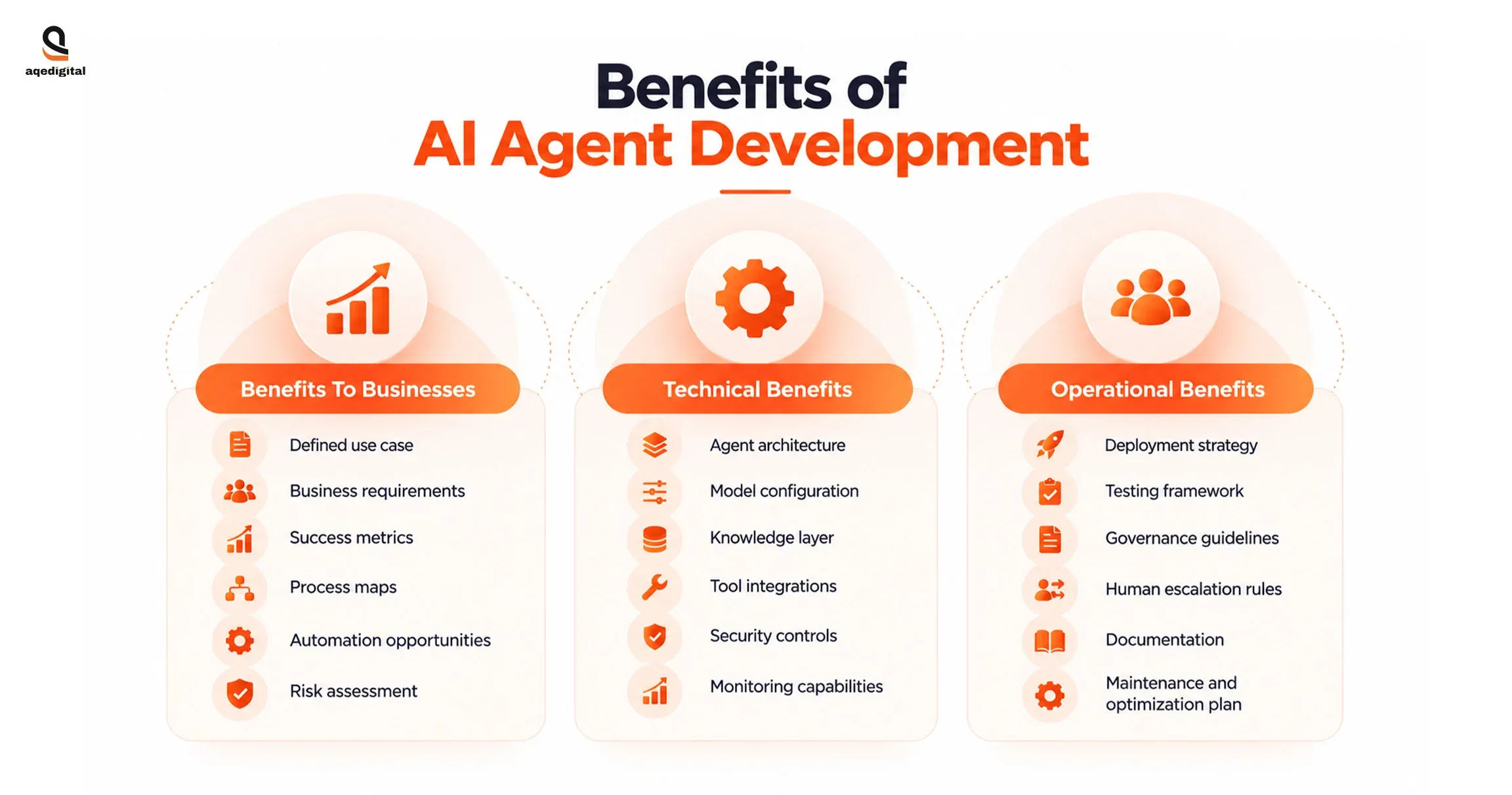
Enterprises should expect more than a functioning chatbot or demonstration.
A professional AI agent development company should typically deliver a combination of technology, documentation, and operational capabilities.
Business Deliverables
- Defined use case
- Business requirements
- Success metrics
- Process maps
- Automation opportunities
- Risk assessment
Technical Deliverables
- Agent architecture
- Model configuration
- Knowledge layer
- Tool integrations
- APIs
- Security controls
- User interfaces
- Monitoring capabilities
Operational Deliverables
- Deployment strategy
- Testing framework
- Governance guidelines
- Human escalation rules
- Documentation
- Maintenance and optimization plan
The value of agentic AI development services should be measured by what the organization can operationalize, not simply what the development team can demonstrate.
How Much Does AI Agent Development Cost?
There is no reliable universal price for an enterprise AI agent.
The AI agent development cost depends on the complexity of the workflow, number of integrations, data requirements, model strategy, security requirements, user volume, autonomy level, and ongoing operational needs.
A basic internal productivity agent may require relatively limited development effort.
A customer-facing enterprise agent connected to CRM, ERP, payment, knowledge, and support systems can require significantly more engineering.
The AI agent development cost should therefore be evaluated using the complete implementation scope rather than an isolated development quote.
Consider:
Discovery + architecture + development + integrations + data preparation + security + testing + deployment + monitoring + ongoing optimization
A low initial quote can become expensive if critical enterprise requirements appear only after development begins.
What Should Enterprises Look For When They Hire AI Agent Developers?
Choosing the right team is as important as choosing the underlying AI technology.
When enterprises hire AI agent developers, they should evaluate more than experience with a particular framework or foundation model.
The strongest development teams understand both AI and enterprise software engineering.
That combination matters because most production agents do not operate in isolation. They must work with the technology stack the organization already depends on.
Common Mistakes Enterprises Should Avoid
Agentic AI initiatives can lose momentum when organizations underestimate the difference between a compelling demonstration and a dependable production system.
- Choosing a Use Case for Novelty: Building an impressive agent without measurable business value makes adoption difficult to justify.
- Giving Agents Excessive Permissions: Broad system access can create unnecessary security, compliance, and operational risks.
- Skipping Workflow Redesign: Adding an agent to an inefficient process may automate existing inefficiencies instead of improving the underlying operation.
- Ignoring Integration Complexity: An agent cannot deliver enterprise value if it cannot reliably access the systems required to complete its workflow.
- Treating Governance as Documentation: Governance must influence architecture, permissions, monitoring, testing, and operating procedures from the beginning.
- Scaling Before Proving Reliability: Expanding an unstable agent across departments can multiply operational problems rather than multiply business value.
How AQe Digital Can Help With AI Agent Development
Building enterprise AI agents requires a combination of AI expertise, software engineering, data capabilities, integration experience, and production discipline.
AQe Digital can support organizations across the complete agent lifecycle, from identifying viable opportunities to deploying and scaling production-ready solutions.
AI Agent Consulting: We help enterprises identify high-value agent opportunities, assess feasibility, define business requirements, and create practical implementation roadmaps.
Custom AI Agent Development: AQe Digital develops purpose-built agents around specific business workflows, data environments, user roles, decision rules, and enterprise requirements.
Agentic AI Development Services: We design and develop agentic systems capable of reasoning through workflows, using approved tools, accessing enterprise knowledge, and completing defined tasks within controlled boundaries.
AI Agent Integration Services: We connect AI agents with enterprise applications, APIs, databases, CRM, ERP, cloud platforms, and other systems required to execute real business workflows.
AI Agent Implementation Services: Our teams support deployment, testing, security, monitoring, workflow integration, user adoption, and transition from controlled pilots to production environments.
Enterprise AI Agent Development: We help organizations build scalable agent architectures that support security, governance, interoperability, observability, and future expansion across departments.
AI Automation: We design intelligent workflows that combine AI agents with business applications to reduce repetitive work and improve operational efficiency.

Conclusion
The difference between an impressive prototype and a dependable enterprise capability lies in the decisions made around workflows, integrations, security, governance, and continuous improvement. Choosing an experienced AI agent development company can help enterprises move from experimentation to practical, scalable adoption with the right balance of automation and human oversight.
AQe Digital brings together AI engineering, enterprise integration, data expertise, and production experience to build agents around real business requirements.
Contact Us to build and scale enterprise AI agents designed for measurable business impact.