

Scaling a business today is about how fast you can execute it, how efficiently you use resources, and how smartly you adapt to market changes. That’s exactly why global enterprises and fast-growing startups alike are turning to offshore software development services as a long-term growth strategy rather than a short-term cost fix. By 2026, the market of global offshore software development is estimated to reach $198.3 billion and continue expanding to $509.2 billion by 2035.
From tech giants setting up development centers in global IT hubs like India to emerging businesses building lean product teams, the shift is clear. The offshore business model offers affordability as well as helps businesses unlock access to skilled engineers, emerging technologies, and delivery speed that would otherwise be difficult or expensive to achieve locally. When competition is fierce and timelines are tight, offshore development becomes a powerful lever for innovation and scale.
Offshore software development allows companies to delegate complex technical responsibilities to experienced teams while staying focused on their core business goals. From accelerating product development to expanding technical capabilities to supporting long-term digital transformation, offshore teams bring flexibility and depth that modern businesses need.
In the sections below, we’ll explore the key benefits of offshore software development, how it supports different business goals, how it works, and why companies, regardless of size or industry, are embracing this model to stay ahead in a rapidly evolving digital landscape.
What Is Offshore Software Development?
Offshore software development is a delivery model where businesses delegate part or sometimes the entire software project to a development team located in another country, often operating in a different time zone. But this approach is no longer just about cutting costs. Today, it’s a strategic move designed to help companies scale faster, innovate smarter, and stay competitive in global markets.
At its core, offshore development allows organizations to access highly skilled engineers beyond local hiring limitations. Businesses often begin their offshore journey by engaging Software Development Consulting Services to assess feasibility, define delivery models, and align offshore strategy with long-term business goals.
Companies in regions like the US or Australia often collaborate with offshore teams in talent-rich locations such as India. As India offers a strong mix of technical expertise, mature development practices, and cost efficiency, it makes offshore software development services a compelling option for businesses of all sizes.
Offshore teams don’t operate in isolation. They work as an extension of your in-house team, following agile methodologies, aligning with sprint cycles, and contributing to continuous delivery. This is especially impactful for offshore app development, where speed, scalability, and rapid iteration directly influence user experience and market success.

How Offshore Development Works in Practice
Many companies adopt flexible engagement models to maximize results:
- Dedicated Offshore Development Centers (ODCs): Long-term teams focused exclusively on your products
- Hybrid Offshore–Nearshore Models: A balance of time zone overlap, cultural alignment, and 24/7 productivity
- Build-Operate-Transfer (BOT) Model: Offshore teams are built and managed externally, then internalized once operations stabilize
These models give businesses control and adaptability while reducing operational complexity.
Offshoring vs. Outsourcing vs. Nearshoring vs. Onshoring: What’s the Real Difference?
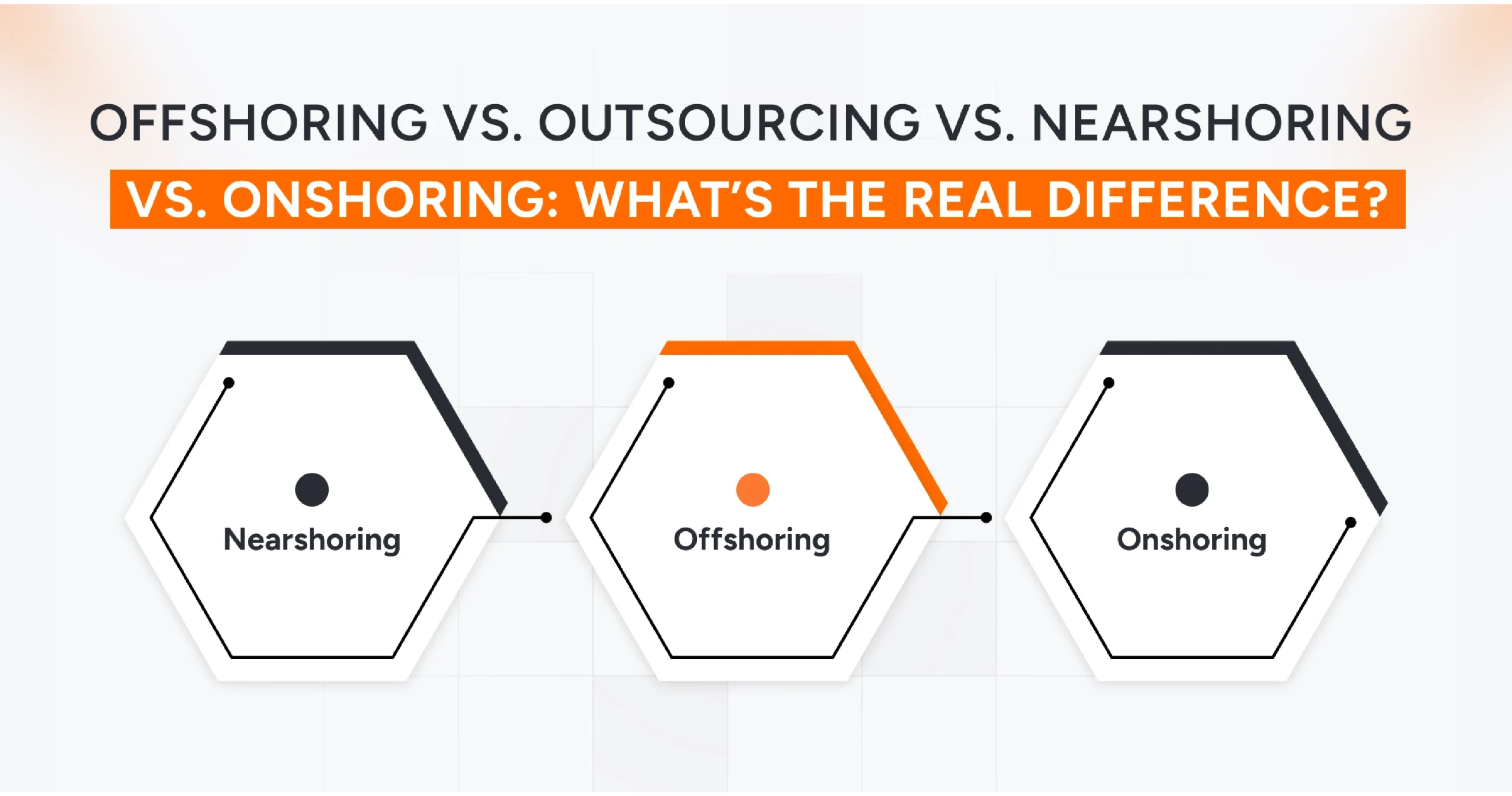
As businesses look for faster innovation and smarter ways to scale, global delivery models have become a core part of modern technology strategy. Terms like offshoring, outsourcing, nearshoring, and onshoring are often used interchangeably, but they represent very different approaches to building and managing development teams. Understanding these differences is critical when choosing the right offshore business model or delivery strategy for long-term growth.
While each model aims to improve efficiency and access to talent, they vary significantly in team structure, collaboration style, cost dynamics, and level of control.
Offshoring: Long-Term Global Capability Building
Offshoring is about creating dedicated, high-performing technology teams in another country. This model is commonly used by organizations that want consistent delivery, deep domain expertise, and scalable capacity.
With offshore software development services, businesses gain access to large global talent pools, lower development costs, and around-the-clock productivity due to time zone differences. Offshore teams typically work as an extension of in-house teams, following the same processes, tools, and performance standards.
Best suited for:
- Long-term product development
- Scaling engineering teams without local hiring constraints
- Companies seeking cost efficiency without sacrificing quality
Outsourcing: Task-Based and Short-Term Execution
Outsourcing focuses on delegating specific tasks or projects to an external vendor, usually for a defined timeframe. The goal is speed and convenience rather than building a long-term team.
Unlike offshoring, outsourcing doesn’t always guarantee continuity or deep product knowledge. It’s effective for clearly defined deliverables but may lack flexibility as requirements evolve.
Best suited for:
- One-time projects or maintenance tasks
- Non-core development activities
- Short-term capacity gaps
Nearshoring: Geographic Proximity with Cultural Alignment
Nearshoring involves setting up development teams in neighbouring or nearby countries, offering similar time zones and cultural compatibility. This model balances cost savings with easier collaboration.
Businesses often choose nearshoring when real-time communication is critical but local talent is either scarce or expensive. While nearshoring can reduce coordination challenges, it may not always deliver the same cost advantages as a full offshore business model.
Best suited for:
- Teams needing frequent collaboration
- Projects requiring strong cultural alignment
- Businesses prioritizing time zone overlap
Onshoring: Maximum Control, Higher Costs
Onshoring means building and managing software teams within the same country as the business headquarters. This approach offers direct oversight, instant communication, and strong regulatory alignment.
However, onshoring often comes with higher labor costs and limited access to specialized skills, especially in competitive talent markets.
Best suited for:
- Highly regulated industries
- Projects requiring strict data governance
- Organizations prioritizing face-to-face collaboration
Benefits of Offshore Software Development
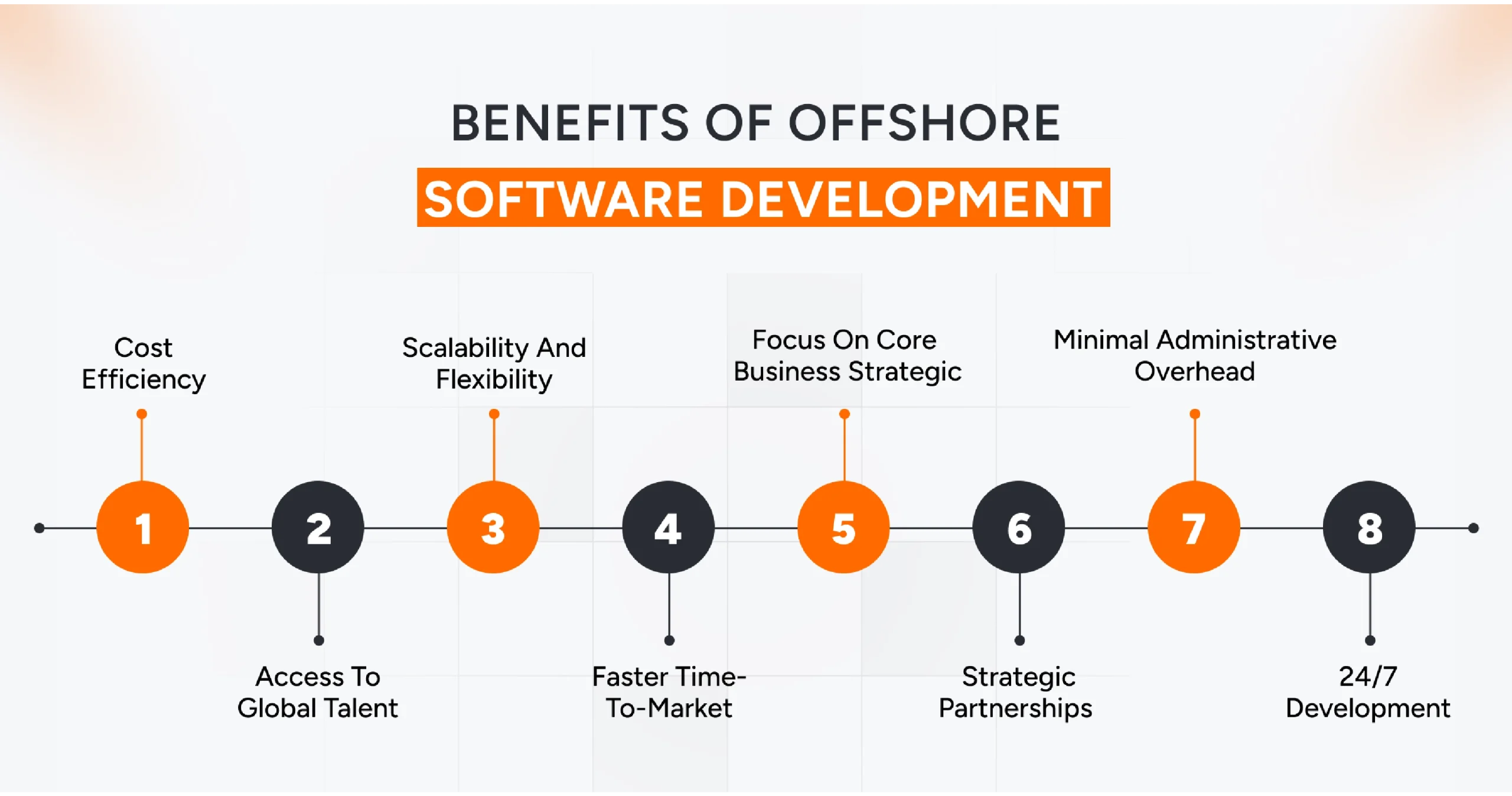
When executed strategically, offshore development becomes a growth engine, one that blends operational efficiency, global talent access, and business agility into a single, scalable delivery model. For modern enterprises and fast-growing digital businesses, the offshore business model is less about outsourcing tasks and more about building long-term capability that fuels innovation and speed.
Below are the key benefits of offshore development:
Cost Efficiency That Improves Total Ownership Value
Offshore development can reduce direct development costs significantly, but the real value lies in lowering the total cost of ownership. Instead of investing heavily in local hiring, infrastructure, onboarding, and retention, businesses shift these responsibilities to experienced offshore partners. According to a report by Deloitte, 70% of companies primarily focus on saving costs when outsourcing services.
With offshore software development services, costs related to HR management, office space, compliance, and operational overhead are bundled into a predictable engagement model. This allows organizations to reallocate budgets toward innovation, product enhancements, and customer experience, areas that directly drive revenue.
How Offshore Software Development Makes It Happen?
Offshore teams operate in cost-efficient regions with mature IT ecosystems. Vendors provide ready-to-scale teams, infrastructure, and governance, eliminating the need for internal setup while maintaining delivery quality.
Access to Global and Niche Technical Talent
Hiring skilled engineers in areas like AI, cloud-native architecture, DevOps, or microservices has become increasingly competitive and expensive. Offshore development removes geographic limitations, opening doors to deep, specialized talent pools across the globe.
Through offshore app development, businesses gain access to engineers who work daily with modern frameworks, emerging technologies, and enterprise-scale systems. This accelerates digital transformation and reduces the learning curve for advanced initiatives.
How Offshore Software Development Makes It Happen?
Offshore software development services tap into regions with strong technical education systems and large developer communities. Teams are assembled based on skill alignment, not proximity, ensuring faster access to expertise that fits the project’s exact needs.
Scalability and Operational Flexibility
Digital projects rarely follow a straight line. They expand, pause, pivot, and scale, sometimes all together. Offshore development supports this reality by offering elastic team structures that grow or shrink based on demand.
Instead of overstaffing internally or scrambling to hire, companies using an offshore business model can scale resources on demand. This flexibility is especially valuable during product launches, peak development phases, or large platform rollouts.
How Offshore Software Development Makes It Happen?
Offshore partners maintain talent pipelines and bench strength, enabling rapid team expansion or contraction. This dynamic resourcing model keeps delivery on track without long-term workforce commitments.
Faster Time-to-Market Through Continuous Delivery
Speed is a competitive advantage, and offshore development helps businesses move faster. Distributed teams working across time zones enable a development cycle where progress continues even after in-house teams log off.
For companies building digital platforms or customer-facing products, offshore app development shortens release cycles, accelerates testing, and speeds up feature deployment without exhausting internal teams.
How Offshore Software Development Makes It Happen?
Offshore software development services leverage agile workflows, DevOps automation, and time zone coverage to maintain momentum. Work is handed off seamlessly between teams, reducing idle time and accelerating delivery timelines.
Sharper Focus on Core Business Priorities
Managing software development internally often pulls leadership into daily execution details. Offshore development changes that equation. By shifting technical execution to offshore teams, internal stakeholders can focus on strategy, growth, and differentiation.
This separation allows businesses to prioritize initiatives such as customer experience, new revenue streams, and market expansion, while offshore teams handle development complexity.
How Offshore Software Development Makes It Happen?
Offshore teams operate with defined ownership, KPIs, and governance models. Clear accountability ensures that execution stays on track, freeing internal teams from micromanagement.
Strategic Partnerships That Drive Innovation
Long-term offshore engagements evolve into strategic partnerships. Instead of acting as task-based vendors, mature offshore teams bring industry insights, engineering best practices, and proactive innovation to the table.
This approach transforms the offshore business model into a collaborative ecosystem where solutions are co-created.
How Offshore Software Development Makes It Happen?
Offshore software development services invest in domain knowledge, architectural thinking, and continuous improvement. Over time, offshore teams gain deep product understanding and contribute strategically, not just technically.
Minimal Administrative and Management Overhead
Handling recruitment, payroll, compliance, office management, and local labor regulations can slow down growth. Offshore development removes this burden entirely.
With offshore app development teams managing their own operations, businesses gain simplicity, predictability, and reduced internal workload.
How Offshore Software Development Makes It Happen?
Offshore partners take full responsibility for HR, infrastructure, and compliance. Companies interact with a single delivery interface while operational complexity stays behind the scenes.
24/7 Development for Faster Outcomes
One of the most overlooked benefits of offshore software development is round-the-clock productivity. While in-house teams rest, offshore teams continue building, testing, and optimizing.
This continuous cycle results in quicker turnarounds, faster issue resolution, and accelerated project completion, especially valuable for time-sensitive releases.
How Offshore Software Development Makes It Happen?
By leveraging global time zones and structured handover processes, offshore software development services ensure that work progresses without interruption, maximizing productivity every hour of the day.
To see how these benefits translate into real-world outcomes, explore our full-cycle offshore development and modernization success story that highlights measurable business impact.

Managing Risks in Offshore Software Development (and How to Mitigate Them)
To unlock the advantages of offshore software development sustainably, businesses must address the risks that come with distributed delivery models. Offshore success doesn’t happen by chance. It’s the result of thoughtful planning, strong governance, and choosing the right offshore business model from the start.
Below are the most common offshore challenges and how leading companies mitigate them.
Communication Barriers
Working across geographies can introduce language gaps, unclear documentation, or mismatched expectations. Small misunderstandings can snowball into rework and missed deadlines.
How to mitigate it:
Clear communication frameworks make all the difference. Standardized documentation, shared project management tools, and structured reporting keep everyone aligned.
Quality Assurance and Delivery Consistency
Without defined oversight, offshore app development efforts may suffer from uneven quality, inconsistent coding practices, or delayed defect detection.
How to mitigate it:
High-performing offshore software development services embed quality from day one. Continuous testing, automated QA pipelines, and shared coding standards ensure delivery remains predictable and enterprise-grade.
Security, Data Protection, and Compliance
Offshore teams often work with sensitive customer or business data. Without proper controls, this can raise concerns around GDPR, HIPAA, PCI DSS, and other regulatory frameworks.
How to mitigate it:
A mature offshore business model prioritizes compliance. Working only with certified partners, enforcing strict SLAs, and conducting regular security audits protects both data and reputation.
Cultural Differences
Differences in communication styles, feedback expectations, or decision-making approaches can slow collaboration or reduce trust between teams.
How to mitigate it:
Cross-cultural training and blended team structures help bridge gaps. Many companies assign onshore product owners to work closely with offshore teams, ensuring clarity and alignment.
Time Zone Gaps
Time differences of 6–12 hours can reduce real-time collaboration and slow agile feedback loops if not planned carefully.
How to mitigate it:
Successful offshore app development teams define overlap hours, establish clear handoff protocols, and rely on asynchronous communication to keep momentum moving.
Legal, Regulatory, and IP Risks
Weak contracts or limited local legal knowledge can expose businesses to intellectual property disputes, compliance violations, or operational disruptions.
How to mitigate it:
Strong legal frameworks are essential. Well-drafted contracts, IP ownership clauses, NDAs, and jurisdictional safeguards protect long-term interests and reduce uncertainty.
Conclusion
In a world where speed, resilience, and innovation define success, businesses need models that evolve as fast as their ambitions. The offshore business model enables organizations to experiment boldly, adapt quickly, and build digital products that scale without being constrained by geography or talent shortages. The real value lies in continuity, global collaboration, and the ability to turn ideas into outcomes with confidence.
With deep expertise in offshore software development services and a strong focus on quality, security, and innovation, AQe Digital helps businesses transform vision into scalable digital solutions. Contact us to explore how our offshore app development teams can accelerate your growth.
FAQs
Offshore app development allows businesses to build dedicated teams that grow alongside the product. Over time, these teams gain domain knowledge, improve velocity, and contribute strategically. This continuity supports faster feature releases and long-term roadmap execution.
Yes, startups benefit greatly from the offshore business model. It reduces upfront hiring costs, accelerates MVP development, and provides access to experienced engineers. This helps startups validate ideas faster without overextending budgets.
Reputable offshore software development services follow standardized coding practices, automated testing, and peer reviews. Continuous integration and quality assurance processes ensure consistency, scalability, and maintainable code across all development phases.
Absolutely. Offshore app development teams are well-equipped to manage enterprise-grade applications involving cloud architecture, microservices, and system integrations. Many teams specialize in handling complex, high-traffic, and security-sensitive platforms.
Common models include dedicated teams, fixed-price projects, and time-and-material contracts. The offshore business model is flexible, allowing companies to choose based on project scope, duration, and control requirements.