Why Healthcare Mobile App Development Is Crucial For Every Healthcare Provider?

Vishal Panchal
Healthcare is undergoing a structural digital shift. Patient expectations continue to evolve, care delivery models are becoming increasingly hybrid, and regulatory oversight is tighter than ever. In such a market scenario, healthcare mobile app development becomes a strategic necessity for the providers. Organizations evaluating mobile app development services must consider far more than user interface design or feature sets.
Healthcare providers and orgnizations are investing in mobile solutions not simply to modernize experiences, but to improve accessibility, streamline operations, and remain competitive in a rapidly transforming industry. As per the report published by McKinsey, 75% of healthcare executives consider and view digital transformation as an important factor for streamlining the clinical processes.
Yet many organizations underestimate what app development for healthcare truly involves. Unlike consumer-focused applications, healthcare apps must operate within complex clinical environments, integrate with fragmented systems, and handle highly sensitive data under strict compliance frameworks.
Healthcare mobile app development demands a fundamentally different approach. The approach is grounded in strategy, validation, security, and regulatory awareness.
What Is Healthcare App Development?
Healthcare application development involves creating mobile software designed to handle and process health-related data for users. These applications support individuals and healthcare communities seeking to monitor, manage, or improve health outcomes through accessible digital tools. By offering features such as medical information access, appointment scheduling, and health tracking, healthcare apps simplify how users interact with healthcare services and make informed decisions about their well-being.
Beyond convenience, healthcare app development plays a direct role in strengthening patient engagement. Mobile applications enable real-time communication between patients and providers, encourage continuous health monitoring, and facilitate more personalized care experiences. Instead of relying solely on episodic clinical visits, users can actively participate in their care journey through consistent digital interaction.
Why Healthcare App Development Is Important?
Healthcare is no longer confined to hospitals and clinics. Care delivery, patient engagement, and health management increasingly depend on digital access, real-time data, and seamless communication. This shift is precisely why healthcare mobile solutions have become essential rather than optional.
Healthcare app development empowers organizations to improve service delivery, enhance patient experiences, and operate more efficiently in an environment defined by rising expectations and regulatory pressures.
Well-designed healthcare applications create measurable impact across clinical, operational, and patient-centered dimensions:
- Improved Patient Engagement: Enable continuous interaction, reminders, and personalized health insights.
- Better Access to Care: Support tele-consultations, remote monitoring, and digital health services anywhere.
- Enhanced Care Coordination: Streamline communication between patients, providers, and caregivers.
- Operational Efficiency: Reduce administrative burdens through automation and structured workflows.
- Data-Driven Decision Making: Provide real-time patient data and treatment progress.
- Regulatory & Security Alignment: Build systems designed for privacy, compliance, and secure data handling.
- Scalable Care Models: Extend healthcare services without proportional increases in infrastructure.
Ultimately, healthcare app development is important because it directly influences care quality, accessibility, and sustainability. Organizations that invest strategically in mobile technologies position themselves to deliver faster, safer, and more patient-centric healthcare experiences.

Different Types of Healthcare Mobile Apps
Healthcare mobile app development spans a wide spectrum of use cases, each designed to address the distinct needs of patients, clinicians, and healthcare operations. Understanding these variations is essential for organizations planning effective app development for healthcare, as the target audience directly influences design, functionality, HIPAA compliance requirements, data security architecture, and overall regulatory alignment.
Healthcare Apps for Patients
Patient-centric applications act as digital health companions. They help users monitor wellness metrics, track symptoms, manage medications, access medical information, and stay engaged with their care plans. These apps often include features like reminders, educational resources, and progress tracking, enabling individuals to take a more proactive role in managing their health.
Healthcare Apps for Providers
Provider-focused apps are built to enhance clinical productivity and decision-making. They offer secure access to patient records, streamline documentation, support e-prescriptions, and facilitate collaboration across care teams. By reducing manual friction and improving information accessibility, these solutions contribute to faster workflows and more informed clinical actions.
Healthcare Apps for Medical Administration Staff
Administrative applications optimize the operational backbone of healthcare organizations. They assist with appointment coordination, billing processes, digital record management, and inventory oversight. Some platforms also incorporate internal communication tools, improving information flow between departments and minimizing administrative inefficiencies.
mHealth Applications
Mobile health, or mHealth, apps emphasize accessibility and continuous care delivery. These applications commonly support telemedicine, remote patient monitoring, chronic disease management, and personalized interventions. By leveraging mobile connectivity, mHealth solutions extend care beyond traditional clinical environments and enable real-time health engagement.
Medical Resource & Information Apps
Resource-oriented healthcare apps deliver rapid access to critical medical knowledge. Examples include drug reference tools, clinical guidelines, diagnostic support utilities, and medical calculators used for dosage or risk assessment. Such applications play a valuable role in improving accuracy, efficiency, and on-the-go decision support for both professionals and patients.
Each category highlights different types of healthcare mobile app development and precisely explains how different types of apps align with user roles, clinical contexts, and operational demands.
Benefits of Healthcare Application Development
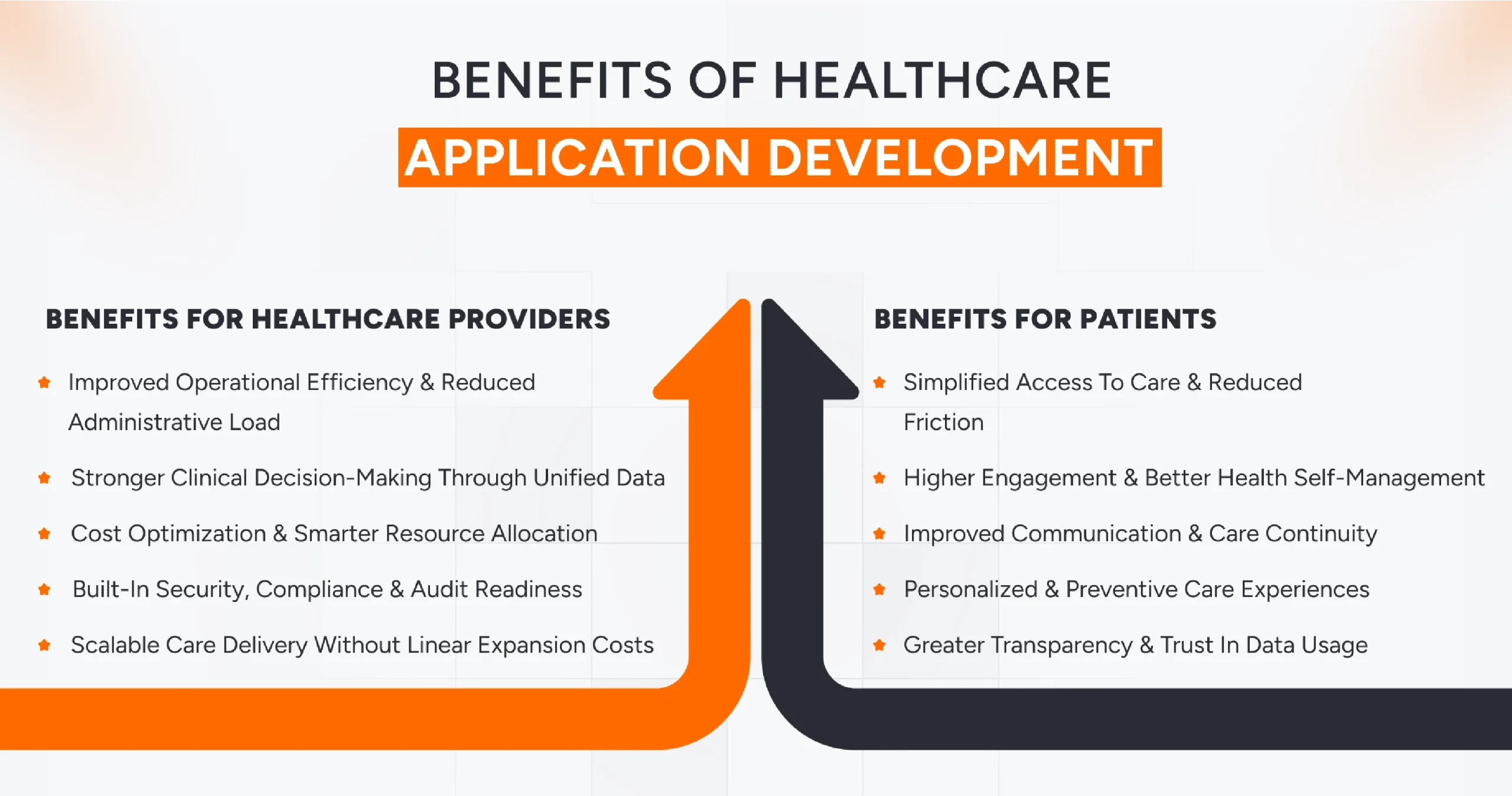
Healthcare mobile app development creates tangible advantages across the entire care ecosystem. When executed with the right strategy, AI healthcare solutions improve how providers operate and how patients experience care. This is precisely why healthcare application development has become a high-impact investment.
Benefits for Healthcare Providers
Well-designed mobile solutions address some of healthcare’s most persistent operational and clinical challenges. Beyond convenience, they reshape efficiency, decision-making, and scalability.
Improved Operational Efficiency & Reduced Administrative Load
Mobile applications automate scheduling, documentation, and reporting workflows that traditionally consume significant clinical time. By minimizing manual processes, providers can redirect attention toward patient care instead of administrative overhead.
Stronger Clinical Decision-Making Through Unified Data
Provider-facing apps consolidate information from electronic health records, diagnostic systems, and connected devices into a structured, accessible interface. When analytics and AI capabilities are layered in, clinicians gain faster insights and improved diagnostic confidence.
Cost Optimization & Smarter Resource Allocation
Digital health platforms help reduce appointment no-shows, eliminate redundant procedures, and support telehealth models that limit unnecessary in-person visits. The result is more efficient utilization of staff, infrastructure, and clinical resources.
Built-In Security, Compliance & Audit Readiness
Regulatory and privacy requirements are integral to app development for healthcare. Modern healthcare apps embed safeguards such as encryption, access controls, consent management, and audit trails, helping organizations reduce risk while maintaining data integrity.
Scalable Care Delivery
Mobile-enabled care models allow providers to extend services including remote monitoring and virtual consultations without proportionally increasing physical infrastructure. This supports sustainable growth while expanding patient reach.
Benefits for Patients
Healthcare mobile app development also transforms the patient experience. These applications empower individuals with greater access, visibility, and control over their care journey.
Simplified Access to Care & Reduced Friction
Mobile apps enable appointment booking, virtual consultations, and digital triage, reducing complex processes and wait times. Care becomes more accessible, particularly for patients with mobility or geographic constraints.
Higher Engagement & Better Health Self-Management
Features such as medication reminders, symptom tracking, and personalized health insights encourage patients to actively participate in their treatment plans. Consistent engagement often correlates with improved adherence and outcomes.
Improved Communication & Care Continuity
Secure messaging, shared records, and coordinated care features bridge gaps between providers and patients. This continuity reduces misunderstandings, duplicated tests, and fragmented treatment experiences.
Personalized & Preventive Care Experiences
Data-driven healthcare apps tailor recommendations and alerts based on individual profiles, behaviors, and health indicators. Patients receive timely guidance rather than generic interventions.
Greater Transparency & Trust in Data Usage
Access to records, prescriptions, and consent preferences gives patients clearer visibility into their healthcare information. Integrated privacy controls reinforce confidence in how sensitive data is handled.
Mobile-enabled care models allow providers to expand services without proportional infrastructure growth. Explore how our telemedicine app development for healthcare providers help extend clinical services while maintaining care continuity and patient engagement.

Step By Step Process For Healthcare Mobile App Development
Successful healthcare mobile app development follows a structured, validation-driven process that balances user expectations, clinical realities, and regulatory obligations. Skipping steps or compressing decisions often leads to security gaps, poor adoption, or costly redesigns. A disciplined healthcare application development approach, on the other hand, creates a foundation for scalability, compliance, and long-term product success.
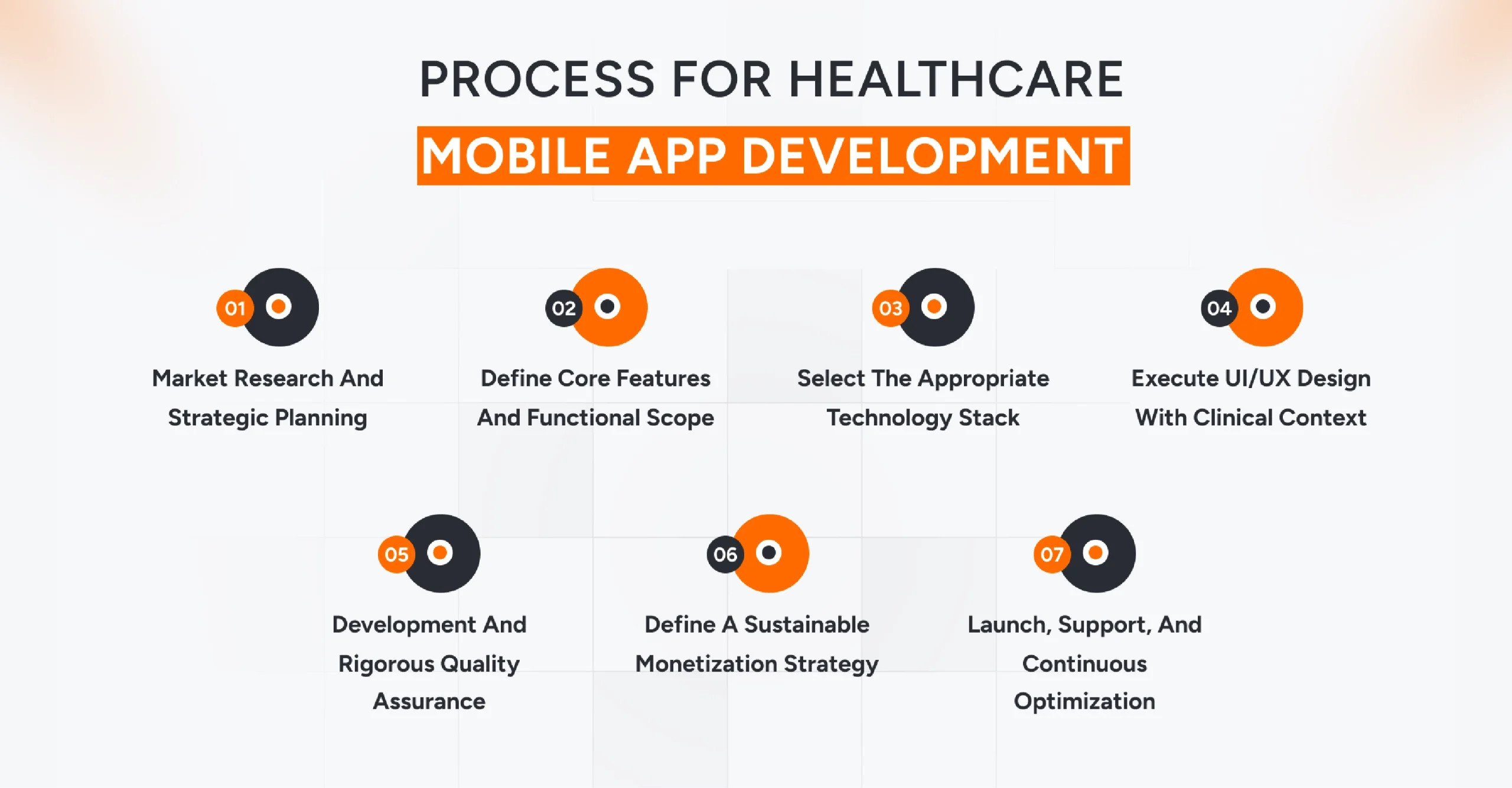
Step 1: Market Research and Strategic Planning
Every effective product begins with clarity. Identify who the app serves, patients, providers, caregivers, or multiple stakeholders, and define the problems worth solving. This stage also requires careful evaluation of regional healthcare regulations, privacy frameworks, and data protection requirements that may influence design decisions.
Expert insight: Quantify target audience size, usage behavior, and adoption barriers early to confirm commercial viability before investing in full-scale development validating the demand and understanding the market gap.
Step 2: Define Core Features and Functional Scope
Healthcare applications must solve specific problems without unnecessary complexity. Prioritize essential capabilities for the Minimum Viable Product (MVP), such as appointment management, remote consultations, monitoring tools, or secure communication. Focus on usability and data security from the outset rather than treating them as later enhancements.
Expert insight: Document scalability pathways early so the application can evolve alongside user growth and operational expansion.
Step 3: Select the Appropriate Technology Stack
Technology choices directly influence performance, security, and integration flexibility. Healthcare mobile app development typically demands architectures designed for interoperability, reliability, and data protection. The selected stack should also support future integrations with electronic health records, payment systems, analytics engines, or third-party services.
Expert insight: Favor technologies that simplify maintenance and adaptability rather than optimizing purely for development speed.
Step 4: Execute UI/UX Design With Clinical Context
Healthcare interfaces must prioritize clarity, accessibility, and cognitive simplicity. Navigation should feel intuitive across diverse user groups, including elderly patients or time-constrained clinicians. Visual hierarchy, readability, and responsive layouts play a critical role in reducing friction and improving engagement.
Expert insight: Interactive prototypes enable early feedback, minimizing usability risks before engineering resources are committed.
Step 5: Development and Rigorous Quality Assurance
Development phases require tight coordination between front-end and back-end systems to ensure stability and secure data exchange. Testing extends beyond functional validation. Security assessments, performance checks, integration testing, and compliance verification are essential to meet healthcare standards.
Expert insight: Embedding compliance reviews within QA cycles significantly reduces regulatory and operational risk.
Step 6: Define a Sustainable Monetization Strategy
Healthcare applications must align business models with user expectations and market dynamics. Subscription structures, enterprise licensing, usage-based pricing, or partnership-driven approaches are common. The monetization logic should reinforce the application’s value without creating adoption barriers.
Expert insight: Competitive analysis and user behavior research help avoid pricing models that undermine growth.
Step 7: Launch, Support, and Continuous Optimization
Deployment marks the beginning, not the conclusion. Post-launch performance monitoring, user feedback analysis, and rapid issue resolution are vital for maintaining reliability. Regular updates ensure compatibility, security resilience, and feature evolution as healthcare needs shift.
Expert insight: Dedicated support and iterative improvement cycles sustain engagement and protect long-term product viability.
Conclusion
Healthcare innovation is increasingly shaped by how intelligently technology connects patients, providers, and data. Healthcare mobile app development is about building resilient digital ecosystems that adapt to changing care models, patient behaviors, and regulatory landscapes. Organizations that view healthcare application development through this long-term lens position themselves for sustained efficiency, trust, and scalability rather than short-term functionality.
AQe Digital combines deep technology expertise with practical healthcare domain understanding, enabling organizations to build secure, compliant, and future-ready solutions. Our approach prioritizes usability, performance, and measurable outcomes. If you are planning your next digital initiative, contact us to explore how we can help.