

Cloud cost optimization is now a boardroom priority as cloud bills rise despite strict cost controls, driven by AI workloads, Kubernetes sprawl, and real-time consumption-based pricing models. Idle resources, overprovisioned infrastructure, hidden data transfer fees, and AI-driven workloads silently drain budgets every month, often without delivering proportional business value. In fact, industry studies estimate that 20-35% of cloud spend is wasted due to inefficiencies and limited visibility.
Modern cloud cost optimization goes beyond basic monitoring. It combines proven cloud cost optimization strategies, tools, and best practices to continuously identify waste, improve resource utilization, and align cloud spend with real business demand rather than assumptions.
As organizations scale AI, Kubernetes, and multi-cloud environments, adopting effective cloud cost-optimization techniques and solutions becomes essential for predictable spend, higher ROI, and sustainable growth.
In this guide, we explore what cloud cost optimization is, why it matters now, the most effective strategies, tools, and best practices, and how businesses can regain control of cloud costs without slowing innovation.
What is Cloud Cost Optimization?
Cloud cost optimization is the process of identifying and optimizing unused or wasted resources to reduce expenses. It includes resource analysis, identification, monitoring, and management of instances. This process is not a one-off event but a continuous activity that goes beyond resource monitoring and management.
Why Do You Need Cloud Cost Optimization?
Cloud cost optimization strategies can help your business gain sustainability and growth. Leveraging the cloud cost optimization best practices, enterprises can balance costs against performance, ensuring higher ROI, and capitalize on the potential of cloud computing.
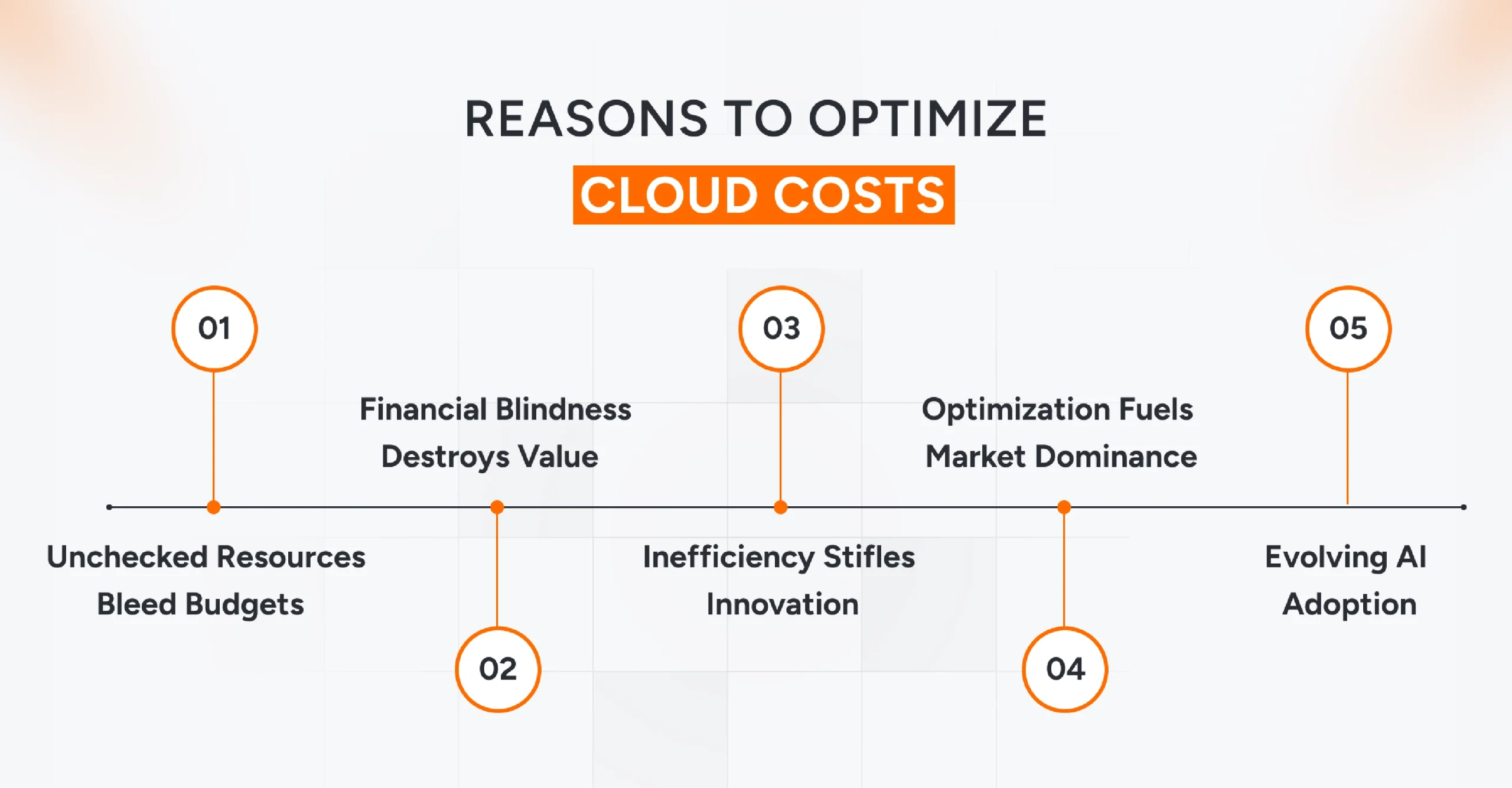
Some of the key reasons to optimize cloud costs are,
1. Unchecked Resources Bleed Budgets
Idle assets are silent killers. You are actively paying for capacity you do not use. Because dynamic pricing hides the leak, this includes idle instances, forgotten storage volumes, and overprovisioned databases.
2. Financial Blindness Destroys Value
Spending must drive actual performance. Budget surprises are unacceptable in modern operations. Because unpredictability paralyzes your strategic planning, you end up with unstable monthly bills, skewed forecasts, and zero transparency into ROI.
3. Inefficiency Stifles Innovation
Your teams get stuck managing junk. Right-sizing resources is mandatory for speed. Plus, manual maintenance creates critical bottlenecks. This includes slow scaling, bloated IT processes, and distracted engineering teams.
4. Optimization Fuels Market Dominance
Cloud cost savings must fund the future. Efficient resource use immediately lowers your carbon footprint. Because wasted energy threatens long-term viability, this includes new financing products, expanding markets, and reducing environmental impact.
5. Evolving AI Adoption
AI adoption has shifted cloud costs from static infrastructure pricing to highly variable, real-time consumption economics driven by GPUs, inference workloads, and token-based usage models. Training, fine-tuning, and inference introduce new financial metrics such as cost per inference, cost per 1K tokens, and cost per AI-driven transaction.
This is why it is essential to optimize cloud costs, especially in 2026, when AI adoption is set to increase exponentially. But what are the key strategies to maximize cloud cost?

Cloud Cost Optimization Strategies That Deliver Results
Cloud cost optimization is not about budget cuts. It goes beyond and focuses on the strategic discipline often termed as FinOps. Organizations must address rate and cloud usage optimization to reduce cloud costs.
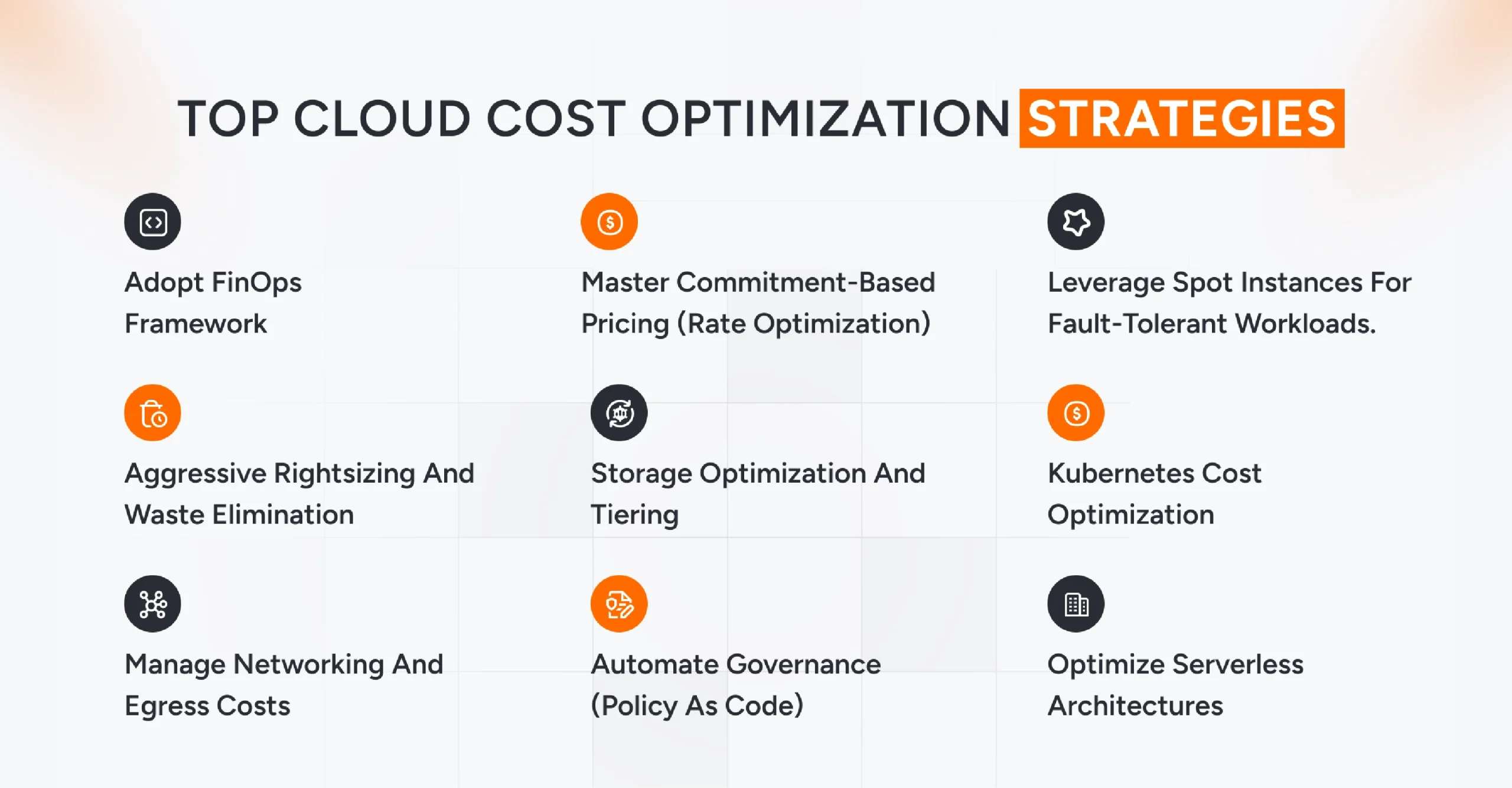
Here are some of the key strategies you can use for cloud cost optimization,
1. Adopt FinOps Framework
Adopting the FinOps framework for your enterprise development projects involves three stages,
- Inform (Visibility) – Accurately allocate cloud and AI spend using tagging, telemetry, and business-mapped unit economics.
- Optimize (Efficiency) – Leverage real-time decision-making to reduce waste, right-size resources, and capitalize on tiered and commitment-based pricing.
- Operate (Governance) – Embed cost management into daily engineering workflows, ensuring that cloud cost becomes a key metric.
Let’s understand the above framework through an example. An eCommerce business launches a new “AI Product Recommendation” feature. The cloud computing bill suddenly shoots up to $50,000 in a month. To reduce this cost, the eCommerce company needs to apply the FinOps framework in the following phases,
Phase 1: Figure out who spent the money and why.
The goal is to stop guessing and start measuring.
- Action (Tagging): The engineering leads implement a mandatory tagging policy. Every server used for the new feature is tagged with Project: AI-Recs and Team: Data-Science.
- Action (Reporting): They generate a Showback report. This report reveals that the $50k cost came specifically from the Data Science team leaving high-performance GPU servers running 24/7, even when no customers were browsing the site at 3 AM.
- Outcome: The “mystery bill” is solved. The business now has visibility into unit economics: they know precisely how much the AI feature costs per day.
Phase 2: Take immediate action to reduce waste (Optimize)
Now that the source of the cost is known, the team makes data-driven decisions to lower it without hurting performance.
- Action (Right-Sizing): Telemetry data indicates the servers are underutilizing CPU capacity. The team downsizes to more minor, cheaper instances that better fit the actual workload.
- Action (Scheduling): They implement auto-scaling scripts that automatically shut down development servers at night and on weekends.
- Action (Rate Optimization): Since this AI feature is a long-term project, they purchase a Savings Plan (a commitment to use compute for 1 year) rather than paying expensive on-demand rates.
- Outcome: The monthly bill drops from $50,000 to $18,000, instantly increasing the product’s profit margin.
Phase 3: Prevent it from happening again (Operate)
The final phase ensures that cost efficiency becomes a permanent part of the engineering culture.
- Action (Alerts): The team sets up an automated budget alert. If the Project: AI-Recs spend exceeds $650/day, the engineering manager gets an instant Slack notification.
- Action (Metrics): “Cloud Cost” is added to the weekly engineering dashboard alongside “Uptime” and “Latency.” Engineers are now responsible for the cost of their code.
- Outcome: Optimization becomes a continuous habit, not a panic reaction to a high bill.
Note: This is a hypothetical example to help you understand how to apply the FinOps framework.
2. Master Commitment-Based Pricing (Rate Optimization)
Optimizing the instances and ensuring you pay as per workload needs makes sense. One key cloud cost-optimization strategy is to avoid on-demand charges for predictable workloads.
Here is what you can do,
- Commit to usage for 1-3 years and leverage massive discounts provided by cloud service providers compared to on-demand rates.
- Use a hybrid strategy that blends on-demand and reserved instances to help you save on cloud costs.
- Leverage Committed Use Discounts (CUDs) from service providers like Google Cloud based on the resources you need.
3. Leverage Spot Instances for Fault-Tolerant Workloads
Using a provider’s spare capacity offers the deepest discounts and makes sense for specific jobs. One key strategy is to use these instances for batch processing and CI/CD pipelines, despite the risk of interruption.
Here is what you can do,
- Leverage Spot instances for fault-tolerant workloads, but ensure you are ready for interruptions (2 minutes on AWS, “any time” on Azure).
- Use diversified instance fleets to reduce the impact of capacity shortages in a single pool.
- Be aware of nuances, such as GCP’s fixed 24-hour runtime limit on Spot VMs.
4. Aggressive Rightsizing and Waste Elimination
Matching instance types to actual performance requirements makes sense. One key cloud cost-optimization strategy is to stop overprovisioning out of caution.
Here is what you can do,
- Use tools like AWS Compute Optimizer or Azure Advisor to identify oversized resources and to monitor average CPU utilization.
- Ensure you don’t pay for “zombie resources” by automating the deletion of unattached storage and old snapshots.
- Rightsize your resources to match CPU, RAM, and I/O needs rather than estimating.
5. Storage Optimization and Tiering
Ensuring storage costs don’t become a “silent drain” on your budget makes sense. One key strategy is moving infrequently accessed data to lower-cost tiers.
Here is what you can do,
- Leverage “cold” or “archive” tiers like AWS S3 Glacier Deep Archive for massive discounts on data you rarely use.
- Use automation features, such as S3 Intelligent-Tiering, to move data between tiers based on access patterns.
- Avoid using expensive provisioned IOPS unless strictly necessary to help you save on cloud costs.
6. Kubernetes Cost Optimization
One key cloud cost-optimization strategy is to reduce container overprovisioning to lower costs.
Here is what you can do,
- Ensure developers set resource “requests” that align with reality using tools such as Kubecost or the Vertical Pod Autoscaler.
- Leverage autoscalers such as Karpenter to dynamically select the appropriate instance sizes for pending pods.
- Focus on “bin packing” to reduce fragmented and wasted space on nodes.
7. Manage Networking and Egress Costs
Overlooking data transfer costs until they cause “bill shock” is inefficient. One key strategy is managing how data leaves the cloud.
Here is what you can do,
- Keep traffic within the same Availability Zone (AZ) where possible to avoid cross-AZ fees.
- Leverage Content Delivery Networks (CDNs) to cache content closer to users and lower egress rates.
- Use private IP addresses for internal traffic to avoid public internet charges.
8. Automate Governance (Policy as Code)
Manual monitoring cannot scale, and enforcing rules automatically makes sense. One key strategy is implementing “Governance as Code” to reduce waste.
Here is what you can do,
- Leverage tools like Cloud Custodian to define policies, such as stopping untagged instances.
- Automatically shut down non-production resources during nights and weekends to avoid wasting cloud resources.
- Ensure you enforce off-hours scheduling for dev and staging environments.
9. Optimize Serverless Architectures
While serverless eliminates idle costs, ensuring code efficiency makes sense. One key strategy is optimizing execution duration to reduce total cost.
Here is what you can do,
- Optimize memory allocation and code efficiency, as you pay for execution time.
- Evaluate the break-even point, as serverless might be more expensive than reserved instances for high-volume workloads.
- These strategies, along with specific tools, help you optimize cloud costs and ensure optimal performance. But which tools do you use for cloud cost optimization?

Cloud Cost Optimization Tools for Visibility and Control
For organizations, the journey towards optimal cloud costs begins with using the native tools provided by cloud service providers. Some of these services come with cost calculators directly integrated into the billing systems, providing real-time data access.
- AWS Cost Explorer & Compute Optimizer offer detailed reports on your cloud spends according to categories like services, tags, or linked accounts.
- Azure Cost Management + Billing integrates with Azure’s governance framework to enable precise cost allocation across teams and projects, providing essential visibility and budgeting capabilities.
- Google Cloud Cost Management provides detailed reporting and the ability to export billing data to BigQuery for custom analysis, allowing teams to detect anomalies and understand cost drivers.
Third-Party Platforms for Advanced Tracking and Unit Economics
For organizations, the journey towards multi-cloud management begins with using third-party platforms that provide centralized visibility and “unit economics.”
Some of these services offer advanced allocation capabilities, providing real-time data on cost per customer or product.
- CloudZero offers detailed reports on your cloud spend by business metrics such as customer, feature, or product, allowing teams to track engineering-led FinOps with anomaly alerts.
- Apptio Cloudability includes robust budgeting and forecasting capabilities that enable precise cost allocation across business units, providing essential visibility for accurate chargeback and showback models.
- VMware Tanzu CloudHealth provides granular visibility across hybrid and multi-cloud environments, enabling teams to implement strict, policy-driven governance and compliance monitoring alongside cost management.
- Binadox offers a unique combination of cloud and SaaS cost management, providing real-time tracking across major cloud providers and managing SaaS license utilization.
- Finout comes with a unified dashboard for cloud and SaaS spend that supports “virtual tagging,” enabling retroactive cost allocation to untagged resources.
Kubernetes-Specific Cost Visibility
Containerization is a key aspect of cloud application development. Container cost efficiency begins with specialized solutions that track spend by pod, namespace, or service.
Some of these services provide direct integration with the cluster, delivering real-time resource usage data.
- Kubecost provides granular, real-time cost breakdowns for Kubernetes environments by resource usage, such as CPU and RAM, enabling teams to implement chargeback models based on specific microservices.
- OpenCost is the open-source engine powering Kubecost, providing standardized Kubernetes cost monitoring and allocation without upfront licensing fees.
Tools for Anomaly Detection and Budget Control
For organizations, the journey towards preventing “bill shock” begins with tools that detect spending spikes in real time.
Some of these services include machine learning capabilities that provide alerts for unusual usage patterns.
- nOps offers real-time, usage-pattern-based detection of cost anomalies, allowing teams to schedule resources off during non-peak hours with “nSwitch.”
- Anodot leverages AI to identify unusual spikes in cloud spending for volatile workloads, allowing teams to prevent billing issues before they escalate.
- Turbo360 includes Azure-specific designs that enable cost-spike alerts and anomaly detection, providing essential support for resolving issues before they affect the monthly bill.
Automated Policy Enforcement and Governance
Gaining active control begins by first using tools that enforce policies automatically. Some of these services include “governance as code” engines that provide security and compliance without manual intervention.
- Cloud Custodian provides an open-source rules engine that enforces security policies defined in YAML, enabling teams to implement security policies and automatically shut down unused resources.
- Harness Cloud Cost Management integrates with the CI/CD pipeline to enable financial guardrails, offering essential capabilities to block expensive deployments or shut down idle environments.
- Cloud Toggle provides a simple interface for scheduling the shutdown of non-production servers across AWS and Azure, allowing teams to prevent waste from idle resources.
- ProsperOps automates the management of commitment-based discounts, continuously adjusting portfolios to maximize savings and minimize lock-in risk.
Cloud Cost Optimization Best Practices for Long-Term Savings
Optimizing your cloud costs is a dynamic process that requires continuous tracking of resources, pricing, and changing market needs. Here are some strategies that address the specific needs of evolving markets and deliver optimal cloud cost reduction.
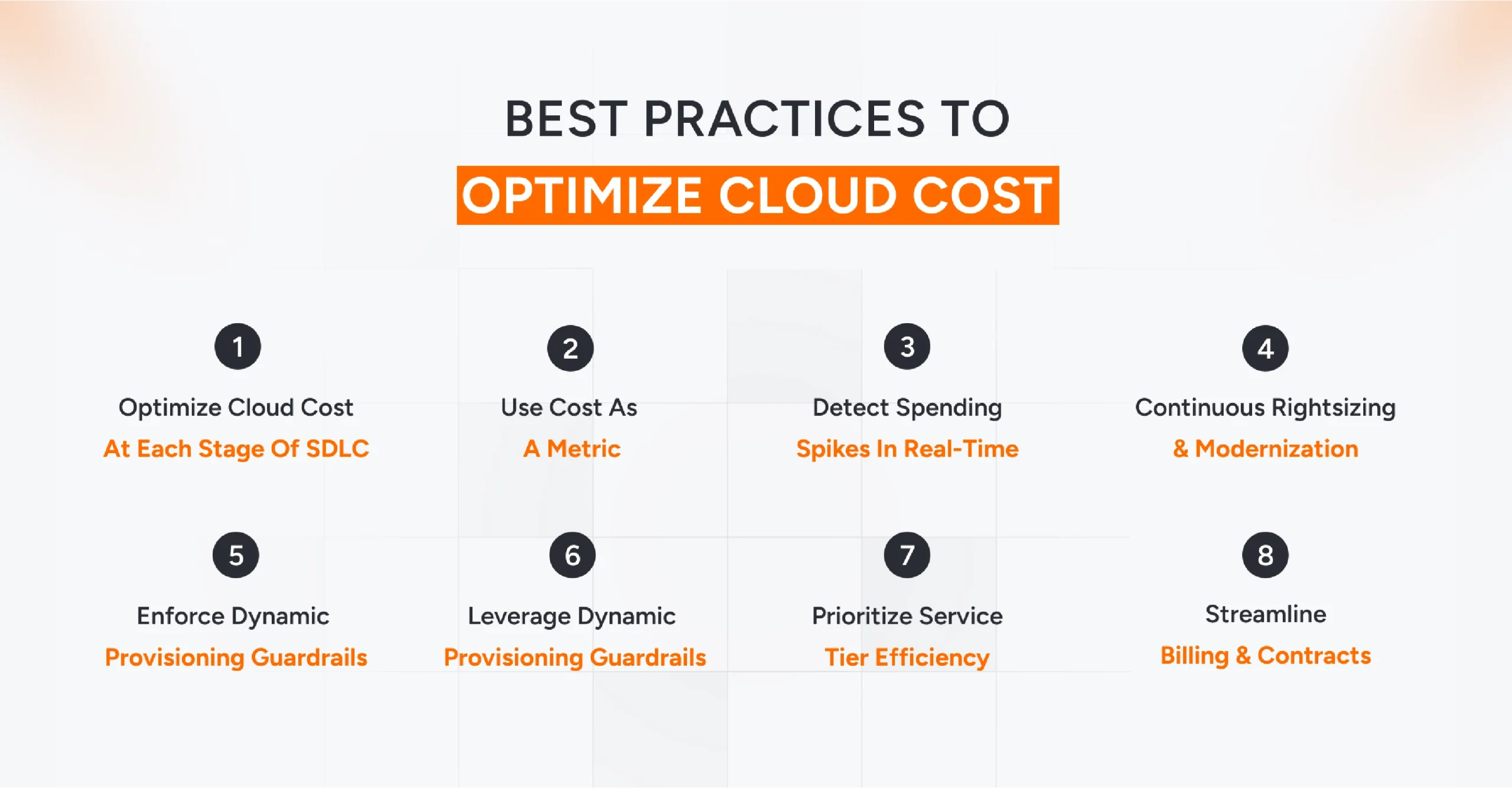
1. Optimize Cloud Cost at Each Stage of SDLC
Cloud cost optimization at each stage of the software development lifecycle needs continuous assessments, data tracking, and monitoring. Here are the stagewise actions recommended for your project,
- Planning: Select serverless or containerized architectures to maximize density. Design stateless workloads for Spot Instances and minimize cross-zone data transfer costs.
- Development: Schedule automated shutdowns for non-production environments to eliminate idle waste. Enforce strict resource tagging and utilize Spot instances for testing pipelines.
- Deployment: Right-size compute resources based on actual performance data. Implement storage tiering lifecycles and define precise autoscaling boundaries to prevent over-provisioning.
- Operations: Secure commitment-based discounts (RIs) for baseline loads. Automate the removal of orphaned resources and deploy real-time anomaly detection.
2. Use Cost as a Metric
To achieve actual financial efficiency, organizations must shift their perspective and treat costs as a primary operational metric, giving them the same weight as performance and security. By integrating cost data into daily operational dashboards, teams can make data-driven decisions that balance technical requirements with financial constraints, ensuring that every architectural choice is economically viable.
3. Detect Spending Spikes in Real-Time
Traditional monthly billing cycles often hide expensive mistakes until it is too late. To counter this, businesses should deploy tools that provide real-time visibility and AI-driven anomaly detection.
These tools can flag unusual spending patterns, such as a misconfigured Lambda loop or a runaway process,s allowing for immediate remediation. Organizations that implement proactive alerting systems have effectively reduced cloud overage costs.
4. Continuous Rightsizing & Modernization
Rightsizing is not a one-time “set and forget” event but a continuous process of matching infrastructure to actual workload demands. Beyond simply resizing instances, this strategy involves modernizing infrastructure by migrating to newer, more efficient instance families.
For example, moving from x86 architectures to ARM-based processors (such as AWS Graviton or Azure Cobalt) can deliver better price-to-performance.
5. Enforce Dynamic Provisioning Guardrails
Moving from static to dynamic resource allocation requires robust governance. Utilizing Infrastructure-as-Code (IaC) allows organizations to embed policy guardrails directly into the provisioning process.
These policies prevent cost overruns by blocking the deployment of expensive, non-compliant resources, such as oversized databases or unapproved regions, before they are ever created.
6. Leverage Multi-Cloud Economics
A hybrid or multi-cloud strategy allows companies to practice “cloud arbitrage,” placing workloads in the environment where they are most cost-effective.
- Licensing Optimization – Utilizing programs like the Azure Hybrid Benefit allows the reuse of existing on-premises Windows or SQL licenses in the cloud.
- Strategic Placement- Workloads can be distributed based on strength and cost; for instance, using GCP for specific data analytics tasks where it offers better price-performance, while leveraging AWS or Azure for general compute needs based on spot pricing stability.
7. Prioritize Service Tier Efficiency
Selecting the “best” service doesn’t always mean choosing the most expensive one.
- Storage Optimization- Implementing Intelligent-Tiering storage classes automatically moves data between tiers based on real-time access patterns. This can generate cloud cost savings without requiring any manual operational overhead.
- Database Selection- Teams should rigorously evaluate whether a managed service (such as RDS) justifies its 20-50% premium over self-managed options, or whether serverless databases (such as Aurora Serverless) offer better value for applications with sporadic or unpredictable traffic.
8. Streamline Billing & Contracts
Simplifying the procurement process can lead to significant savings in administrative and direct costs.
- Consolidated Billing– Using centralized management tools or cloud marketplaces to consolidate third-party software spend onto a single cloud bill simplifies procurement and can contribute toward enterprise discount commitments.
- Enterprise Agreements- For large-scale operations, negotiating Private Pricing Agreements (PPAs) or Enterprise Agreements (EAs) is essential. These contracts secure capacity guarantees and provide custom discounts well below standard list prices.
How AQe Digital Can Optimize Cloud Cost for Your Business?
Cloud cost optimization is a continuous FinOps-driven discipline that aligns performance, scalability, and spend. From eliminating idle resources and right-sizing infrastructure to optimizing AI workloads, Kubernetes storage,e and network egress, effective optimization transforms unpredictable cloud bills into measurable business value.
Backed by 27+ years of cloud and engineering expertise, AQe Digital delivers proventool-agnostic optimization strategies that maximize ROI and ensure sustainable cloud growth.
AQe Digital Cloud Excellence Includes:
- FinOps led cost governance
- AI-aware cloud optimization
- Kubernetes and container cost efficiency
- Automated policy as code governance
- Multi-cloud and hybrid optimization
- Continuous rightsizing and waste elimination
Start optimizing your cloud costs with AQe Digital. Schedule a free assessment today.
FAQs
Cloud bills often rise due to hidden inefficiencies like idle compute, overprovisioned instances, unused storage, and data transfer charges. Dynamic pricing, AI workloads, and always-on resources can silently inflate costs without adding business value. Without FinOps visibility and continuous rightsizing, 20 to 35 percent of cloud spend typically goes to waste.
To ensure value, cloud costs must be mapped to business outcomes such as customers, features, or transactions. This requires cost allocation, tagging, and unit economics reporting. When teams can see cost per product or customer, cloud spend shifts from being an expense to a measurable driver of growth, profitability, and faster innovation.
Accurate forecasting comes from combining historical usage data, commitment-based pricing, and real-time anomaly detection. Budget alerts, spend thresholds, and automated governance guardrails embedded within our solutions help you catch misconfigurations early. Organizations that monitor costs daily rather than monthly avoid bill shock and gain predictable cloud spend.
Kubernetes itself is not expensive, but poor configuration leads to waste. Low pod utilization, incorrect resource requests, and fragmented node usage can reduce efficiency to under 20 percent. Proper rightsizing, bin packing, and autoscaling improve cluster utilization and can reduce Kubernetes costs.
The most common hidden costs include data egress fees, cross-availability-zone traffic, orphaned storage volumes, old snapshots, and always-on non-production environments. These costs often go unnoticed because they are distributed across services. Automation and policy-based governance are essential to continuously eliminate them.