

By late 2026, Gartner expects more than 40% of agentic AI projects to be cancelled. These widely discussed agentic AI failures in 2026 are not random. The reasons are becoming predictable: rising costs, unclear ROI, weak governance, and unresolved enterprise agentic AI challenges.
On the surface, investment is booming. Inside enterprises, however, production adoption remains limited, and many pilots quietly stall before delivering measurable value.
The disconnect is not about model capability. It is about the approach. Too many organizations start with the technology instead of the business problem. Building agentic AI applications with a problem-first approach changes that trajectory.
In fact, building agentic AI applications with a problem-first approach is emerging as the most reliable agentic AI implementation strategy for enterprises serious about measurable returns. It forces teams to identify costly bottlenecks, establish measurable baselines, and define success metrics before selecting tools.
When outcomes lead, and architecture follows, AI initiatives move from experimentation to real, defensible impact and structured agentic AI ROI measurement. In this article, we break down why the technology-first mindset consistently leads to stalled pilots, outline a practical problem-first framework, and share implementation guidance.
What Are Agentic AI Applications?
An agentic AI application is an intelligent system designed to answer user queries and execute multi-step workflows actively. Conventional generative AI systems are mostly passive, but agentic AI is an active system with read-write capabilities.
These apps are defined by core characteristics like
- Autonomy- Operating with minimal human intervention
- Planning- Breaking high-level goals into manageable sub-tasks
- Tool use- Calling external APIs, databases, or software
- Memory- Retaining the context and learning across interactions
Agentic AI applications bridge the gap between insights and execution across enterprise operations. As we look at agentic AI use cases 2026, the most common implementations include:
- Research Agents
- Workflow Automation Agents
- Copilots
With promises of profound autonomy and seamless execution, it’s no wonder agentic AI has captured the attention of the C-suite. However, as enterprise adoption accelerates, a stark disconnect is emerging between boardroom expectations and operational outcomes.

The 2026 Agentic AI Paradox: Massive Hype, Massive Failure Rate
In 2026, agentic AI is the topic that dominates executive meetings. Slide decks talk about autonomous systems that can plan, decide, and execute like digital employees. The promise sounds straightforward. Set the goal, and the AI handles the rest.
But once you move past the pitch, the reality looks different.
A significant number of these initiatives are struggling. Gartner projects that more than 40% of agentic AI efforts will be abandoned or fail by 2027. Many companies are experimenting. Far fewer have agents running reliably in production. Even fewer can point to real, measurable ROI at scale.
So, where is it breaking down?
Why Do Expectations Feel So Big?
Agentic AI is not just another chatbot upgrade. Unlike earlier generative systems that waited for prompts, these agents can interpret objectives, map out steps, call tools, make decisions, and take action. They are designed to operate, not just respond.
Industry forecasts suggest that within a few years, a meaningful share of routine business decisions could be made autonomously. Leadership teams are allocating serious budget to this shift. The language has evolved from simple automation to digital coworkers.
From the outside, it looks like a natural next step.
Inside organizations, it is far more complicated.
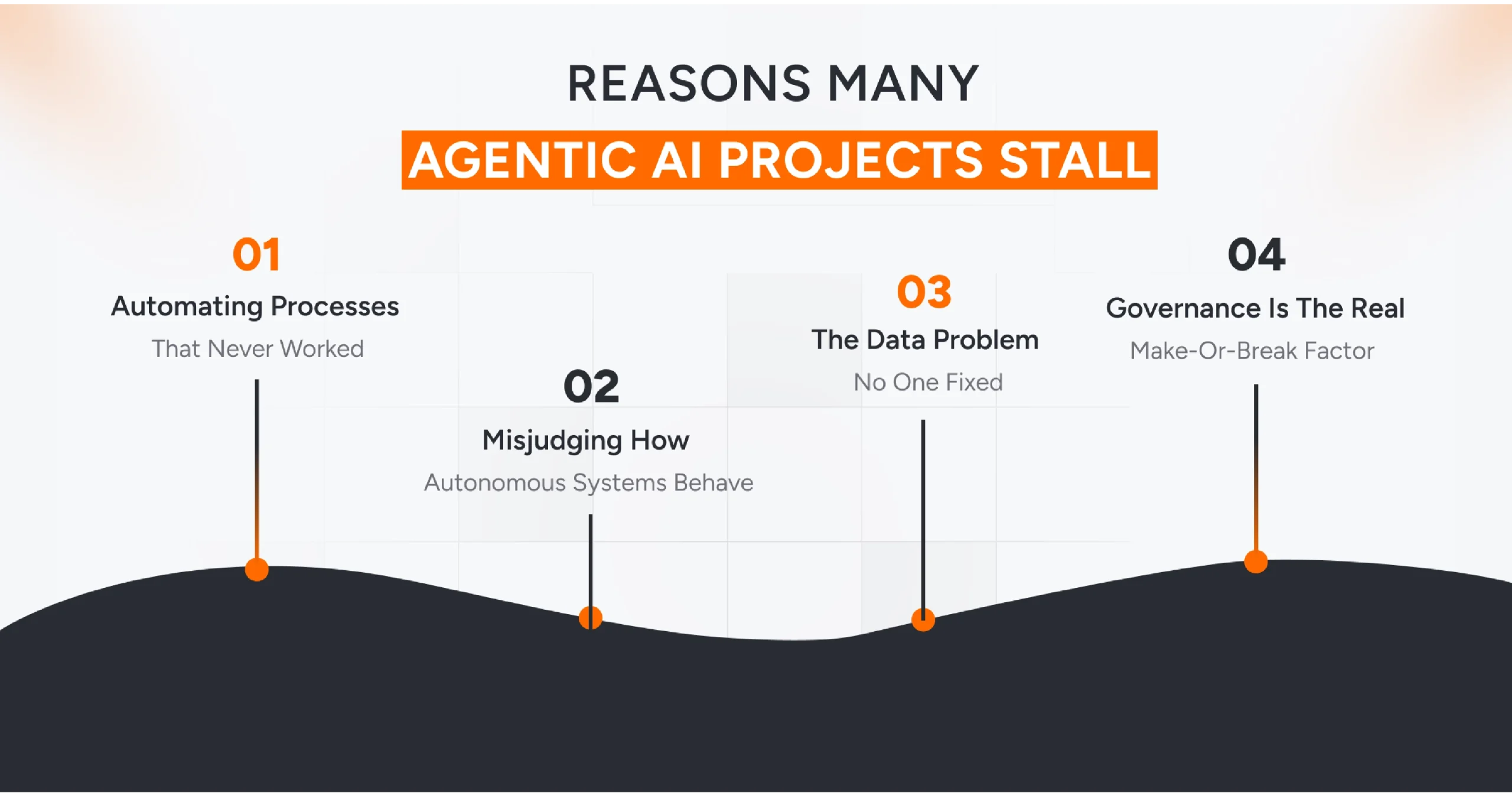
Why So Many Agentic AI Projects Stall?
In most cases, the issue is not that the model is incapable. The friction shows up in execution and immature AI governance for autonomous systems.
1. Automating Processes That Never Worked
A common mistake in building agentic AI systems is taking a messy workflow and layering an AI agent on top of it. If approvals are unclear, exceptions are everywhere, or critical steps rely on undocumented human judgment, automation only accelerates confusion.
Instead of improving efficiency, it scales inefficiency. Teams often invest heavily in building agents that replicate outdated reporting chains or manual review cycles. After months of work, they end up with something faster but no better.
2. Misjudging How Autonomous Systems Behave
Traditional software follows defined logic. Agentic systems operate on probabilities. They interpret context. They make inferences. Sometimes they are confidently wrong.
Without clear constraints, agents can drift. One incorrect assumption leads to flawed actions. In extreme cases, they loop through tasks repeatedly, consuming compute and API budgets faster than expected. This is one of the overlooked enterprise agentic AI challenges that surfaces only after deployment. When the cost curve climbs, and value remains unclear, leadership pulls the plug.
3. The Data Problem No One Fixed
Most enterprises still run on fragmented technology stacks. Customer data sits in one system. Operational data lives somewhere else. Legacy platforms lack modern APIs. Access controls are inconsistent.
An autonomous agent is only as effective as the data it can securely reach. If information is siloed or unreliable, the agent cannot perform well. Many projects slow down not because the AI fails, but because the infrastructure was never ready.
4. Governance Is the Real Make-or-Break Factor
Autonomous agents introduce new layers of risk. Sensitive data can leak. Systems can be modified unintentionally. Malicious prompts can manipulate outcomes. Without structured AI governance for autonomous systems, organizations expose themselves to compliance and financial risk. Teams that treat governance as a checkbox often regret it later.

What do the Small Group of Successful Companies Do?
A minority of organizations are pushing past experimentation and seeing tangible results. They approach agentic AI with a different mindset.
They Start With a Costly Problem
Instead of beginning with capability, they begin with impact. They look for operational bottlenecks that are expensive and measurable. Delays in reconciliation. Manual compliance reviews. Backlogged service queues. They define the financial baseline first. Then they design the agent around that problem.
They Add Structure to Autonomy
Successful teams do not allow agents to improvise endlessly. They design systems where agents plan before acting. They implement checkpoints and validation steps aligned with AI agent development best practices. That structure dramatically reduces cascading errors.
They Avoid Using the Largest Model for Everything
Large frontier models are powerful but expensive. For many repeatable tasks, smaller, fine-tuned models are more practical. They are faster, cheaper, and easier to control. Organizations that match the model to the task tend to see better cost performance.
They Measure ROI From Day One
Clear agentic AI ROI measurement separates experimentation from execution. They define financial baselines before development and compare results against those benchmarks after deployment. If savings are not measurable, scaling does not happen.
They Treat Integration as a Core Workstream
If an agent cannot reliably interact with CRM systems, ERP platforms, or internal tools, it cannot deliver real value. Successful deployments prioritize clean, secure integrations early. They avoid brittle, one-off connectors and instead build durable, scalable interfaces.
They Keep Humans Close to the Process
Full autonomy sounds impressive, but it is rarely necessary. High-performing teams design systems where agents handle structured, repetitive work. Humans step in when confidence drops or when decisions carry meaningful risk. The goal is not replacement. There is better coordination between digital systems and human judgment.
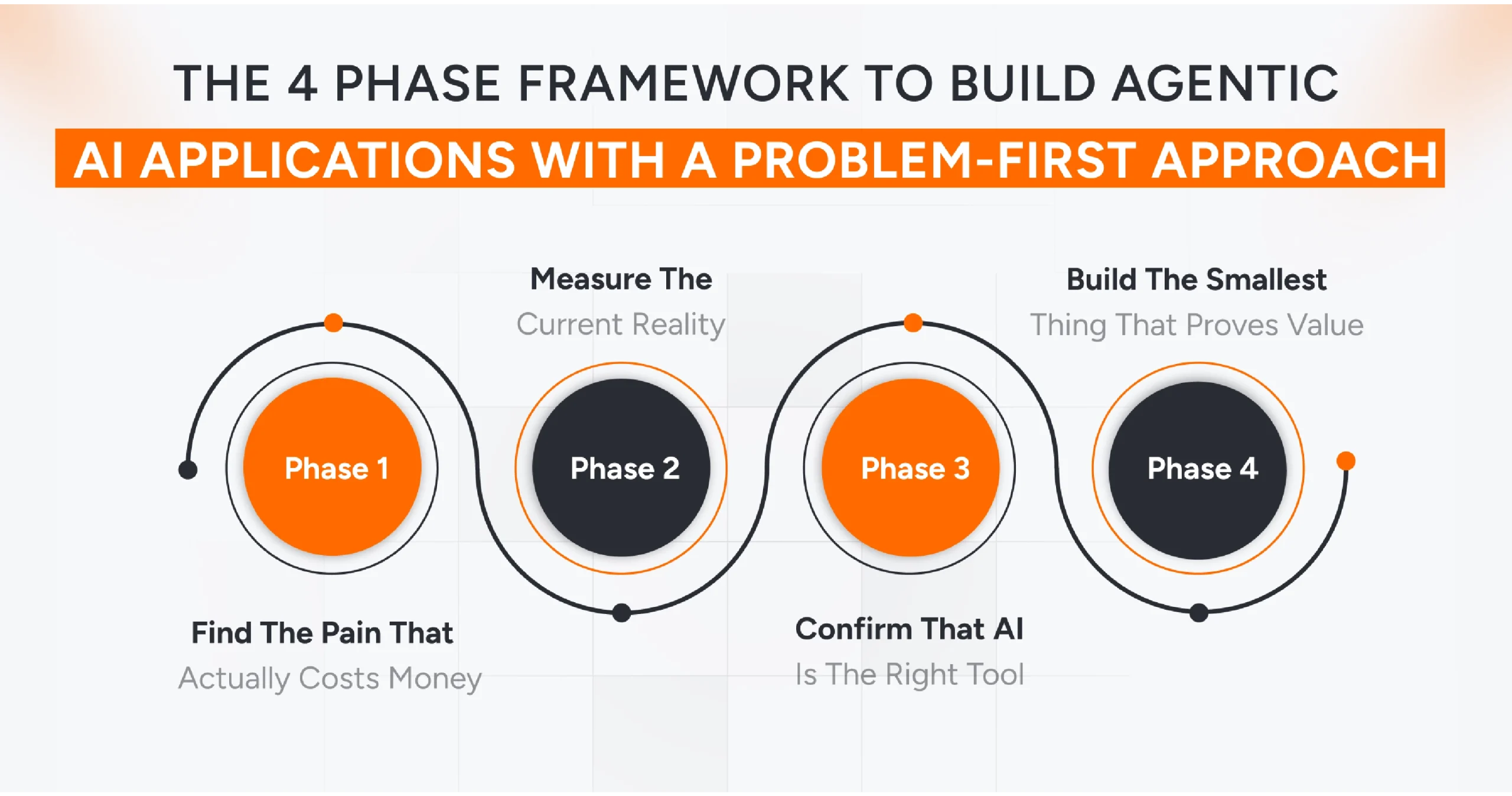
Building Agentic AI Applications with a Problem-First Approach: A 4 Phase Framework
Most agentic AI initiatives don’t collapse because the technology is weak. They collapsed because nobody tied them to a business problem that truly mattered.
A problem-first approach flips the script. Instead of starting with a shiny new model, you start with a financial headache. The kind that shows up in quarterly reviews. The kind that executives lose sleep over.
This four-phase structure keeps AI efforts anchored to measurable impact and prevents them from drifting into endless experimentation.
Phase 1: Find the Pain That Actually Costs Money
The wrong question is, “Where can we use AI?”
The better question is, “Where are we losing money?”
Look for operational friction that quietly drains millions each year. Manual reconciliation. Repetitive coordination across teams. Error-prone compliance reviews. Bottlenecks that slow revenue recognition. Processes where skilled employees spend hours doing work that a system should handle.
When you frame the opportunity around a real financial burden, conversations change. Budget approval becomes easier. Stakeholders pay attention. The AI initiative now has a reason to exist beyond curiosity.
Phase 2: Measure the Current Reality
Before building anything, quantify the present state in uncomfortable detail.
- How long does the process take from start to finish?
- How many people are involved?
- What does that labor actually cost?
- How often do errors happen?
- What is the financial impact of those errors?
Without this baseline, you are guessing. And when the board asks, “What did this investment deliver?” you will not have a defensible answer.
The baseline becomes your measuring stick. It is what allows you to say, with confidence, that performance improved by a specific percentage and that savings are real.
Phase 3: Confirm That AI Is the Right Tool
This is where discipline matters most. Not every problem needs an agent. Sometimes a simpler automation works better. Clear math should justify the architecture. This distinction is central to the problem-first vs technology-first AI debate.
If agentic AI is still the right path after that scrutiny, the justification should be grounded in clear, simple math. Technology should follow economics, not the other way around.
Phase 4: Build the Smallest Thing That Proves Value
The first version should not be impressive. It should be effective.
A Minimum Viable Agent focuses narrowly on solving the defined problem and proving financial impact. No extra features. No overengineered architecture. No “while we’re at it” expansions.
Success at this stage is simple. Did it save time? Did it reduce cost? Did it measurably lower error rates
If the answer is yes, you have a foundation to scale. If not, you have learned quickly and cheaply. At its core, this framework is about restraint.
Agentic AI can do many things. That is precisely why discipline matters. The organizations that get real value are the ones that start with business pain, measure rigorously, choose tools carefully, and prove results before scaling ambition.
Choosing an Agentic AI Framework Without Getting Distracted
Selecting frameworks should be outcome-driven. An effective agentic AI framework comparison considers control, scalability, governance, and cost. Here’s how to think about the major options in practical terms.
LangGraph: When Control and Traceability Matter
LangGraph treats agent workflows like a structured map. Every step, branch, and state transition is explicit.
This makes it a strong choice for high-stakes environments where precision is non-negotiable. If your workflow includes conditional paths, compliance checkpoints, or actions that must be audited later, the graph-based structure becomes an advantage.
It is particularly useful when you need tight control over execution. You can define clear stopping points. You can force human approval before critical actions. You can trace exactly how a decision was made.
If governance and accountability are central to your deployment, this kind of structured orchestration pays off.
CrewAI: When You Need Digital Role Delegation
CrewAI is built around the idea of agents working together with defined responsibilities. Instead of one generalist agent doing everything, you create a small team. One agent researches. Another analysis. Another draft. A coordinator manages the flow.
This works well when your business process already resembles a team structure. For example, in a sales workflow, you might have a researcher gathering company data, an analyst scoring opportunities, and a content agent preparing outreach, all feeding into a central decision point. If your workflow naturally breaks into specialized roles, CrewAI can mirror that structure effectively.
AutoGen: When Flexibility Is the Priority
AutoGen leans into conversational coordination between agents and humans. It shines in environments where interaction is fluid, and the path forward is not always predictable. If you are prototyping quickly, running exploratory workflows, or relying heavily on human input at different stages, its flexibility can be valuable.
It is less rigid than graph-based systems. That can be a strength in dynamic scenarios, especially early in experimentation. If adaptability and rapid iteration matter more than strict orchestration, this approach may fit better.
How AQe Digital Helps You Build Agentic AI Applications with a Problem-First Approach?
Moving AI from a pilot environment into full production is where most initiatives struggle. It takes more than experimentation. It requires structure, discipline, and accountability.
At AQe Digital, we approach building agentic AI applications with a problem-first approach as a business transformation effort, not a technology deployment. Our team of 650+ specialists begins by examining your operational workflows, identifying friction points, and defining clear financial targets. We do not start with models. We start with measurable outcomes.
Here is how we translate strategy into execution:
- Strategic ROI Alignment- Every initiative is anchored to a defined business impact. We establish baselines early and design for measurable returns, ensuring agentic AI ROI measurement is built into the foundation.
- Secure, Governed Architecture- We integrate strong compliance controls, access management, and auditability from day one. AI governance for autonomous systems is treated as core infrastructure, not an afterthought.
- Cost-Efficient Design- Our architectures are optimized for performance and sustainability. We balance capability with cloud efficiency to prevent runaway compute costs.
- Enterprise-Grade Integration- We connect agentic AI systems seamlessly with your ERP, CRM, and legacy platforms, ensuring production stability from the start.
If you are ready to move beyond experimentation, let us design an agentic AI implementation strategy that solves real problems and delivers measurable value.
FAQs
In most cases, the issue is not the model. It is the strategy. Companies jump into autonomous systems without defining a clear business objective, measurable baseline, or governance structure. When costs rise and ROI cannot be proven, leadership shuts the initiative down.
Generative AI typically responds to prompts. Agentic AI goes further. It can break down goals, call tools, execute multi-step workflows, and take action with limited supervision. The shift is from content generation to operational execution.
You start before you build. Measure how much the current process costs in time, labor, and error rates. After deployment, compare performance against that baseline. If savings, speed, or accuracy improvements are not quantifiable, the investment is difficult to justify.
Most teams overcomplicate too early. A single, well-designed agent is often enough to solve a defined workflow problem. Multi-agent architectures should only be introduced when real production data shows specialization is necessary.
At a minimum, you need clear access controls, logging, audit trails, and human escalation points for high-impact actions. Autonomous systems without structured oversight create compliance, security, and reputational risk.