

Scaling a car rental business in 2026 demands more than just fleet expansion. It requires a fundamental shift in operational intelligence. With the global car rental market projected to reach nearly $247.7 billion by 2034, the widening gap between market leaders and laggards will be defined by efficiency, not just inventory size.
The data is precise: manual operations are a revenue leak. Recent industry analysis reveals that operators utilizing AI-driven predictive maintenance can reduce maintenance costs by up to 40% and cut fleet downtime by nearly 50%.
Furthermore, shifting from static to dynamic pricing models can boost fleet utilization by 15%. In an ecosystem where asset utilization is the primary driver of profit, moving to a “software-defined” model is no longer optional but a survival strategy.
In this article, you will explore the specific AI workflows from reducing damage inspection times to automating fleet “right-sizing” that are driving efficiency gains for your car rental business.
Top AI Workflow Automation Strategies to Scale Your Car Rental Operations
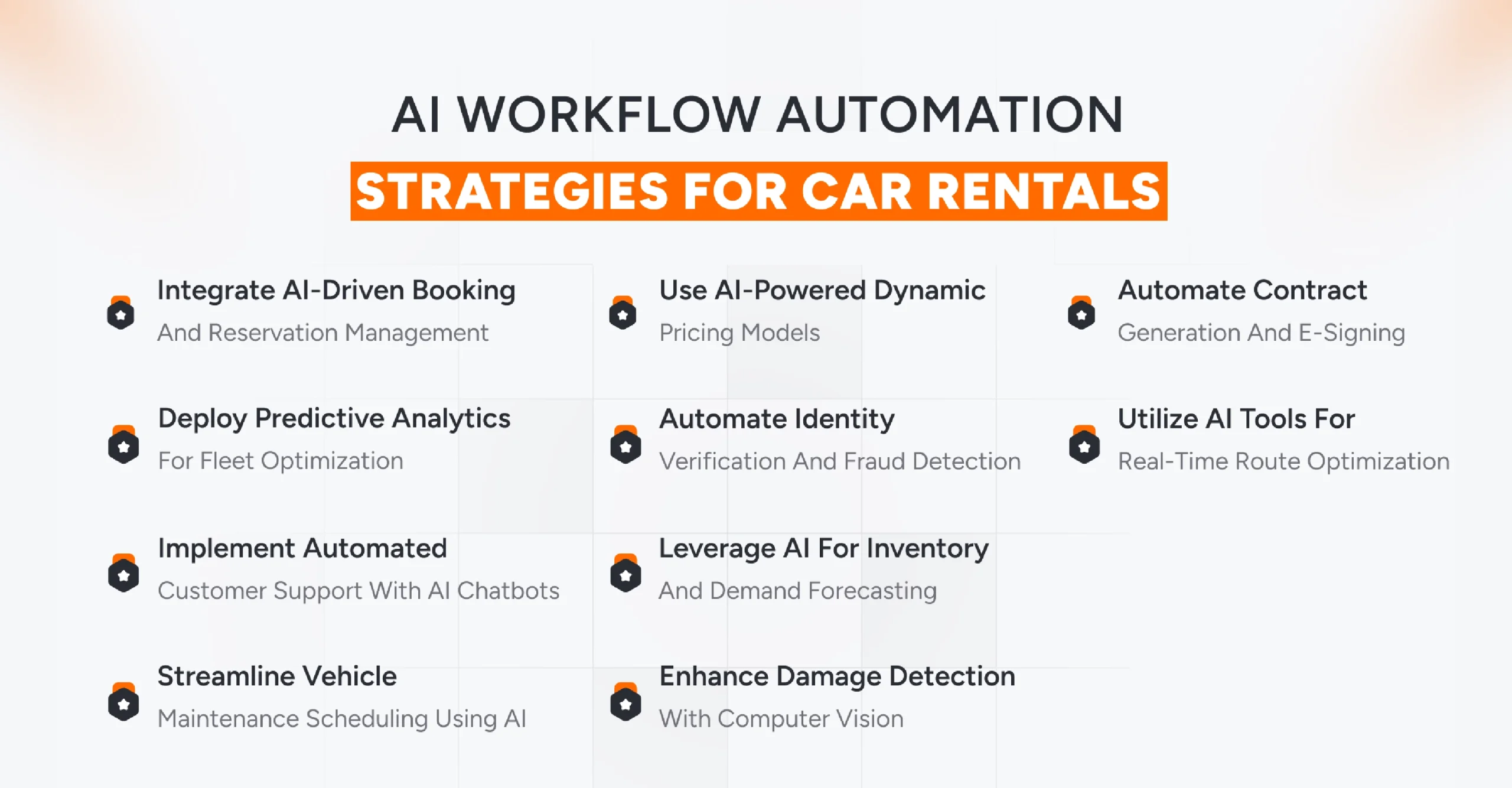
Scaling car rental operations in a dynamic market requires moving beyond simple digitization to a “software-defined ecosystem” where AI drives decision-making and efficiency. Here are some of the top AI workflow automation strategies to scale your operations.
1. Integrate AI-Driven Booking and Reservation Management
Modern artificial intelligence in the care rental business goes beyond rigid scripts to create fluid, self-service booking experiences. By integrating AI-driven reservation systems, you can automate complex booking workflows that adapt to real-time inventory and customer needs.
AI integration can help your car rental business.
- Operational Impact: AI algorithms can predict demand patterns to optimize vehicle availability and handle bookings without human intervention, significantly reducing manual errors.
- Conversational Interfaces: Advanced platforms now use generative AI to conduct natural dialogues, allowing customers to modify reservations or ask specific property questions in their own words.
- Seamless Handover: Automation enables “wireless-first” rentals where customers locate and unlock vehicles via mobile apps, bypassing the rental counter entirely and reducing staffing costs at high-traffic locations like airports.
2. Deploy Predictive Analytics for Fleet Optimization
To scale efficiently, operators must maximize the utilization of their most expensive assets. AI-powered fleet management and optimization tools analyze real-time data to align fleet size and location with actual needs.
- Asset Placement: AI analyzes historical usage, seasonal trends, and local events to optimize vehicle distribution across depots. This “load-aware” distribution can improve inter-depot move speedsand reduce unnecessary mileage.
- Utilization Analysis: AI identifies underutilized vehicles and recommends retirement or reallocation, ensuring the fleet is “right-sized” for current market demand.
3. Implement Automated Customer Support with AI Chatbots
AI chatbots and virtual assistants provide 24/7 support, ensuring no booking opportunities are missed due to office hours or high call volume.
- Productivity Gains: By instantly answering FAQs regarding pricing, policies, and availability, AI agents can reduce staff workloads and boost overall productivity.
- Omnichannel Presence: These agents handle inquiries across WhatsApp, SMS, and web platforms simultaneously, meeting customers where they are and reducing resolution times.
- Contextual Assistance: Tools like Booking.com’s “AI Rental Helper” simplify the experience by instantly explaining terms and conditions or insurance details.
4. Streamline Vehicle Maintenance Scheduling Using AI
Transitioning from reactive to predictive maintenance is critical for scaling fleets without ballooning repair costs.
- Predictive Capabilities: Machine learning models analyze real-time telematics data to predict engine failures accurately.
- Cost & Uptime Benefits: This proactive approach can reduce breakdowns and maintenance costs, while also minimizing downtime by scheduling repairs during planned idle periods rather than waiting for a failure.
5. Use AI-Powered Dynamic Pricing Models
Static pricing quietly drains revenue. AI-driven dynamic pricing updates rates in real time, reacting to demand shifts, competitor moves, and even the weather.
- Strategic Agility: These systems strike a balance between occupancy and yield, automatically raising rates during demand spikes and lowering them during slow periods to maintain utilization.
- Revenue Growth: Implementing microservices-based real-time pricing has increased revenue and reduced pricing response time, enabling operators to react faster than competitors using manual updates.
6. Automate Identity Verification and Fraud Detection
Scaling requires robust security that doesn’t slow down the customer. Automated verification tools use AI to speed up onboarding while mitigating risk.
- Instant Verification: Solutions using Optical Character Recognition (OCR) and biometrics can extract data from driver’s licenses and verify identities in seconds, eliminating manual typing and reducing error rates.
- Fraud Prevention: AI models cross-reference identities against global databases and detect anomalies (e.g., deepfakes or mismatched data) to prevent high-risk rentals and chargebacks.
7. Leverage AI for Inventory and Demand Forecasting
AI excels at pattern recognition, making it indispensable for predicting future inventory needs.
- Holistic Forecasting: By ingesting data from past rentals, economic indicators, and local event calendars, AI systems provide accurate demand forecasts across different time horizons.
- Inventory Optimization: These insights enable managers to defer purchases or schedule fleet transfers well in advance, thereby reducing capital tied up in idle assets.
8. Enhance Damage Detection with Computer Vision
Automated damage detection addresses one of the most contentious aspects of car rentals: disputes over vehicle condition.
- Automated Inspection: Systems like FocalX and UVeye use high-resolution cameras and AI to scan vehicles in seconds, identifying scratches and dents with millimetre precision.
- Efficiency & Transparency: This technology can reduce inspection times compared to manual methods.
The “Human-in-the-Loop” Necessity: While efficient, fully automated billing for damage can lead to customer backlash if not managed carefully. It is recommended to maintain human review for flagged damages to ensure fairness and prevent “CX meltdowns”.
9. Automate Contract Generation and E-Signing
AI can streamline the legal and administrative heavy lifting of rental agreements.
- Smart Contracts: Generative AI can draft customized contracts based on specific rental parameters and jurisdiction requirements, identifying potential risks during creation.
- Lifecycle Management: Automation manages the entire lifecycle, from clause insertion to renewal notifications, digitizing what was once a paper-heavy process.
10. Utilize AI Tools for Real-Time Route Optimization
For operators managing vehicle delivery, collection, or shuttling, AI-driven routing is essential for reducing fuel costs and improving service speed.
- Dynamic Adjustments: Unlike static GPS, AI routing analyzes real-time traffic, weather, and road conditions to recalculate the most efficient paths instantly.
- Resource Efficiency: These tools can improve fuel efficiency by 15-20% and increase daily service capacity by optimizing multi-stop schedules and reducing idle time.

Key Use Cases for AI Workflow Automation in the Car Rental Industry
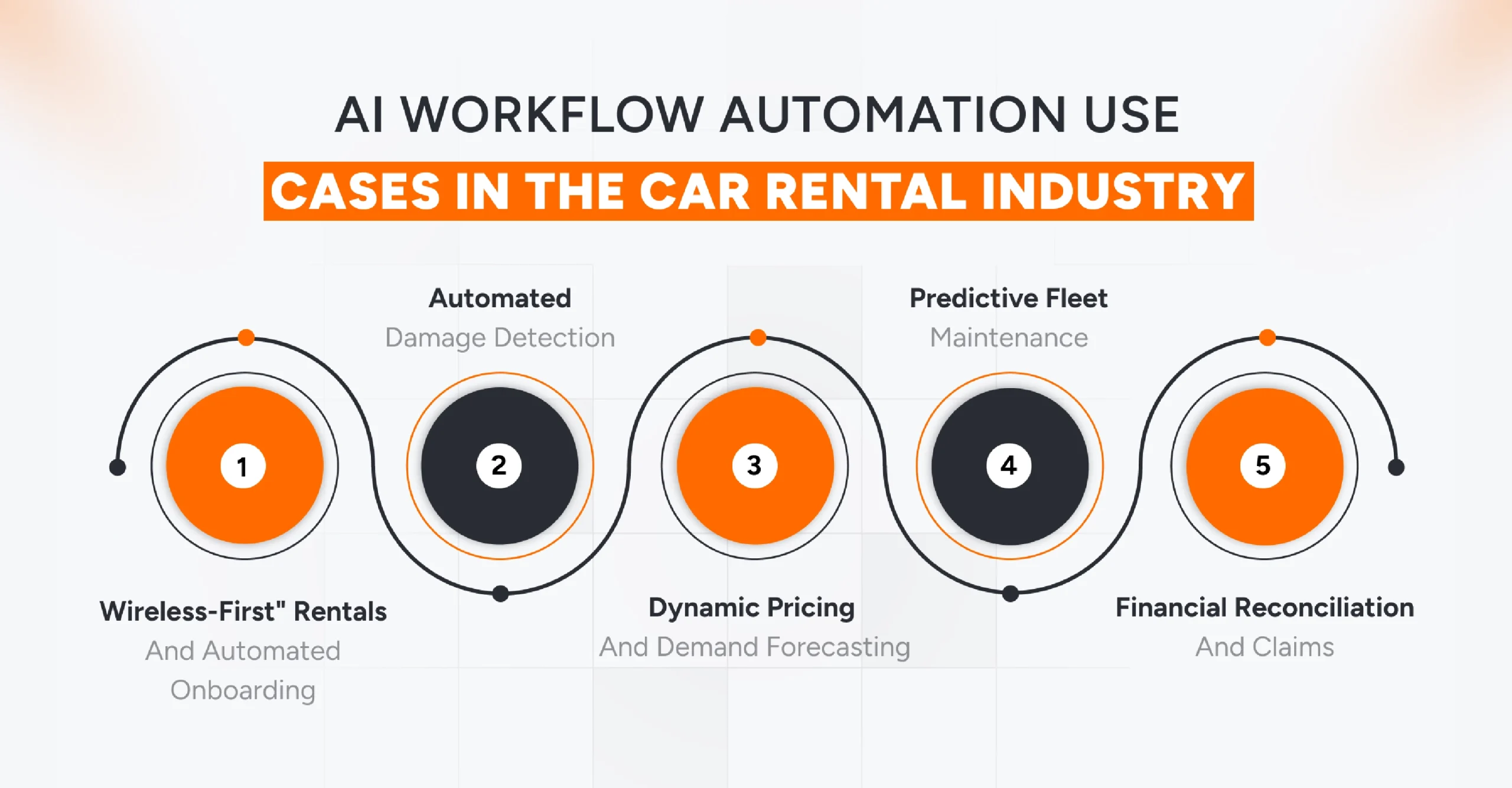
The integration of AI workflow automation in the car rental industry is described as a structural reset, moving from a hardware-centric model to a “software-defined ecosystem” often termed the “Automotive Renaissance”. Operators are shifting toward “hyperautomation,” which combines AI, machine learning (ML), and robotic process automation (RPA) to streamline entire business cycles.
Here are the primary use cases and the operational realities of implementing these technologies.
1. “Wireless-First” Rentals and Automated Onboarding.
The modern rental experience is shifting toward contactless handovers where the rental counter is bypassed entirely.
- Identity Verification: AI-driven identity verification tools use Optical Character Recognition (OCR) and biometrics to verify driver’s licenses and identities in seconds, down from hours. These systems check liveness to prevent deepfakes and perform background checks against criminal databases.
- Chatbots and Agents: Generative AI chatbots handle inquiries 24/7 across WhatsApp and SMS, managing bookings and answering specific questions without human staff. This can reduce staff workload.
2. Automated Damage Detection
Computer vision is replacing manual vehicle walk-arounds to resolve one of the most contentious aspects of car rentals: damage disputes.
- Speed and Precision: Automated inspection tunnels or mobile scanning apps capture 360-degree images to detect scratches, dents, and tire wear with millimeter precision.
- Efficiency: AI inspections can reduce vehicle processing time from 45 minutes to just 5 minutes, a 90% reduction that enables faster fleet turnover. For lease-end inspections, processing time can drop from 10 days to a single day.
3. Dynamic Pricing and Demand Forecasting
AI takes the guesswork out of revenue management by moving beyond static seasonal rates.
- Real-Time Adjustments: Algorithms analyze competitor activity, local events, and weather to dynamically adjust prices. This approach has been shown to increase revenue and improve pricing response times.
- Asset Placement: AI predicts demand spikes to optimize vehicle distribution between depots (“load-aware” distribution), reducing unnecessary mileage and idle time for assets.
4. Predictive Fleet Maintenance
Transitioning from reactive repairs to predictive maintenance is a significant cost-saver.
- Proactive Alerts: By analyzing telematics data (engine health, tire pressure), AI predicts component failures with high accuracy.
- Operational Impact: This strategy can reduce vehicle breakdowns and maintenance costs, ensuring vehicles are serviced during planned downtime rather than breaking down mid-rental.
5. Financial Reconciliation and Claims
Processing Back-office automation handles the heavy lifting of financial transactions.
- Reconciliation: AI tools automatically match payments to invoices, parsing vague bank memos and handling partial payments that traditional rule-based automation cannot process. This can reduce monthly bookkeeping work by over 50%.
- Claims Automation: AI agents can automate the insurance claims lifecycle (First Notice of Loss to settlement) by extracting data from police reports and repair estimates, potentially closing simple claims in minutes.

Implementation Challenges of AI Workflow Automation in the Car Rental Industry
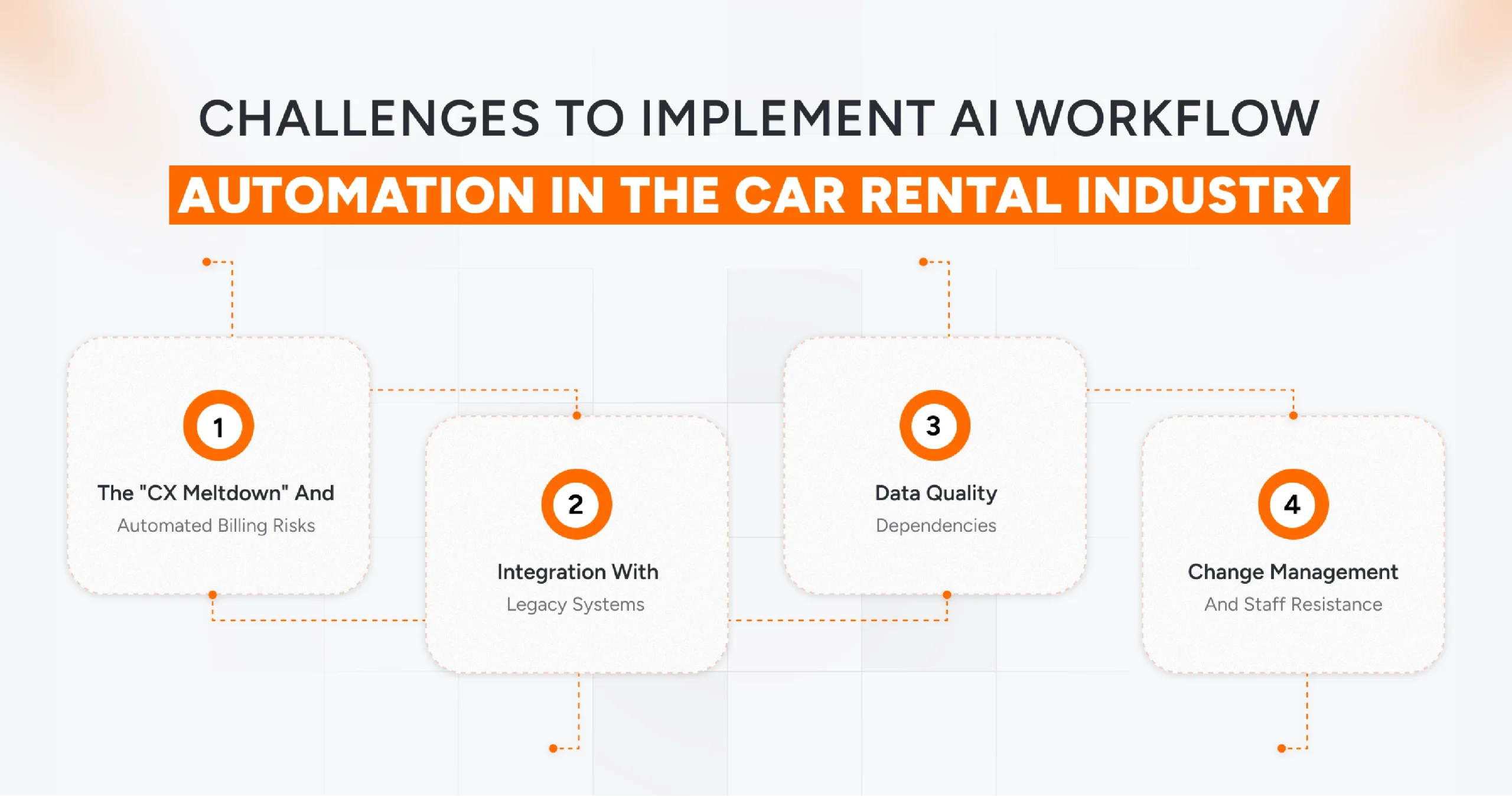
While the technology offers efficiency, real-world deployment has exposed significant friction points and risks.
1. The “CX Meltdown” and Automated Billing Risks
A major on-ground reality is the backlash against fully automated billing for vehicle damage.
- False Positives: There have been high-profile instances, such as with Hertz and Sixt, where AI scanners flagged pre-existing damage as new or identified negligible wear and tear as billable damage.
- Customer Backlash: Customers have reported feeling “blindsided” by automated charges for damage they did not cause, leading to viral complaints and regulatory scrutiny.
- The Human Necessity: The industry is learning that AI should support, not replace, human judgment in billing. A “Human-in-the-Loop” approach, where an agent reviews AI findings before a customer is charged, is essential to prevent a customer experience (CX) disaster.
2. Integration with Legacy Systems
Established rental companies often operate on decades-old IT infrastructure that was not built for real-time AI.
- The “Build Around” Strategy: Completely rebuilding legacy systems is risky and expensive. The practical reality is a “Build Around, Not Through” approach, where modern AI tools connect to legacy cores via APIs or middleware to add intelligence without destabilizing mission-critical operations.
- Data Silos: Legacy systems often trap data in silos, leading to separate systems for inventory and point-of-sale, which creates data discrepancies that hamper AI’s ability to forecast demand accurately.
3. Data Quality Dependencies
AI is only as good as the data it is fed.
- Garbage In, Garbage Out: If a car model is listed under five different names in a database, demand forecasts will be fundamentally flawed.
- Requirement: Successful implementation requires 2–3 years of clean, standardized historical data to train models effectively.
4. Change Management and Staff Resistance
Moving to automated workflows requires cultural adaptation.
- Fear of Replacement: Employees may view automation as a threat. Successful operators focus on “redeploying” staff from low-value data entry to high-value customer service roles.
- Training: Staff must be trained to interpret AI outputs (such as fraud risk scores or damage reports) rather than blindly following them, maintaining a balance between automated efficiency and human oversight.
How AQe Digital Helps you Implement AI Workflow Automation for car Rental Operations?
From AI-driven car rental bookings to predictive fill optimization, smart maintenance, and dynamic pricing, there are many AI workflow automation strategies in the car rental business. Implementing them can transform your ops, improve ROI, and increase profits. However, implementing these strategies is not easy. There are challenges of data quality, legacy systems, and change management.
And this is where AQe Digital can help with AI-driven Car Rental Solutions. With more than 27 years of experience and 650+ professionals serving car rental businesses worldwide, AQe Digital has been at the forefront of delivering efficient automation solutions.
So, if you are looking to automate your car rental operational workflows, connect with our experts now. We ensure improved data quality, modernization of legacy systems, and innovative solutions.
FAQs
AI shifts operations to a software-defined ecosystem, automating bookings and fleet distribution to improve productivity and inter-depot speeds.
It adjusts rates in real time based on demand and competitors, increasing revenue and improving pricing response time.
By analyzing telematics to predict failures with accuracy, it reduces vehicle breakdowns and maintenance costs.
Yes, computer vision scans vehicles to detect damage with millimeter precision, reducing inspection time by 90% (from 45 to 5 minutes).
Automated billing can flag false positives for damage; a "Human-in-the-Loop" review is essential to prevent customer disputes and bad experiences.