AI Voice Agent in Healthcare: A 2026 Implementation & ROI Guide for Health Systems

Priyanka Wadhwani
If you spend any time looking at healthcare operations right now, the math doesn’t add up. Patient volumes are climbing, the clinical workforce is shrinking, and the administrative burden on the staff that remains has reached a breaking point. You can’t hire your way out of a gap this wide. And the basic chatbots are only making patients more frustrated.
This is why the conversation around an AI voice agent in healthcare has shifted so quickly from experimental tech to an operational necessity. These are not robotic menus that tell patients to “press 1 for billing.” But there are AI agents that can hold fluid, contextual conversations, understand complex medical terminology, and actually resolve patient requests without a human ever having to pick up the phone.
In this guide, we will break down exactly what these systems are, how they integrate into real clinical workflows, and why deploying voice AI for healthcare is becoming the only sustainable way to manage the growing demand for care.
What Is an AI Voice Agent in Healthcare?
An AI voice agent in healthcare operations can carry a full conversation with a patient, answer questions, book appointments, and handle follow-ups, all without human intervention. What makes healthcare-specific systems different is that they’re trained in real medical language.
Drug names, procedure codes, clinical terminology, and accents from patients across different regions. These systems are highly accurate at recognizing difficult words like drug names, medical terms, procedure codes, and various patient accents. This high accuracy is crucial because the information goes straight into patient records.
How Does It Work?
Four core components keep it running:
- Speech Recognition (ASR): Converts what the patient says into text, using models trained on actual clinical dictations, not generic voice samples
- Natural Language Understanding (NLU): Reads intent, not just words. “I need to move my Thursday visit” and “Can I reschedule?” mean the same thing, and the system knows it. Some platforms also pick up on emotional cues, flagging when a caller sounds distressed or confused.
- Text-to-Speech (TTS): Produces responses that sound like a calm, professional person. The tone adjusts depending on the conversation, not one flat robotic voice throughout
- Integration Layer: Connects directly to EHR platforms such as Epic and Cerner via secure APIs. The agent checks live availability, verifies insurance, and logs updates to the patient chart on its own
Real-World Use Cases of AI Voice Agent in Healthcare
- Scheduling: Handles inbound booking, cancellations, and rescheduling around the clock, with live EHR availability. Patients stop waiting on hold
- Outbound follow-ups: Calls patients after discharge, checks on medication adherence, and sends reminders for annual screenings. Work that’s always needed but rarely has enough staff behind it
- Front-desk tasks: Insurance verification, prior authorization gathering, intake questions, and billing FAQs. Repetitive, high-volume work that grinds administrative teams down
- Clinical notes: Ambient AI listens during the patient visit and drafts a structured SOAP note straight into the EHR. Physicians document less and focus more on the patient in front of them.
Higher Compliance Compared to Conventional IVR Systems
These systems handle Protected Health Information, so the compliance bar is high. End-to-end encryption, strict access controls, full audit trails, and signed Business Associate Agreements are standard.
More importantly, every solid platform has escalation built in. If a patient says anything that signals an emergency or asks something outside the agent’s lane, the call goes to a human clinician right away, with the full conversation context handed over so the patient doesn’t have to repeat themselves.
Why Conventional Healthcare Operations Are Breaking Down?
Healthcare is caught in a tough spot right now. Patient volumes are climbing, staff are burning out, and the systems built to manage it all were designed for a world that no longer exists. More organizations are turning to voice AI not because it’s trendy, but because the alternative, doing nothing, is becoming genuinely unsustainable.
The Documentation Problem Nobody Talks About Honestly
Studies now show clinicians log over 13.5 hours a week on documentation, and in some systems, that adds up to 44 or more hours a month spent on charting and clerical tasks. That’s a second job. It’s a leading reason why burnout rates in healthcare have hit a level that should alarm everyone, and why experienced clinicians are leaving the profession earlier than expected.
More Patients, Fewer People to Treat Them
At the same time, the patient population is aging and becoming sicker. Chronic conditions are becoming more complex, and the demand for carecontinues to rise. The workforce isn’t keeping pace. The World Health Organization projects a global shortage of nearly 10 million healthcare workers by 2030.
You simply can’t hire your way out of that gap. There aren’t enough people, and training pipelines take years. Traditional operational models were not built for this reality.
Legacy Tools Are Making It Worse
To handle call volumes, most health systems have relied on IVR phone trees and basic chatbots for years. The problem is these tools were built to route calls, not resolve them. When a patient speaks outside a pre-written script or asks something slightly unexpected, the system misroutes, loops, or drops the call entirely. The numbers reflect how badly it’s failing: average hold times exceed 11 minutes, and call abandonment rates reach as high as 57% during peak hours. Patients give up, staff get overwhelmed picking up the slack, and nothing improves.
The Shift Toward Conversational AI
Healthcare leaders aren’t waiting around. The pivot toward autonomous, agentic AI is accelerating faster than most predicted:
- Adoption timelines: Gartner projects that 80% of healthcare providers will invest in conversational AI technologies by 2026, not 2027 as earlier estimates suggested.
- Investment momentum: By Q1 2026, AI voice agents and digital health tools had already raised $1.8 billion in funding, accounting for 60% of all digital health venture capital during that period.
The core issue is that human capacity has hit its ceiling. Conversational AI in healthcare isn’t just a tech upgrade at this point. It’s a practical response to a system under genuine strain, one that lets automation handle routine tasks so clinicians can focus on patients who actually need them in the room.
However, the organizations moving fastest aren’t just buying into the concept of AI voice agents in healthcare. They’re deploying it across specific workflows where the operational pain is most acute.

Top 8 Use Cases for AI Voice Agents in Healthcare
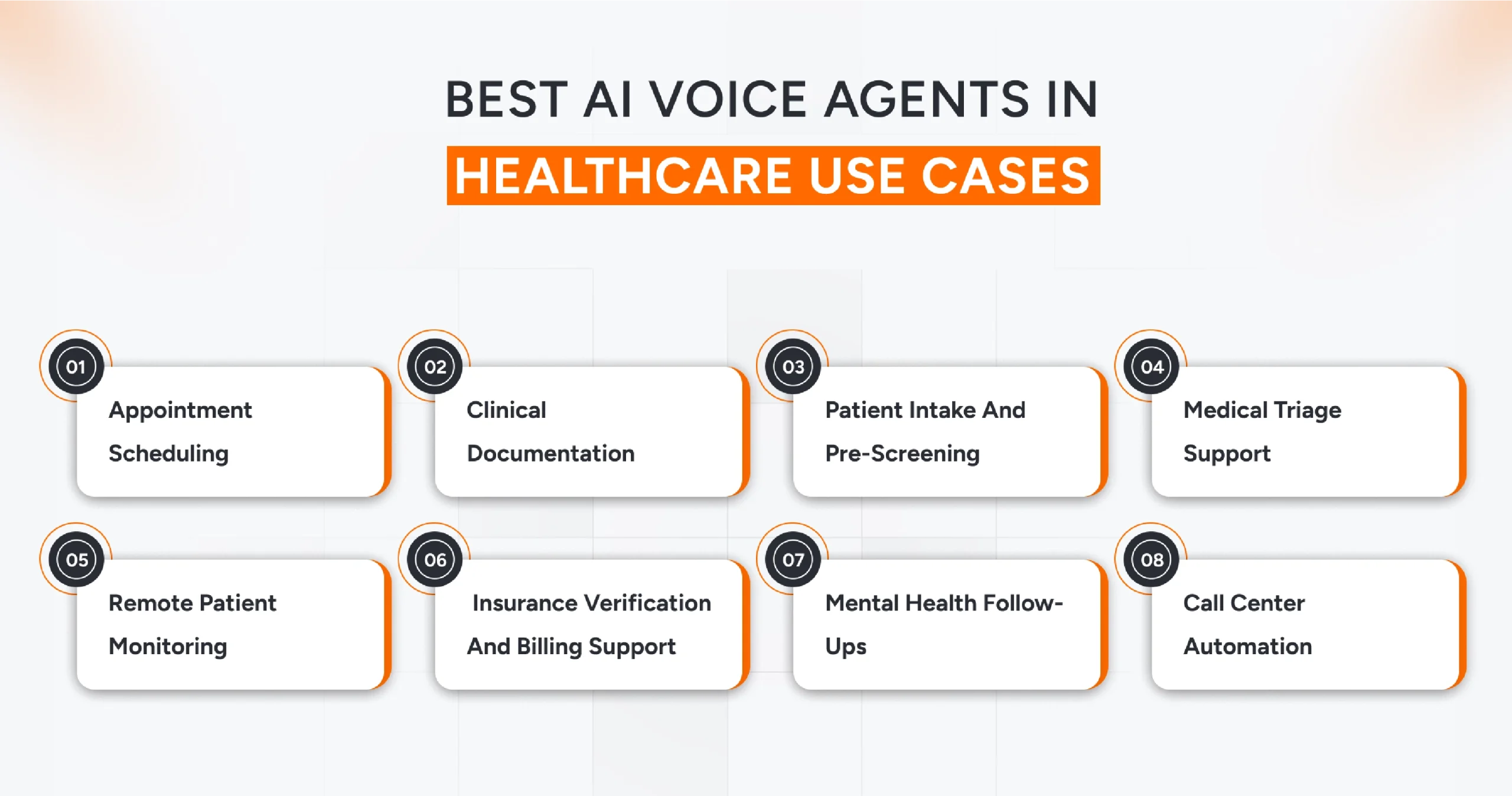
Here are some of the major use cases of AI voice agents in Healthcare.
1. Appointment Scheduling and Reminders
AI voice agent appointment scheduling turns the patient access experience into something that actually works. Patients can book, cancel, or reschedule visits at any time without waiting on hold. The agent checks real-time EHR availability, confirms the appointment, and sends proactive reminders before the visit. No staff required, no missed calls, no voicemails piling up.
2. Ambient Clinical Documentation
Voice AI clinical documentation is one of the most immediate wins for overworked clinical teams. Rather than spending evenings catching up on charts, physicians have an ambient scribe working alongside them in the exam room. It listens to the provider-patient conversation and drafts structured notes, such as SOAP notes, directly in the EHR. Clinicians review and sign off. That’s it.
3. Patient Intake and Pre-Screening
Before a patient walks through the door, a conversational AI in healthcare can handle pre-registration entirely. It collects demographic information, gathers medical history updates, and completes intake forms through a simple outbound call. By the time the appointment begins, the clinical team already has everything they need.
4. Medical Triage Support
An AI voice assistant in healthcare can screen incoming patient symptoms using standardized clinical protocols and route callers to the right level of care, whether that’s urgent care, a telehealth visit, or a scheduled appointment. To be clear, these systems don’t diagnose. But they do catch red-flag language like “chest pain” or “trouble breathing” and immediately connect the patient to emergency staff with full conversation context passed along.
5. Remote Patient Monitoring and Post-Discharge Follow-Ups
For ongoing AI voice-agent patient engagement, these tools serve as consistent care navigators outside the clinic walls. They call patients after procedures, log reported symptoms, check on medication adherence, and flag anything unusual for a human clinician to review. It’s the kind of follow-up that improves outcomes but rarely has enough staff behind it.
6. Insurance Verification and Billing Support
A healthcare voice bot can confirm coverage, collect prior authorization information, and answer routine billing questions before the visit even happens. Staff spend less time on the phone chasing down eligibility, and patients get answers without waiting in a call queue.
7. Mental Health Follow-Ups
In behavioral health settings, an AI voice agent for telehealth and between-session care fills a real gap. It checks in with patients between therapy appointments, sends reminders, and gently reinforces adherence to the treatment plan. The tone matters here, and well-designed systems handle these conversations with care rather than sounding transactional.
8. Call Center Automation
A fully HIPAA-compliant AI voice agent handling your front-line call volume means routine questions about office hours, directions, or parking are resolved instantly. Human staff only step in when the situation genuinely calls for judgment, empathy, or clinical expertise. Volume spikes stop creating backlogs, and patients stop hanging up out of frustration.
The ROI of Voice Agents in Healthcare
The benefits of AI voice agents in healthcare go well beyond saving staff a few hours a week. For many organizations, deployment fundamentally changes the financial picture, reducing costs in places that have been bleeding quietly for years while improving the experience for patients who have grown tired of waiting.
Financial Impact
A significant portion of the savings comes from two places: reducing the labor cost of handling routine work manually, and recovering revenue lost to missed appointments. No-shows are a chronic problem across the industry, and the financial damage adds up fast at a national scale.
Voice agents in the healthcare industry address this by reaching out to patients proactively before their visit and making it easy to reschedule at any time, rather than letting a missed slot go unfilled.
Operational Gains
The operational improvements show up across both the front desk and the exam room:
- Call handling: AI agents manage high volumes of concurrent calls, cutting patient hold times from what used to stretch past 15 minutes down to near-instant responses
- Routine call deflection: The majority of inbound patient inquiries, things like scheduling, intake questions, and basic FAQs, get resolved without a human ever picking up
- Physician time: Ambient AI scribes draft structured clinical notes during the patient visit itself, removing the documentation backlog that pushes charting into evenings and weekends
Patient Experience
Patients today expect the same on-demand access from their healthcare provider that they get from every other service in their lives. An AI voice assistant in healthcare operates as a 24/7 front door. Patients can book appointments, check insurance, or request prescription refills at midnight if needed.
When hold times disappear, and access becomes frictionless, satisfaction scores tend to follow. Organizations consistently report high patient approval ratings for AI-led interactions, which says something given how skeptical people initially are about talking to a machine.
Speed to ROI
Unlike large IT infrastructure projects that take years to show a return on investment, voice AI tends to pay off quickly. Most organizations see measurable ROI within 6 to 12 months of going live. Smaller practices often hit full payback even faster.
The underlying reason is straightforward: the cost of automating a routine task is consistently lower than staffing it, and the volume of routine tasks in healthcare is enormous.

How to Implement an AI Voice Agent in Healthcare: A 6-Step Framework
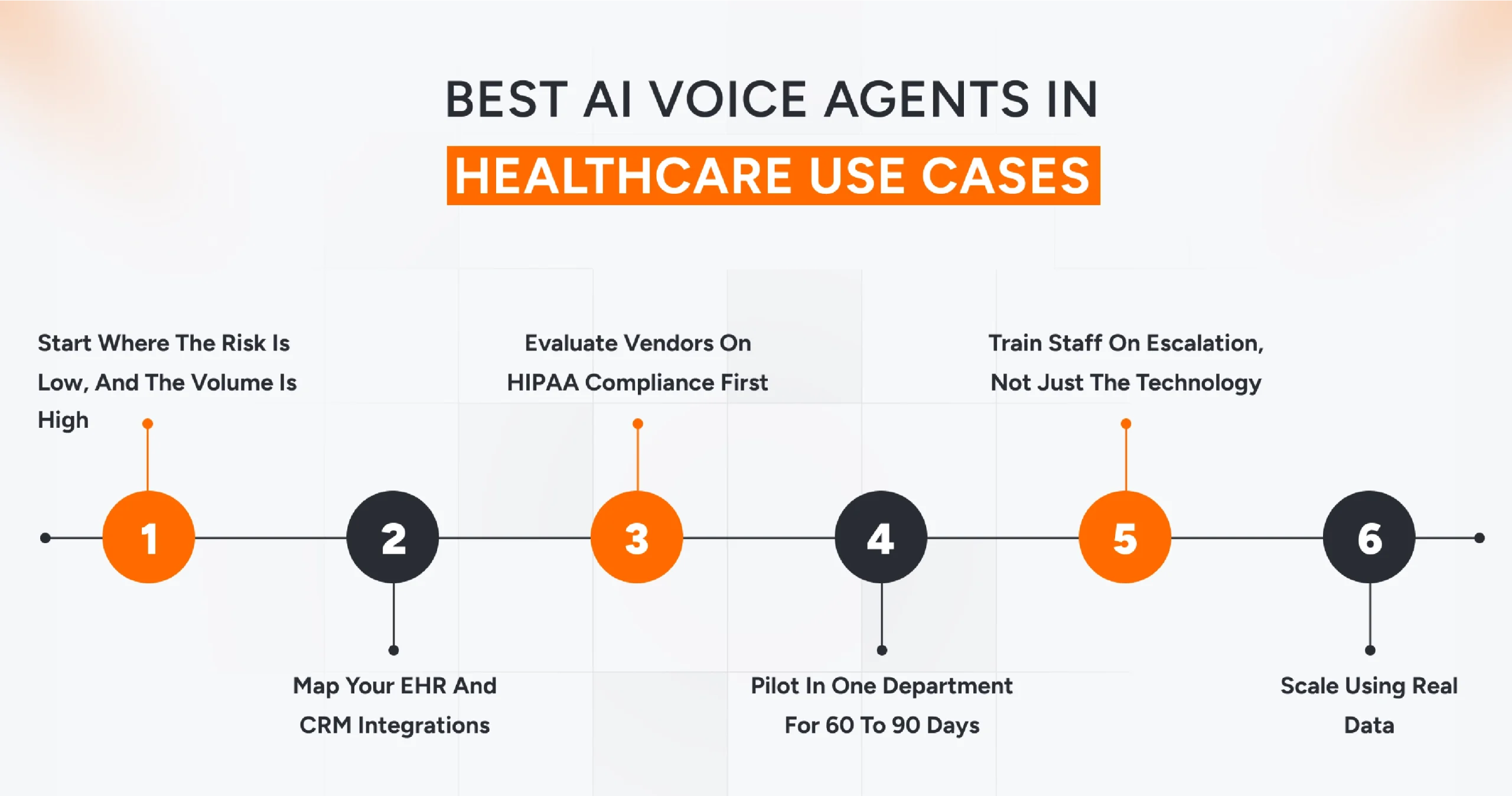
Getting voice AI right in a clinical setting isn’t just a technology decision. It’s an operational and governance challenge that touches patient safety, staff workflows, and regulatory compliance. Here’s a practical path forward.
Step 1: Start Where the Risk Is Low, and the Volume Is High
Before anything else, map where your team spends time on repetitive, rule-based work. Appointment scheduling, lab result notifications, and basic patient FAQs are ideal starting points. These workflows are high-volume, low-clinical-risk, and well-suited for automation. Starting here builds confidence among staff and patients alike, and it delivers visible results quickly before you move into more complex territory.
Step 2: Map Your EHR and CRM Integrations
An AI voice agent is only as useful as the systems it connects to. Work with your technical team to map out bi-directional integrations between your EHR and CRM using standardized protocols such as HL7 FHIR and REST APIs. When the integration is set up properly, the agent can pull patient demographics, check live calendar availability, and write voice AI clinical documentation directly into platforms like Epic or Cerner without anyone doing manual data entry.
Step 3: Evaluate Vendors on HIPAA Compliance First
Not all vendors are built for healthcare. Before anything else, confirm the vendor will sign a Business Associate Agreement (BAA) and that their platform uses end-to-end encryption, role-based access controls, and complete audit logging. Two platforms worth evaluating:
- Avahi AI: A HIPAA-compliant AI voice agent built on AWS infrastructure, designed as a 24/7 virtual front desk with intelligent routing and full audit trails
- Sully.ai: Purpose-built for healthcare workflows with over 95% accuracy on medical terminology, pre-built EHR integrations, and SOC 2 Type II certification covering scheduling, intake, and refill requests
Step 4: Pilot in One Department for 60 to 90 Days
Avoid going clinic-wide on day one. Instead, run a controlled pilot targeting a single department, a specific patient population, or after-hours call traffic. Roll out gradually, starting with a small percentage of call volume directed to the agent and increasing it week by week.
This window lets you catch integration issues, monitor for errors in AI responses, and validate that escalation protocols work before full deployment.
Step 5: Train Staff on Escalation, Not Just the Technology
Your team needs to understand how to work alongside the AI, not just how to use the dashboard. The most important training is around escalation.
If a patient mentions chest pain, expresses serious distress, or asks something outside the agent’s scope, the system should transfer the call immediately and pass along the full conversation context. Staff need to know when and how that handoff happens so nothing falls through the cracks.
Step 6: Scale Using Real Data
Once the pilot shows consistent results, use the data to guide expansion. Track call abandonment rates, first-call resolution, wait times, and patient satisfaction scores on an ongoing basis.
These numbers tell you what’s working, where the friction still exists, and where to invest next. The organizations that scale voice AI well treat it as a continuous improvement process rather than a one-time implementation.
How can AQe Digital help you build AI Voice Agents in Healthcare Operations?
The conversation around voice AI for healthcare has shifted. It’s no longer a question of whether the technology is ready. It’s a question of how quickly your organization is moving. With a global healthcare worker shortage that shows no signs of slowing, traditional manual workflows simply can’t carry the load.
AI voice agents are filling that gap as 24/7 operational backbones, handling scheduling, managing patient inquiries, and generating clinical documentation without adding headcount. However, building such a solution and customizing it to your healthcare operation can be complex.
You need to ensure the AI agent offers voice capabilities specific to your operational functions. Plus, it needs to be secure and offer compliance with HIPAA regulations. This is where AQe Digital can help.
We work with healthcare organizations to design, build, and deploy AI voice agents that are purpose-built for clinical and administrative workflows, not generic tools retrofitted for healthcare.
Our team handles the technical complexity behind EHR integrations, HIPAA-compliant infrastructure, and multi-workflow automation, so your team can focus on care delivery rather than implementation headaches.
If your organization is ready to move from manual bottlenecks to intelligent automation, we’re ready to help you get there. Talk to our team today and get a custom assessment of where voice AI can deliver the fastest impact in your operations.